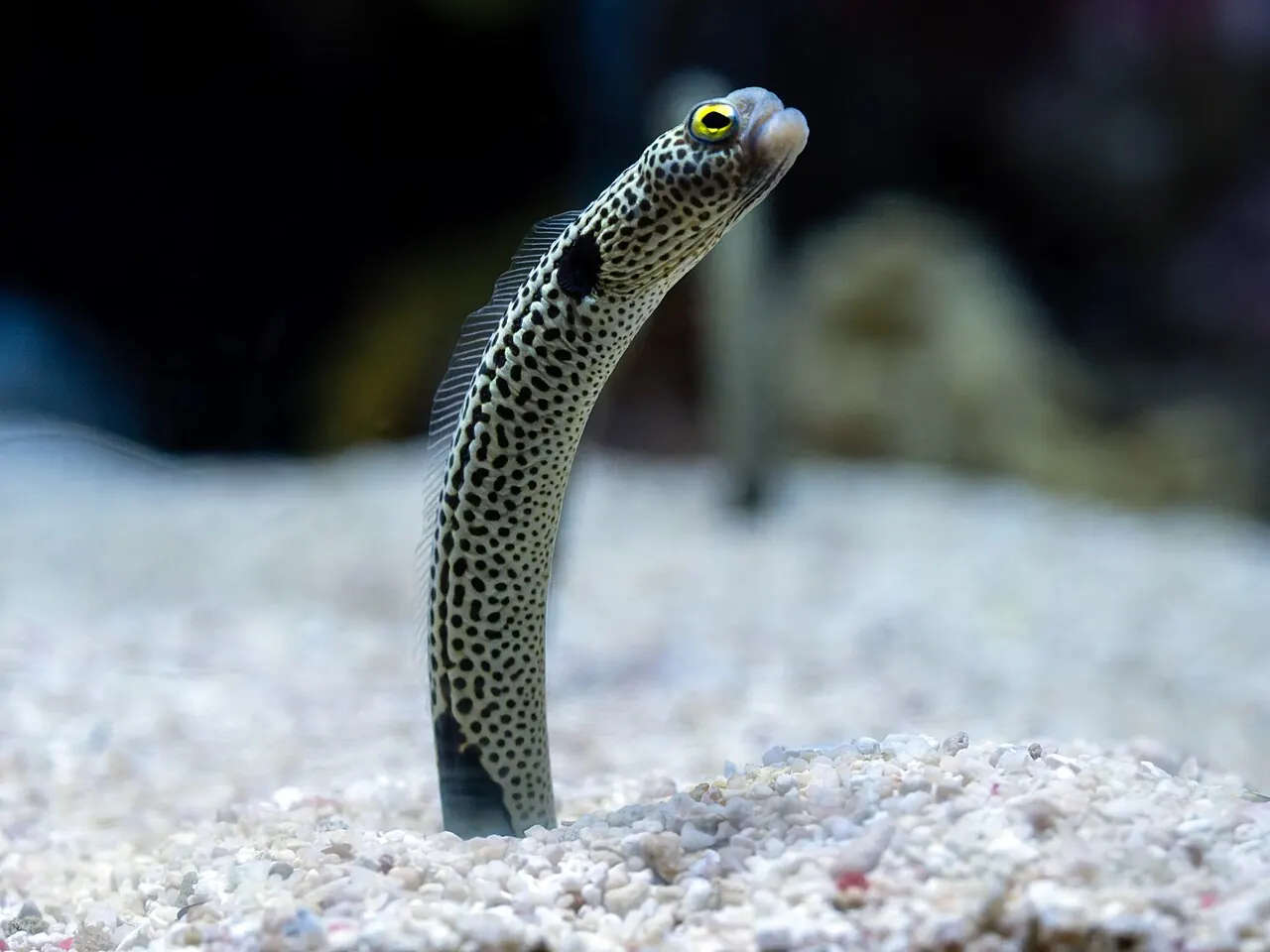
Spotted Garden Eel
Heteroconger hassi
A pencil-thin eel that lives in colonies of hundreds, each rising from its own burrow in the sand to snatch plankton from the current.
Photo: Andrzej Barabasz (Chepry) / CC BY-SA 4.0
3 things to know
- Colonies can hold several hundred eels, each in its own burrow.
- Its body is only about 14 millimeters (half an inch) thick.
- It is named after Hans Hass, the Austrian diving pioneer whose expedition collected the first specimen.
- Scientific name
- Heteroconger hassi
- Depth
- 1 m – 50 m
3 – 164 ft - Size
- Up to about 40 to 45 cm (16 to 18 in) long, but only about 14 mm (0.6 in) thick
- Weight
- Unknown
- Lifespan
- Unknown
- Diet
- Zooplankton, picked from the passing current
- Where
- Indo-Pacific from the Red Sea and East Africa east to the Society and Pitcairn islands, north to southern Japan and south to northwestern Australia and New Caledonia
- IUCN status
- Least Concern
- Depth zones
- Sunlight
From a distance, a colony of spotted garden eels looks like a patch of thin stalks growing out of the sand. Each stalk is an eel, pale and covered in small black spots, with two large black blotches, one around the gill opening and one partway down the body. Juveniles are entirely black. Adults grow to about 40 to 45 centimeters (16 to 18 inches), but their bodies are only about 14 millimeters (half an inch) thick. The species is named for Hans Hass, the Austrian diving pioneer who led the expedition to the Maldives where the first specimen was collected.
It lives across the tropical Indo-Pacific, from the Red Sea and East Africa to the Society and Pitcairn islands, on sandy slopes and rubble in lagoons from about 1 to 50 meters (3 to 164 feet) deep, often below 15 meters (49 feet). Colonies can number several hundred eels. Each digs a permanent burrow and rarely leaves it. During the day the eels rise partway out to pick drifting zooplankton from the current, and they drop back into their holes when anything approaches.
Even mating happens from home. According to Fishes of Australia, neighbors reach across from their burrows and twist their bodies together, and the eggs and larvae drift away in open water. In 2015 Tomohiro Kakizaki and colleagues described garden eels spawning at night, in low light, in a large display tank at Sumida Aquarium in Tokyo, and collected fertilized eggs from spotted garden eels and the related splendid garden eel. Courtship-like behavior had been seen in daytime colonies before, but actual spawning had not been confirmed.
The same aquarium's eels made headlines in 2020. Sumida Aquarium had closed in early March because of the COVID-19 pandemic, and its roughly 300 chin-anago, the Japanese name for spotted garden eels, which had grown used to visitors, began hiding in the sand whenever keepers walked by, making it hard to check on their health. For three days in early May, the aquarium set up tablets in front of the tank and invited people to video-call the eels and show their faces.
The IUCN lists the spotted garden eel as Least Concern, from a 2016 assessment. It is caught for the aquarium trade.
Sources
- fishbase.se/summary/Heteroconger-hassi.html
- fishesofaustralia.net.au/home/species/3913
- Study: doi:10.2305/IUCN.UK.2019-1.RLTS.T198985A2546860.en
- Study: doi:10.1080/10236244.2015.1064213
- fox5ny.com/news/spend-some-time-video-chatting-with-these-spotted-garden-eels-in-japan-…
- cbc.ca/radio/thecurrent/the-current-for-may-22-2020-1.5580159/this-aquarium-set-up-vide…
- thejakartapost.com/life/2020/05/01/forget-me-not-japan-aquarium-seeks-video-chats-for-e…
- afpbb.com/articles/-/3281303
- ja.wikipedia.org/wiki/%E3%83%81%E3%83%B3%E3%82%A2%E3%83%8A%E3%82%B4
- commons.wikimedia.org/wiki/File:Heteroconger_hassi_(Spotted_garden_eel)_AB.jpg



