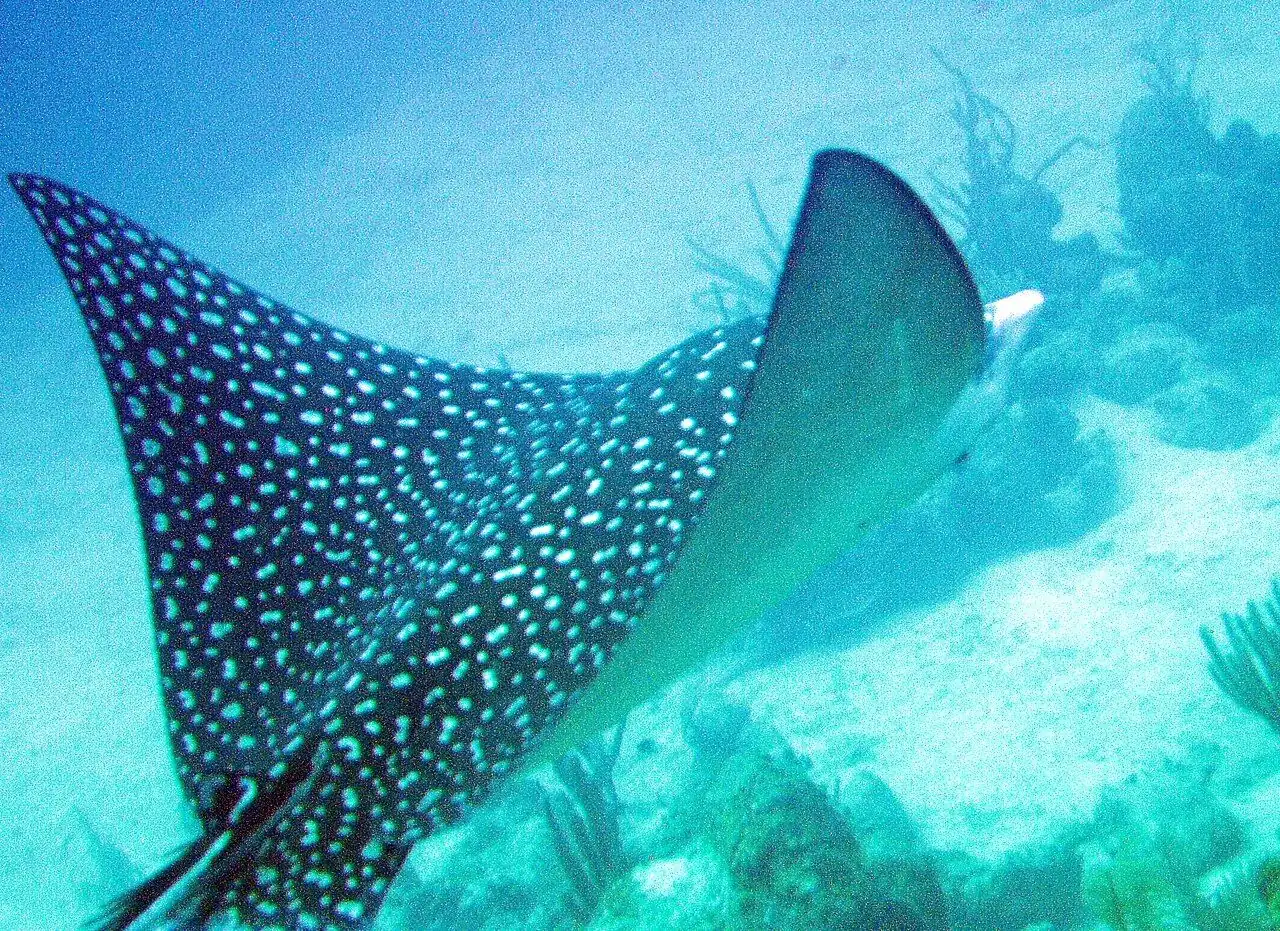
Spotted Eagle Ray
Aetobatus narinari
A black ray covered in white spots that flies through warm Atlantic shallows and crushes clams and snails with plate-like teeth.
Photo: James St. John (photo by Miranda Manross) / CC BY 2.0
3 things to know
- Its tail can be 2.5 to 3 times as long as its disc is wide.
- It can leap clear of the water when chased.
- Florida prohibits harvesting spotted eagle rays.
- Scientific name
- Aetobatus narinari
- Depth
- 1 m – 60 m
3 – 197 ft - Size
- Commonly about 1.4 m (4.6 ft) across; up to about 2.3 m (7.5 ft), with a whip-like tail 2.5 to 3 times the disc width
- Weight
- Up to about 230 kg (507 lb), a figure from a 1986 Atlantic field guide cited by FishBase
- Lifespan
- Unknown
- Diet
- Clams, snails and other mollusks, shrimp, octopus, squid, sea urchins and small fishes
- Where
- Warm Atlantic waters from North Carolina to Brazil, including Bermuda, the Gulf of Mexico and the Caribbean; probably also West Africa
- IUCN status
- Endangered
- Depth zones
- Sunlight
Seen from above, a spotted eagle ray looks like a dark kite sprinkled with small white or bluish spots, sometimes rings. Its pointed, wing-like pectoral fins form a disc about twice as wide as it is long, its snout ends in a fleshy lobe shaped like a duck's bill, and its whip-like tail can be 2.5 to 3 times the width of the disc, with two to six stinging spines near the base. Adults are commonly about 1.4 meters (4.6 feet) across, and the largest reach about 2.3 meters (7.5 feet).
The name now covers Atlantic rays only. FishBase treats the spotted eagle rays of the Indian and western Pacific oceans as a separate species, Aetobatus ocellatus, and those of the eastern Pacific as A. laticeps, and recent Florida studies call the Atlantic species the whitespotted eagle ray. It lives from North Carolina to Brazil, including Bermuda, the Gulf of Mexico and the Caribbean, and probably off West Africa, in bays and over reefs down to about 60 meters (200 feet). Schools cruise near the surface in open water, and a ray being chased can leap clear of the sea.
The eagle ray digs prey out of sand and mud with its snout, crushes it between plate-like teeth and uses small projections inside its mouth to separate the shells from the flesh. To see what Florida's rays eat, Brianna Cahill and colleagues at Florida Atlantic University's Harbor Branch Oceanographic Institute, working with Mote Marine Laboratory, flushed the stomachs of 50 rays from the Indian River Lagoon and off Sarasota and identified the remains by eye and by DNA. The diet was mainly bivalves and snails, with some crustaceans. They found no hard clams, a shellfish Florida farms and restores, they reported in the journal Fishes in 2023.
A female may mate with up to four males in a short time. A male grips the edge of her pectoral fin and rolls beneath her, and the pairing lasts 30 to 90 seconds. The eggs hatch inside the mother, which gives birth to up to four pups.
Florida prohibits harvesting spotted eagle rays. Elsewhere in their range they are caught in trawls, nets and on longlines, and the IUCN lists the species as Endangered.



