Spiny Dogfish
Squalus acanthias
A small, white-spotted shark of cool seas with a defensive spine on each dorsal fin and a pregnancy that lasts up to two years.
Photo: Ecomare/Salko de Wolf / CC BY-SA 4.0
3 things to know
- Each of its two dorsal fins has a sharp spine at the front.
- Pups are born head first, with cartilage sheaths covering their spines.
- The US catch supplies European markets, where dogfish is used in English fish and chips.
- Scientific name
- Squalus acanthias
- Depth
- 50 m – 300 m
164 – 984 ft - Size
- In the northwest Atlantic, males up to about 1 m (3.3 ft) and females up to about 1.2 m (4 ft)
- Weight
- Up to about 9 to 10 kg (20 to 22 lb)
- Lifespan
- 35 to 40 years (NOAA Fisheries); other estimates range from 25 to 50 years
- Diet
- Whatever is plentiful: mostly crustaceans when young; jellyfish, squid and schooling fish such as herring and mackerel when larger
- Where
- Cool temperate seas worldwide except the North Pacific; in the northwest Atlantic from Labrador to Florida, most abundant between Nova Scotia and Cape Hatteras
- IUCN status
- Vulnerable
- Depth zones
- Sunlight · Twilight
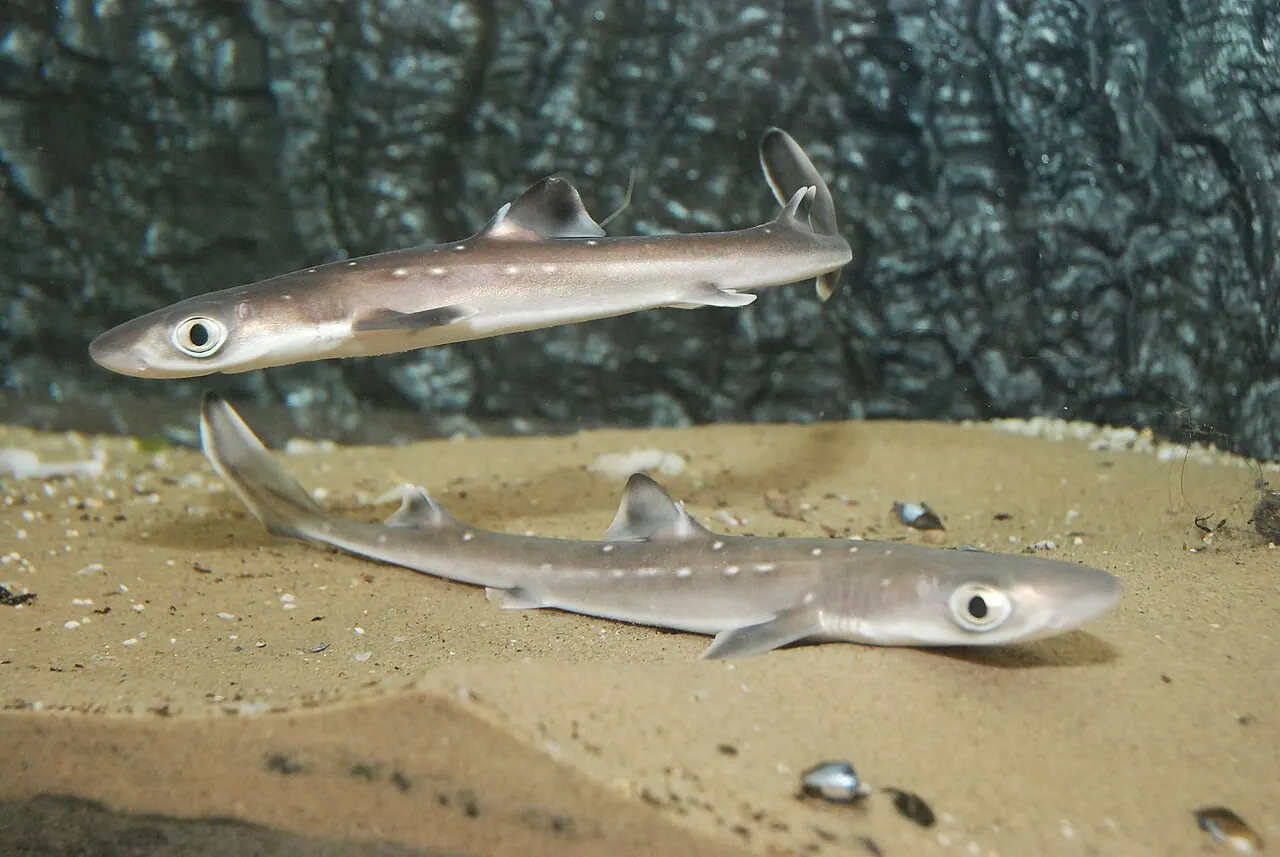
Two sharp spines, one at the front of each dorsal fin, give the spiny dogfish its name. It is a slim gray shark with a narrow, pointed snout, large eyes and scattered white spots on its back that fade with age. In the northwest Atlantic, NOAA Fisheries says males grow to about 1 meter (3.3 feet) and females to about 1.2 meters (4 feet). When threatened, a dogfish curls its body into a bow and strikes with the spines, and the Florida Museum warns that they can cause nasty wounds if the fish is handled carelessly.
It lives in cool, temperate seas in both hemispheres. In the North Pacific a close relative, the Pacific spiny dogfish (Squalus suckleyi), takes its place. In the northwest Atlantic, the spiny dogfish ranges from Labrador to Florida and is most abundant between Nova Scotia and Cape Hatteras. It usually stays near the bottom at about 50 to 300 meters (165 to 985 feet), but it also swims in midwater and at the surface, enters bays and estuaries, and has been recorded close to 2,000 meters (6,500 feet) deep. Dogfish travel in large schools sorted by size and sex and migrate with the seasons. Small ones eat mostly crustaceans; larger ones eat jellyfish, squid and schooling fish such as herring and mackerel.
Pregnancy lasts 18 to 24 months, according to NOAA. A female carries an average of six pups, which are born head first with cartilage sheaths over their spines that protect the mother. Females do not mature until about age 12, and NOAA estimates dogfish live 35 to 40 years.
That slow pace made the species easy to overfish. US landings rose sharply in the 1990s, and because fishers targeted the large mature females, the Florida Museum reports a 75 percent drop in mature females and record-low numbers of pups. NOAA's 2023 stock assessment found the Atlantic stock is not overfished, though NOAA expects the number of mature females may dip because so few pups were born in the 1990s. There is little demand for dogfish in the United States; the US fishery supplies European markets, where dogfish is used for fish and chips in England. The IUCN lists the species as Vulnerable worldwide.



