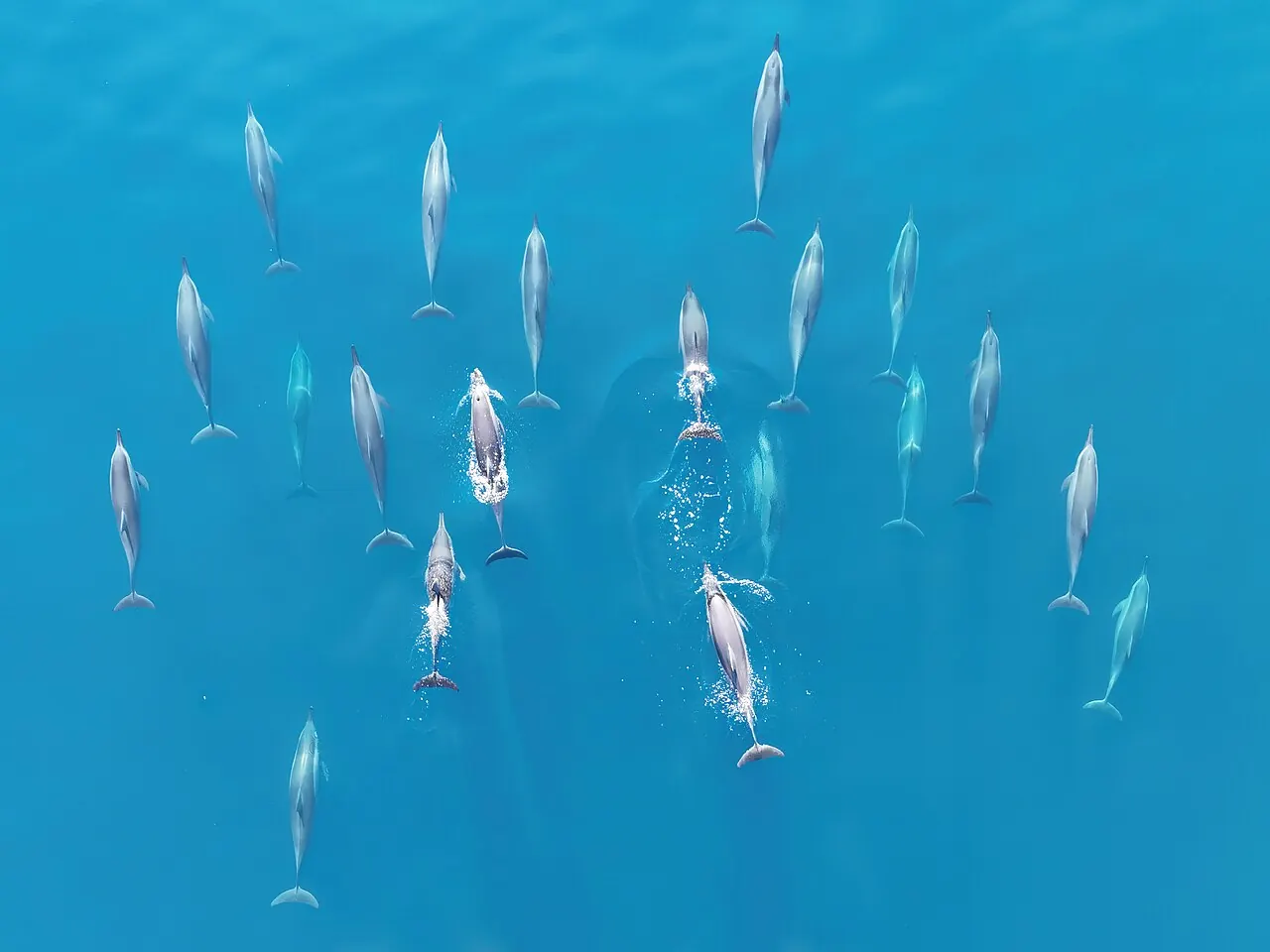
Spinner Dolphin
Stenella longirostris
A slender tropical dolphin that spins up to seven times in one leap, hunts at night and rests by day in sheltered Hawaiian bays.
Photo: Giles Laurent / CC BY-SA 4.0
3 things to know
- It can spin up to seven times in a single leap.
- It stops echolocating while it rests and watches for predators by sight.
- In Hawaii it is illegal to swim with or approach one within 50 yards close to shore.
- Scientific name
- Stenella longirostris
- Depth
- 0 m – 150 m
0 – 492 ft - Size
- About 1.2–2.1 m (4–7 ft) long
- Weight
- About 59–77 kg (130–170 lb)
- Lifespan
- About 20 years; some live at least 25
- Diet
- Small fish, shrimp and squid, often lanternfish
- Where
- Tropical and warm temperate waters worldwide
- IUCN status
- Least Concern
- Depth zones
- Sunlight
A spinner dolphin can leap from the water and twist around its long axis up to seven times before it falls back. NOAA says the spins probably serve mainly as signals to other dolphins, though they may also shake off hitchhikers such as remoras. The species name, longirostris, is Latin for "long beak," and the beak is slender, like the rest of the animal. Adults are about 1.2 to 2.1 meters (4 to 7 feet) long and 59 to 77 kilograms (130 to 170 pounds). Four subspecies live in tropical and warm temperate seas around the world, including a dwarf form from Southeast Asia to northern Australia. The most widespread one, which includes Hawaii's spinners, is dark gray on the back, light gray on the sides and white underneath.
At night they feed on small fish, shrimp and squid that spend daylight hours 200 to 300 meters (650 to 1,000 feet) down, then rise and move toward shore after dark. Off Hawaii they hunt them cooperatively, diving as deep as about 150 meters (490 feet). Lanternfish are a main prey. By morning, Hawaii's island-associated spinners head for calm, clear, shallow bays with sandy bottoms. There they rest for four to five hours, moving slowly back and forth as one tight group. They stop echolocating while they rest and watch for predators by sight, and the open sand presumably makes predators easier to spot. When rest ends they grow noisy and swim in zigzags in and out of the bay, which may help the group agree to head for deep water.
Spinners live about 20 years, some at least 25. They mature around age 7, and females calve about once every three years after an 11-month pregnancy. The IUCN lists the species as Least Concern.
Those predictable resting bays drew crowds. NOAA estimates that upwards of 70 tour operators in Hawaii run trips aimed at spinner dolphins, and researchers counted up to 13 boats and more than 60 swimmers around a single group. Dolphins robbed of rest have less energy to hunt at night. Since October 28, 2021, a federal rule under the Marine Mammal Protection Act has banned swimming with or approaching Hawaiian spinner dolphins within 50 yards (46 meters) in waters within 2 nautical miles of the main Hawaiian Islands, and in designated waters bounded by Lanai, Maui and Kahoolawe.



