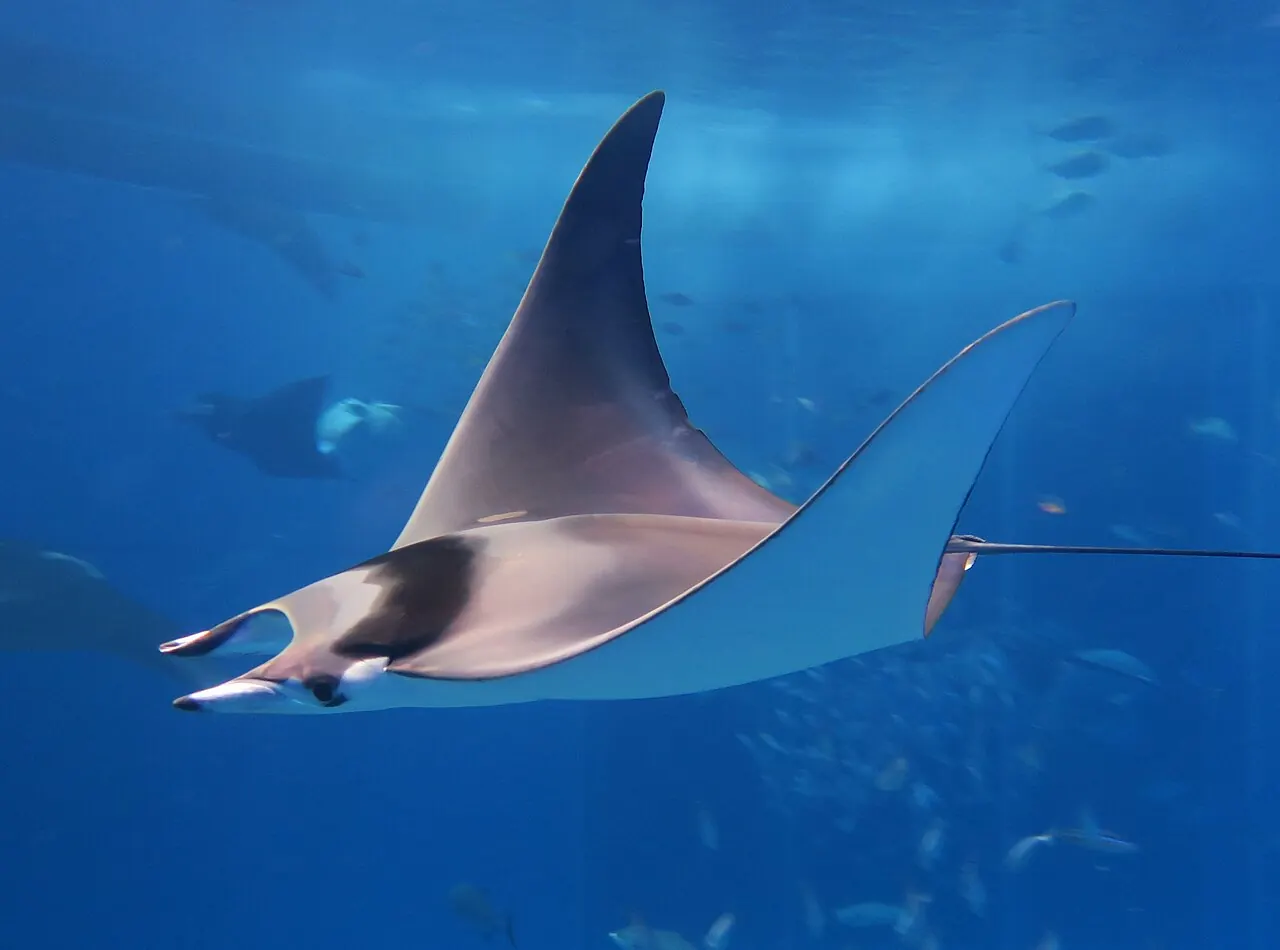
Spinetail Devil Ray
Mobula mobular
A krill-eating devil ray found around the world, named for the spine on its tail and listed as Critically Endangered since 2025.
Photo: Claireelizabethhh / CC BY-SA 4.0
3 things to know
- It is the only devil ray known to carry a spine on its tail.
- A ray tagged off New Zealand in 2013 dove to 649 m (2,129 ft).
- A female gives birth to a single pup, already 85 to 92 cm (about 3 ft) across.
- Scientific name
- Mobula mobular
- Depth
- 0 m – 200 m
0 – 656 ft - Size
- Usually about 1.8–2.7 m (6–9 ft) across; largest known about 3.5 m (11.5 ft) in a 2020 review, though FishBase and NOAA give up to 5.2 m (17 ft)
- Weight
- Not well known
- Lifespan
- Unknown
- Diet
- Mainly krill; also copepods, crustacean larvae and small schooling fish
- Where
- Tropical and warm temperate seas worldwide, including the Mediterranean
- IUCN status
- Critically Endangered
- Depth zones
- Sunlight
A spine on its tail gives this ray its name, and no other devil ray is known to carry one. The giant oceanic manta has only a reduced spine, mostly buried in a calcified lump on its tail. A recent revision of the genus merged the tropical spinetail devil ray, then called Mobula japanica, into Mobula mobular, a species once thought to live only in the Mediterranean. In a 2020 paper, Notarbartolo di Sciara and two colleagues argued that its old name, giant devil ray, never fit: they put its maximum known size at 3.5 meters (11.5 feet) across, small next to some of its relatives, though FishBase and NOAA list maximums of 5.2 meters (17 feet). NOAA's survey guide describes it as dark gray above, with a black crescent-shaped stripe running from shoulder to shoulder, and usually 1.8 to 2.7 meters (6 to 9 feet) wide.
It lives near the surface over continental shelves and around oceanic islands, and the IUCN maps it in tropical and warm seas worldwide, including waters off California, Florida, Texas and Hawaii. It feeds mainly on krill, plus copepods, crustacean larvae and small fish. The ray funnels water into its mouth with the two fins on its head and strains out food on its gill plates. Each pregnancy produces one pup, born at 85 to 92 centimeters across.
In January and February 2013, six spinetail devil rays caught in commercial purse seines off northeastern New Zealand were fitted with pop-up satellite tags and released, for a report by M. P. Francis of NIWA. Only four tags reported, and three of those rays died within two to four days of release. The survivor was tracked for 82 days. Its median depth was 18.5 meters (61 feet) at night and 28.5 meters (94 feet) by day, but it made periodic short deep dives, three of them below 500 meters and the deepest to 649 meters (2,129 feet), a record for the species at the time.
FishBase reports bycatch deaths in Mediterranean driftnets, trawls and purse seines and calls the ray very common bycatch in gillnets set for skipjack tuna, and it is also kept for its meat and its gill plates, which sell at high prices for use in Chinese medicine. In 2025 the IUCN listed the spinetail devil ray as Critically Endangered, with a decreasing population.
Sources
- fishbase.se/summary/Mobula-mobular.html
- iucnredlist.org/species/110847130/279075986
- Study: doi:10.1186/s41200-020-00187-0
- doc.govt.nz/our-work/conservation-services-programme/csp-reports/2013-14/survival-and-d…
- fisheries.noaa.gov/s3/2025-09/giant-manta-ray-and-devil-ray-aerial-survey-id-guide.pdf
- Study: doi:10.11646/zootaxa.2301.1.1



