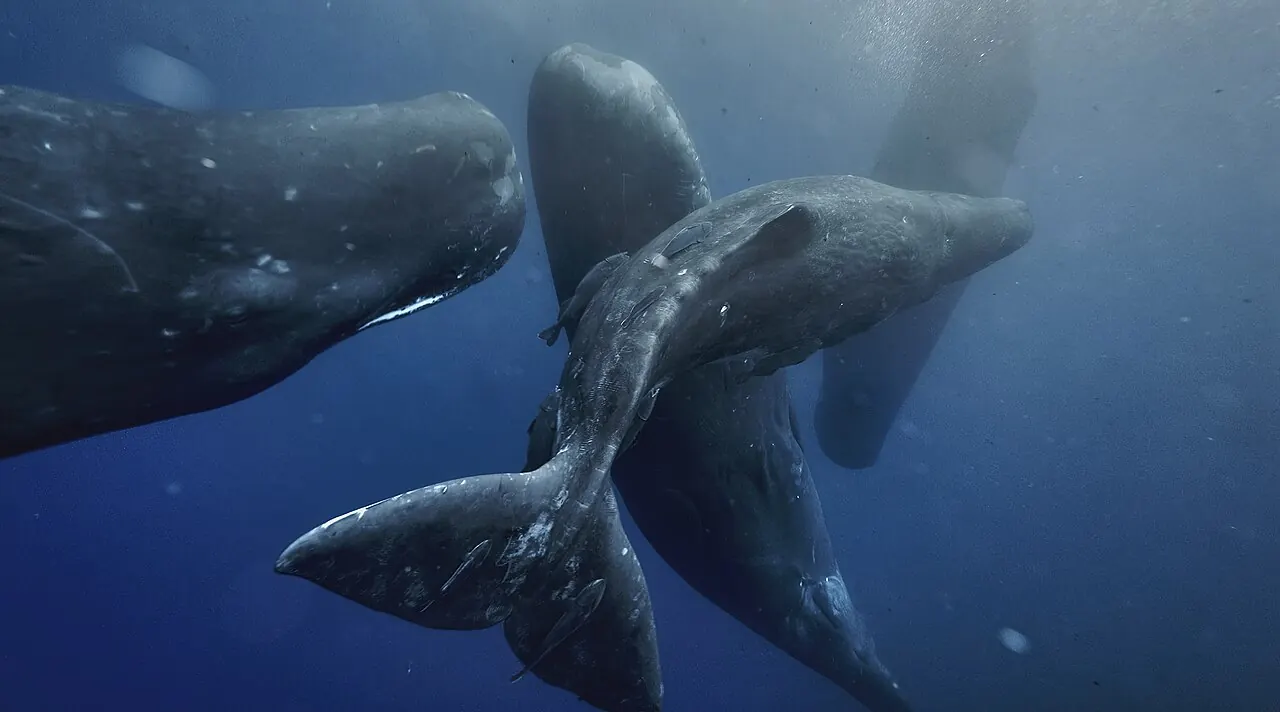
Sperm Whale
Physeter macrocephalus
The largest toothed whale, a deep-diving hunter that lives in family groups and communicates in patterned bursts of clicks.
Photo: Stanislav Stelmakhovich / CC0
3 things to know
- Its head takes up about a third of its body length.
- Its hunting dives routinely reach about 600 m (2,000 ft) and can last 45 minutes.
- Tagged sperm whales spent 7.1% of the recorded time in drifting, inactive rests.
- Scientific name
- Physeter macrocephalus
- Depth
- 0 m – 600 m
0 – 1,969 ft - Size
- Females about 12 m (40 ft); males about 16 m (52 ft)
- Weight
- About 14 metric tons (15 tons) for females; up to about 41 metric tons (45 tons) for males
- Lifespan
- Up to about 60 years
- Diet
- Squid, sharks, skates and fish
- Where
- Deep water in all oceans, from the equator to the edge of the pack ice
- IUCN status
- Vulnerable
- Depth zones
- Sunlight · Twilight
No toothed whale is bigger than the sperm whale. Its head takes up about a third of the body, the lower jaw is narrow, with 20 to 26 large teeth on each side, and the teeth of the upper jaw rarely break through the gums. It is the only living whale or dolphin with a single blowhole set off to the left side of the head. Males reach about 16 meters (52 feet) and 45 tons, females about 12 meters (40 feet) and 15 tons. The name comes from spermaceti, a waxy substance in the head, which NOAA Fisheries describes as an oil sac that helps the whale focus sound.
They live in deep water in every ocean, from the equator to the edge of the pack ice. Hunting dives routinely reach about 600 meters (2,000 feet) and can last 45 minutes, in pursuit of squid, sharks, skates and fish.
Females and their young live together in social units, on average about 12 females plus their calves. A female gives birth to a single calf about 4 meters (13 feet) long after a pregnancy of 14 to 16 months, and only about once every five to seven years. NOAA gives a lifespan of up to 60 years.
Commercial whalers made sperm whales a primary target from 1800 to 1987. The species is endangered under the US Endangered Species Act, and the IUCN's 2025 reassessment kept it as Vulnerable. Ship strikes, entanglement in fishing gear, ocean noise, marine debris, oil spills and contaminants are current threats.
Sperm whales trade codas, short patterned bursts of clicks. In 2024, Pratyusha Sharma and colleagues at MIT and Project CETI reported that codas vary in rhythm and tempo plus two features that shift with the flow of a conversation, which they named rubato and ornamentation. Combined, these give nearly an order of magnitude more distinguishable codas than earlier counts. The whales rest in an odd way, too. Tags placed by Patrick Miller's team at the University of St Andrews recorded drifting rests that added up to 7.1 percent of the tagged time, and a film shot off Chile showed a group floating vertically and motionless, heads at or just below the surface.
Sources
- fisheries.noaa.gov/species/sperm-whale
- Study: doi:10.1038/s41467-024-47221-8
- Study: doi:10.1016/j.cub.2007.11.003
- news.st-andrews.ac.uk/archive/drifting-off-to-sleep
- Study: doi:10.2305/IUCN.UK.2025-2.RLTS.T41755A50382216.en
- iucn-csg.org/red-list-updates-published-for-sperm-whales-and-lahilles-bottlenose-dolphins



