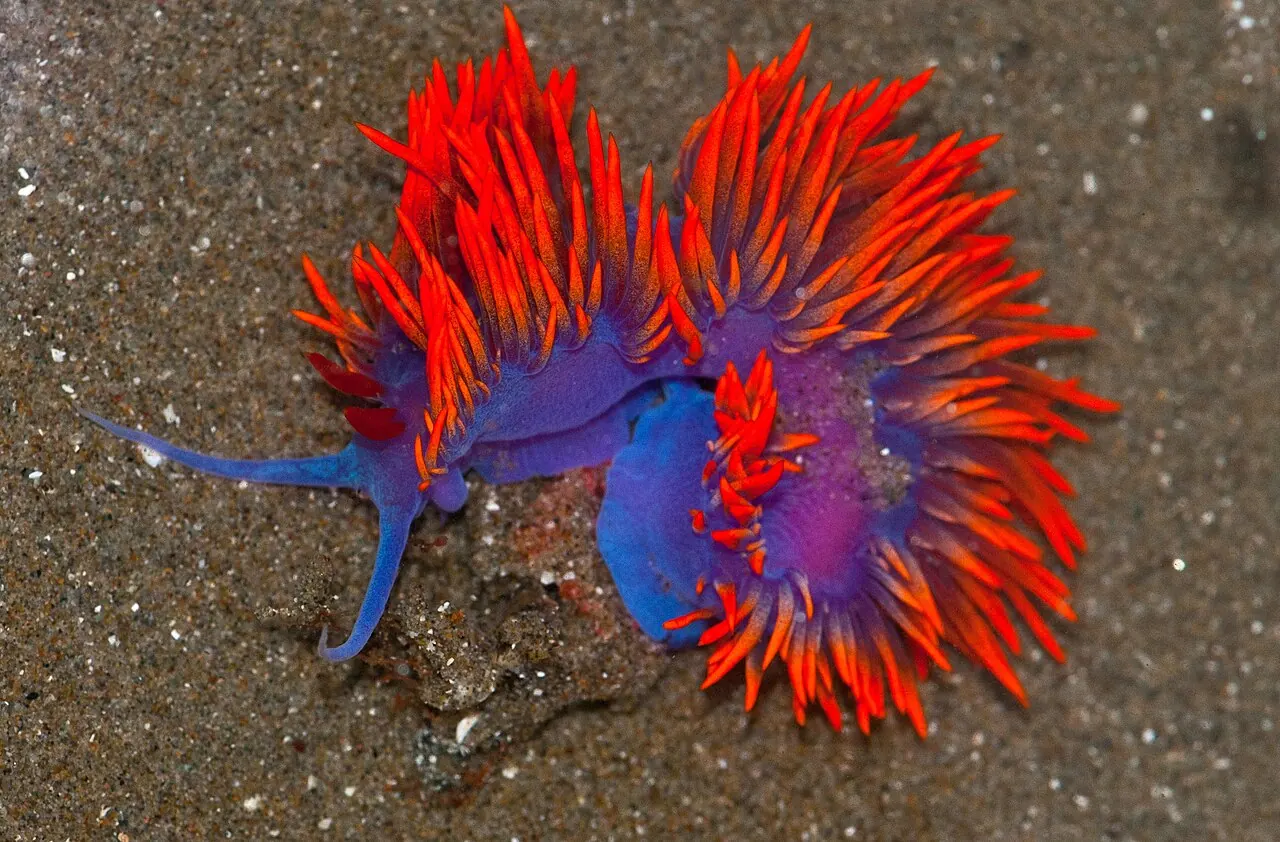
Spanish Shawl Nudibranch
Flabellinopsis iodinea
A purple and orange sea slug of the California coast that gets all three of its colors from a single pigment in the hydroids it eats.
Photo: Jerry Kirkhart from Los Osos, Calif. / CC BY 2.0
3 things to know
- Its purple body, orange cerata and scarlet rhinophores all get their color from one pigment, astaxanthin.
- Disturbed by a predator such as a sea star, it can swim away by flexing its body from side to side.
- On July 4, 2015, during an unusual warm spell in the northeast Pacific, 23 were counted in the tide pools at Trinidad, in Humboldt County, California.
- Scientific name
- Flabellinopsis iodinea
- Depth
- 0 m – 40 m
0 – 131 ft - Size
- Up to about 7 cm (2.8 in) long
- Weight
- Not well known
- Lifespan
- Not well known
- Diet
- Polyps of the hydroid Eudendrium ramosum
- Where
- Pacific coast from Vancouver Island, Canada, to Baja California Sur, Mexico, plus the Gulf of California and the Galápagos; rare north of San Francisco
- IUCN status
- Not Evaluated
- Depth zones
- Sunlight
Violet body, orange back, scarlet horns: the Spanish shawl is hard to overlook. Flabellinopsis iodinea is a nudibranch, a sea slug with no shell, up to about 7 centimeters (2.8 inches) long. Its back is crowded with orange, finger-like cerata, and the two sensory tentacles on its head, the rhinophores, are red. Older sources list it as Flabellina iodinea.
Jeffrey Goddard, writing for the Australian Museum's Sea Slug Forum, ranks it among the showiest and most common aeolid nudibranchs of southern and central California. It has been reported from Punta Asunción in Baja California Sur, Mexico, north to Vancouver Island, Canada, and also in the Gulf of California and the Galápagos, but it is rare north of San Francisco. It lives from the intertidal zone down to about 40 meters (130 feet).
It preys selectively on the orange polyps of one hydroid, Eudendrium ramosum, and that diet paints it. In 1972, J. W. McBeth showed that the purple of its body, the orange of its cerata and the scarlet of its rhinophores all come from a single carotenoid pigment from the hydroid, astaxanthin. The pigment sits in the slug in three slightly different chemical states, free, esterified and bound to a protein, and each gives a different color. The slug lays pinkish-orange egg ribbons, usually on the stalks of the hydroid, and the eggs develop into swimming larvae after about 7 days at 14 °C (57 °F).
Disturbed by a sea star or another predator, a Spanish shawl can lift off the bottom and swim away, flexing its body strongly from side to side. Its look has also been copied: in central California, a color form of the small crustacean Podocerus cristatus, an amphipod, mimics it.
Warm water sends it north. Goddard and colleagues, tracking nudibranchs during the warm anomaly of 2014 and 2015 in the northeast Pacific, found their first one at Hazard Canyon Reef on May 15, 2014, after sampling there since 1999. By May 2015 others had turned up farther north, at Bodega Bay and Trinidad in Humboldt County, and on July 4, 2015, Spencer Dybdahl Riffle counted 23 in the tide pools at Trinidad. It has not been assessed by the IUCN.



