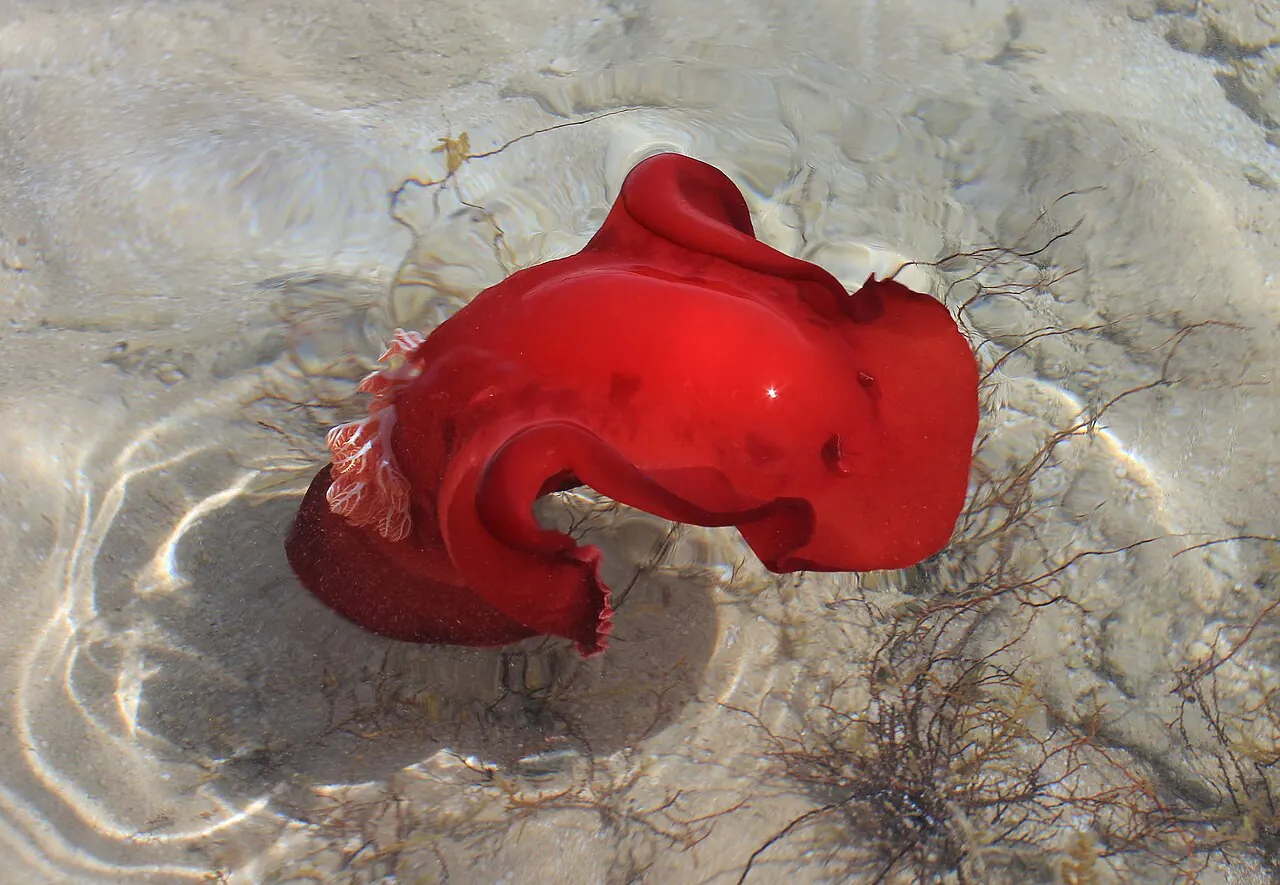
Spanish Dancer
Hexabranchus sanguineus
One of the biggest sea slugs, a red Indo-Pacific nudibranch that swims by rippling its mantle and borrows its chemical defenses from sponges.
Photo: Kora27 / CC BY-SA 4.0
3 things to know
- It swims by flexing its whole body up and down, rippling its broad red mantle.
- It eats sponges and reuses their chemical defenses, even in its egg ribbons.
- A 2023 study found that the name had been covering five different species.
- Scientific name
- Hexabranchus sanguineus
- Depth
- 1 m – 50 m
3 – 164 ft - Size
- Commonly up to about 25 cm (10 in) long; reports to 40 cm (16 in) in the Red Sea
- Weight
- Unknown
- Lifespan
- Unknown
- Diet
- Sponges
- Where
- Indo-Pacific, from East Africa and the Red Sea east to French Polynesia, north to Japan and south to Australia and New Caledonia
- IUCN status
- Not Evaluated
- Depth zones
- Sunlight
Most sea slugs crawl. When a Spanish dancer swims, it throws its body into sweeping up-and-down flexes that send waves through its broad mantle, often red with white edges. Hexabranchus sanguineus is a large nudibranch, a shell-less sea snail. On its back near the rear it carries six gills, each set separately into the body wall, and unlike most related sea slugs it has no pocket to pull them into, Bill Rudman of the Australian Museum noted.
It is one of the largest nudibranchs. A 2023 revision of the genus gives its usual length as up to 25 centimeters (10 inches), with some reports of 40 centimeters (16 inches) in the Red Sea. It lives on coral reefs across the Indo-Pacific, from East Africa and the Red Sea east to French Polynesia, north to Japan and south to Australia and New Caledonia. It has been found from 1 to 50 meters (3 to 165 feet) deep, usually 10 to 20 meters (33 to 65 feet).
It eats sponges, including Halichondria, and gets a potent chemical defense from them. In 1988, Joseph Pawlik and colleagues reported that the defensive chemicals, a group of compounds called macrolides that come from its sponge diet, are present both in the slug and in its egg ribbons, so the eggs carry protection too. Like other nudibranchs, each animal is both male and female. How long it lives is unknown.
For more than 200 years, naturalists could not agree on how many Spanish dancers there were. Over 30 other names had been proposed for the animal, while most recent authors treated it as one Indo-Pacific species, with a separate Atlantic species, Hexabranchus morsomus. In 2023, a team led by Yara Tibiriçá combined anatomy and DNA and concluded that H. sanguineus was really a complex of five species. Four already had names. The fifth was new, and they named it Hexabranchus giganteus, describing it as one of the largest nudibranchs in the world. The authors put its long escape down to confusion in the literature and to its depth range, usually below 30 meters (100 feet).
Because the old name covered several species, older records filed under it, from depths and colors to the sponge chemistry, could belong to its relatives. The IUCN has not assessed the species.



