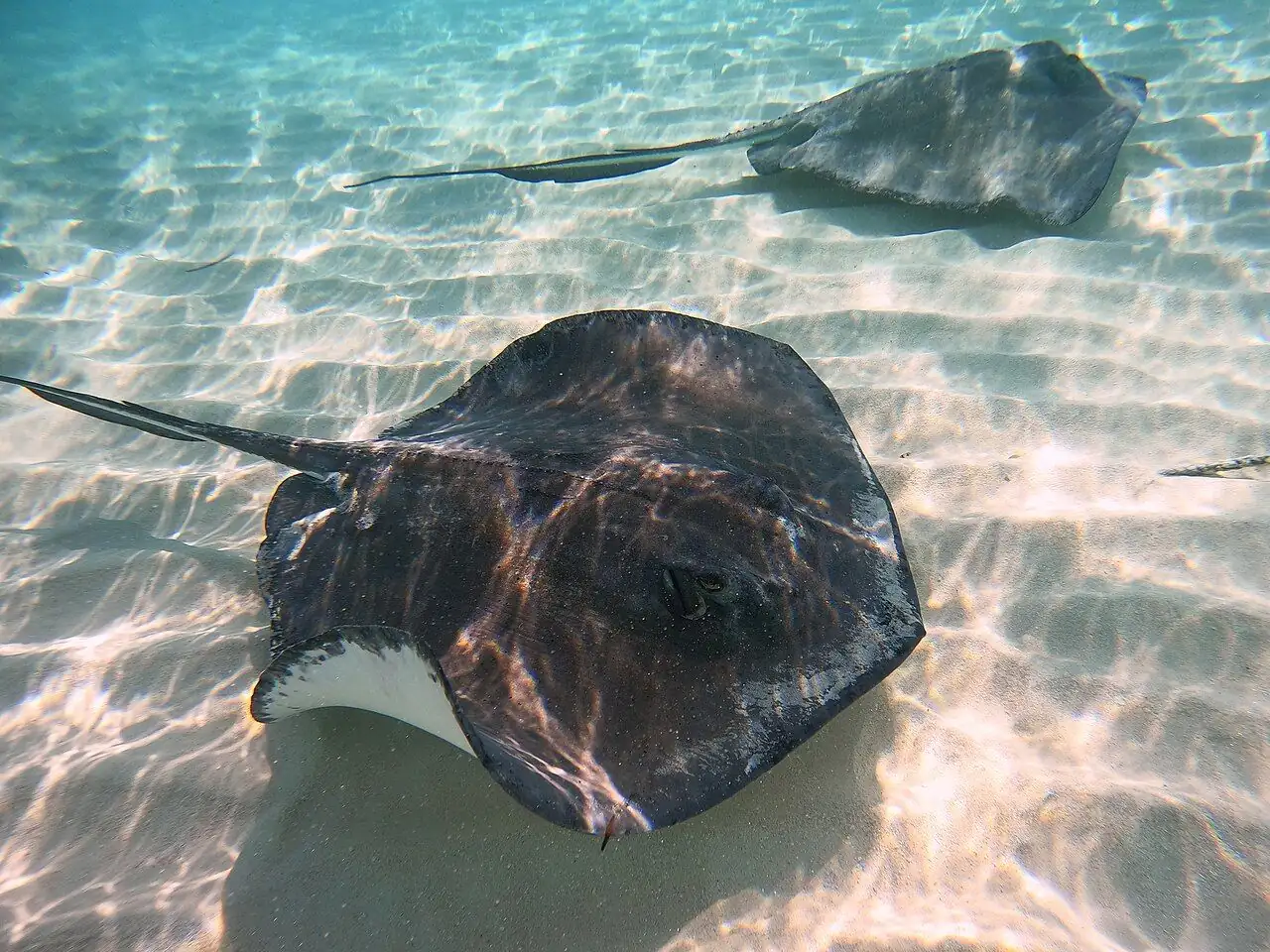
Southern Stingray
Hypanus americanus
A diamond-shaped stingray of warm, shallow Atlantic water, best known for the crowds of hand-fed rays at Stingray City in Grand Cayman.
Photo: Dan Schofield / CC BY 4.0
3 things to know
- Its tail spine has 52 to 80 teeth along each side.
- It breathes through openings on top of its head while lying on the seabed.
- Rays fed by tourists at Stingray City became active by day and still at night, the reverse of wild rays.
- Scientific name
- Hypanus americanus
- Depth
- 0 m – 53 m
0 – 174 ft - Size
- Disc commonly about 90 cm (3 ft) wide; up to about 2 m (6.5 ft)
- Weight
- Up to about 97 kg (214 lb) per the Florida Museum; FishBase lists 136 kg (300 lb)
- Lifespan
- Up to about 28 years (maximum reported age)
- Diet
- Clams and other bivalves, worms, shrimp, crabs and small fishes dug from the sand
- Where
- Western Atlantic from New Jersey to southern Brazil, including the Gulf of Mexico and the Caribbean; most abundant around Florida and the Bahamas
- IUCN status
- Near Threatened
- Depth zones
- Sunlight
Flat, diamond-shaped and olive-brown to gray-green on top, the southern stingray spends most of its life on sandy bottoms in warm, shallow Atlantic water. Its disc can grow to about 2 meters (6.5 feet) across, though about 90 centimeters (3 feet) is more typical. The tail can be twice as long as the body and carries a sharp spine edged with 52 to 80 teeth on each side. While lying on the seabed, the ray draws water in through openings called spiracles on top of its head and pushes it out through gills on its underside.
It ranges from New Jersey to southern Brazil, including the Gulf of Mexico and the Caribbean, and is most abundant around Florida and the Bahamas. Most live in water only a few meters deep, over sand, seagrass and lagoon bottoms, though they have been seen as deep as 53 meters (174 feet). In the wild a southern stingray often buries itself in sand by day and forages at night, using its fins to dig pits in the sand and uncover clams, worms, shrimp, crabs and small fish. It finds them by sensing their electric fields, as well as by smell and touch.
Females give birth to live young after 4 to 11 months, usually about four pups at a time. The embryos live on yolk at first, then on a milky fluid secreted inside the uterus.
Southern stingrays are not aggressive, and injuries usually happen when someone steps on one. At Stingray City Sandbar in Grand Cayman, tour operators have fed them since 1986. Mark Corcoran and colleagues at Nova Southeastern University's Guy Harvey Research Institute in Florida followed rays there and at unfed sites with acoustic tags and tag-and-recapture surveys. At least 164 rays, more than 80 percent of them female, used the small sandbar. The fed rays had flipped their daily schedule, staying active through the day and moving little at night, and they crowded into shared space: their core areas overlapped by 72 percent, compared with 3 percent for wild rays. The study appeared in PLOS ONE in 2013.
The IUCN lists the southern stingray as Near Threatened.



