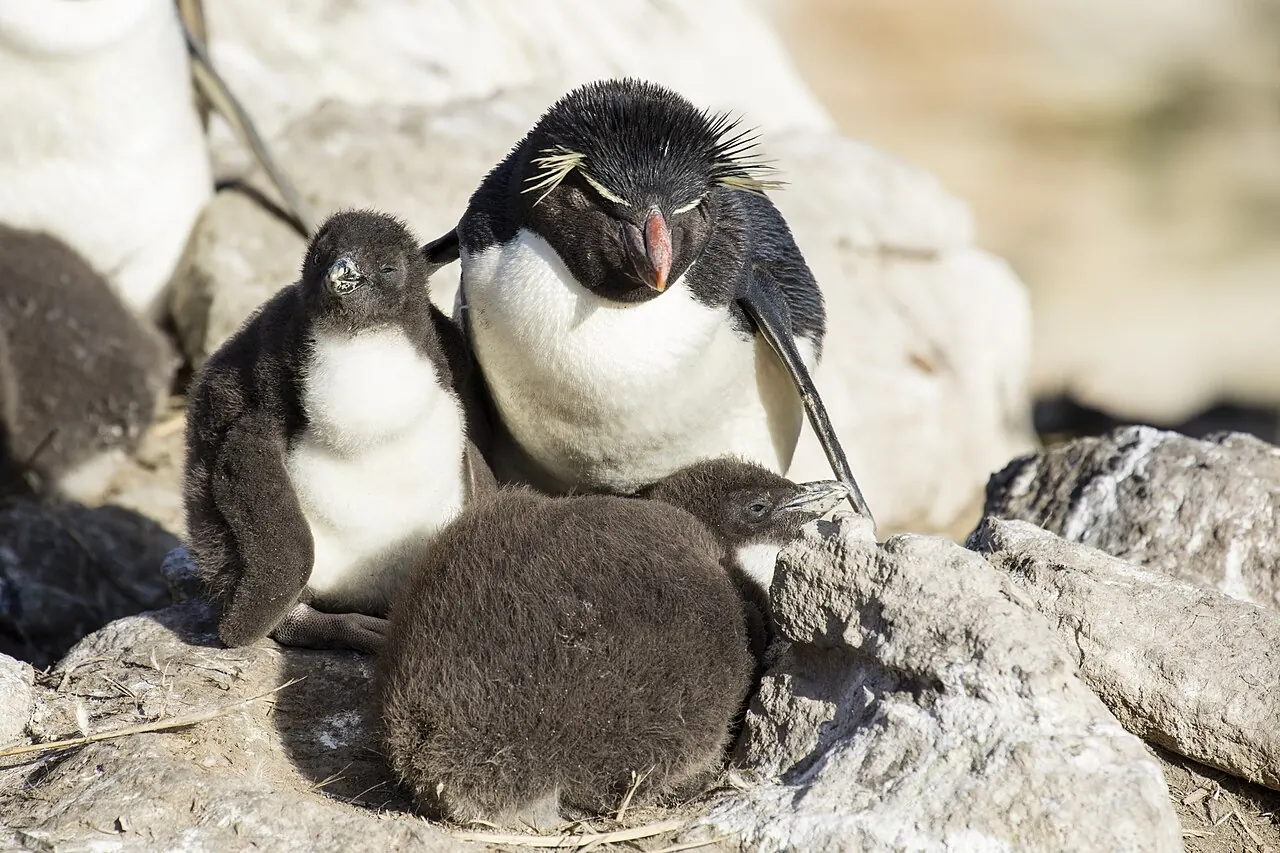
Southern Rockhopper Penguin
Eudyptes chrysocome
A small, spiky-crested penguin that hops between rocks on sub-Antarctic islands and has lost millions of breeding pairs since the 1930s.
Photo: Godot13 / CC BY-SA 4.0
3 things to know
- Some of its dives hug the seafloor so closely that they trace the steps of old lava flows.
- Campbell Island lost about 1.5 million pairs, 94 percent of its rockhoppers, between 1942 and 1986.
- A 2021 genetic study found that southern and eastern rockhoppers are probably separate species.
- Scientific name
- Eudyptes chrysocome
- Depth
- 0 m – 67 m
0 – 220 ft - Size
- About 55 cm (22 in) tall
- Weight
- About 2–3 kg (4.4–6.6 lb)
- Lifespan
- About 10 years on average, according to Animal Diversity Web
- Diet
- Krill and other crustaceans, fish and squid
- Where
- Islands in the South Atlantic, southern Indian Ocean and South Pacific, from about 46°S to Macquarie Island at 54°S
- IUCN status
- Vulnerable
- Depth zones
- Sunlight
Bright yellow brow feathers that sweep back along the sides of the head and a crown of spiky black feathers make the southern rockhopper easy to pick out. It stands about 55 centimeters (22 inches) tall and weighs 2 to 3 kilograms (4.4 to 6.6 pounds). True to its name, it climbs the steep, rocky shores of its breeding islands by hopping from rock to rock.
Rockhoppers breed on islands from the Falklands and the tip of South America across the southern Indian Ocean to New Zealand's sub-Antarctic islands and Macquarie Island. They return to the colonies in October, lay two eggs, and usually fledge one chick in February, though in the Falklands it is not unusual for a pair to raise two. Between seasons they can spend months at sea and travel up to 5,000 kilometers (3,100 miles). They eat krill and other crustaceans, fish and squid.
At the Kerguelen Islands in the southern Indian Ocean, Yann Tremblay and Yves Cherel tracked 16 females on 55 daily trips and found two kinds of dive. Some were ordinary hunts in open water. Others were square-shaped dives along the seafloor, where the birds caught a few fish and small shrimp-like mysids. Sudden changes in depth during these bottom dives matched the thickness of the lava flows that make up the seabed there, so the birds were following the steps of the bottom. Their deepest bottom dive reached 67 meters (220 feet).
What counts as a southern rockhopper is changing. BirdLife International's figures include two groups: about 850,000 pairs around South America and the Falklands, and about 422,000 pairs of the eastern form from the Indian Ocean to New Zealand. In 2021, María José Frugone and colleagues reported genomic evidence that northern, southern and eastern rockhoppers are three distinct species.
The IUCN lists the southern rockhopper as Vulnerable. Campbell Island lost about 1.5 million pairs, 94 percent of its birds, between 1942 and 1986, and the Falklands lost around 1.2 million pairs between 1932 and 2000. In 2016, starving rockhoppers washed up in Tierra del Fuego, the Falklands and Argentina, and Falklands breeding numbers dropped by 31 percent with little recovery since. BirdLife links these die-offs to swings in ocean temperature and food.



