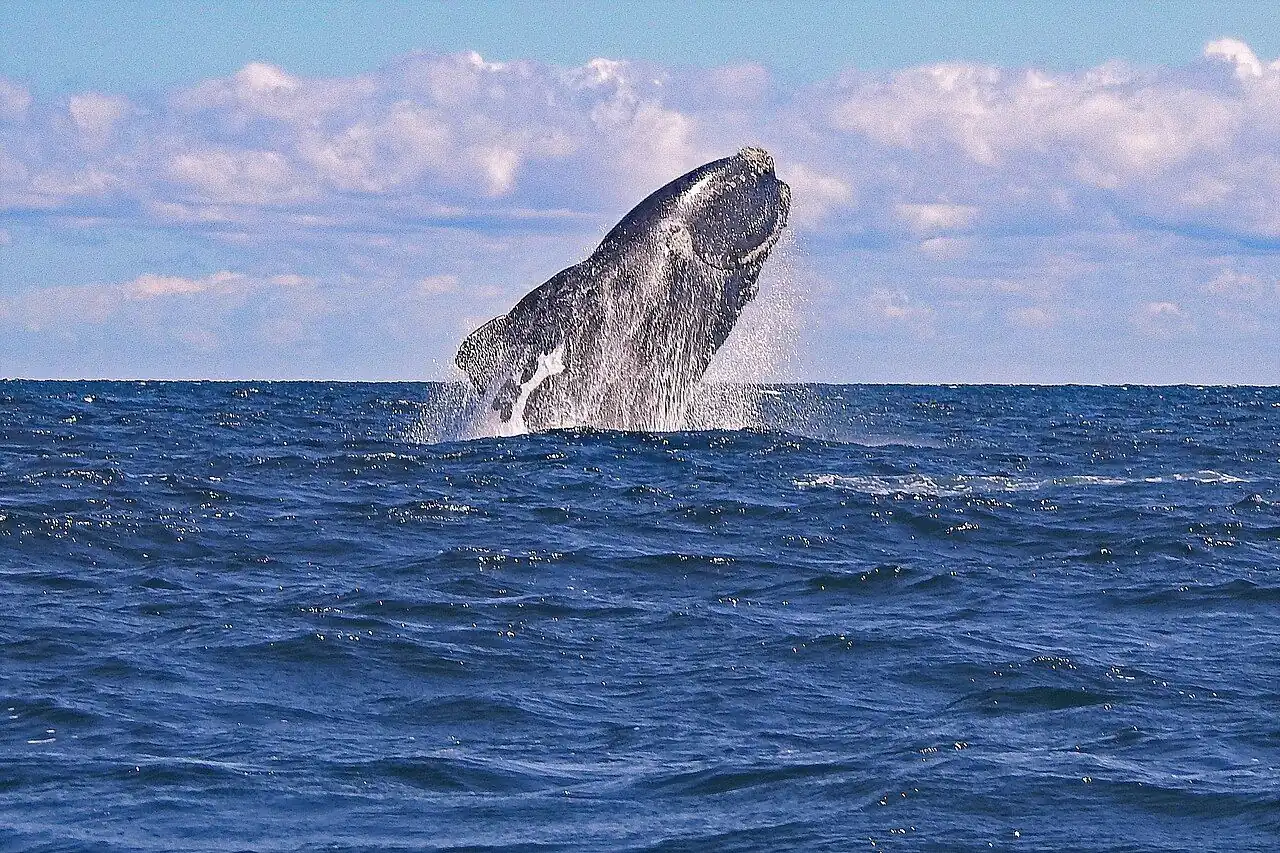
Southern Right Whale
Eubalaena australis
A finless baleen whale of the Southern Hemisphere, back from heavy whaling, that skims plankton and dives to the seafloor to feed.
Photo: Hugo Hulsberg / CC0
3 things to know
- Researchers tell individual whales apart by the pattern of rough callosities on their heads.
- Whales tagged in Argentina's Golfo Nuevo dove as deep as 115 m (377 ft) to feed near the seafloor.
- At Península Valdés, kelp gulls tear skin and blubber from the backs of living whales.
- Scientific name
- Eubalaena australis
- Depth
- 0 m – 115 m
0 – 377 ft - Size
- About 13–17 m (43–56 ft) long
- Weight
- Up to about 80 metric tons (176,000 lb)
- Lifespan
- Unknown; probably at least 70 years, like other right whales
- Diet
- Copepods and krill
- Where
- Southern Hemisphere, from about 20° to 65° S; breeds near the coasts of southern Australia, New Zealand, South America and southern Africa
- IUCN status
- Least Concern
- Depth zones
- Sunlight
Southern right whales are stocky and black, often with white patches on the belly and chin, and they have no dorsal fin. Their huge heads are covered in callosities, patches of rough skin whose pattern differs from whale to whale, so researchers on the breeding grounds use them to recognize individuals. They breach, slap the water with flukes and flippers, and sometimes "sail," holding their tails up and letting the wind push them along.
The species ranges across the Southern Hemisphere from about 20° to 65° south. In the southern winter, breeding whales gather near the coasts of southern Australia, New Zealand's sub-Antarctic islands, Argentina, Brazil, South Africa and Namibia. In summer most head south to feed, straining copepods and krill through their baleen. Females usually have a first calf at 8 to 10 years old, after a pregnancy of about a year, and then calve every three to five years. Nobody knows how long they live; NOAA suggests it is probably similar to northern right whales, at least 70 years.
Argentina's Península Valdés is best known as a calving ground, where right whales had been seen feeding at or just below the surface. In 2024 Valeria D'Agostino and colleagues reported the first feeding dives there, filmed by suction-cup video cameras on eight whales in Golfo Nuevo. Every tagged whale fed. The deepest dive reached 115 meters (377 feet). The tags' depths matched the bottom, so the whales were apparently feeding at the seafloor of a gulf that averages 80 meters (260 feet) deep, and the team found five times more zooplankton by weight at depth than near the surface. One mother went down to 84 meters (276 feet) with her calf beside her.
NOAA says the species was hunted extensively until about the 1960s. The IUCN's 2017 assessment lists it as Least Concern, citing an estimate of about 13,600 whales in 2009 and a five- to tenfold increase since the 1970s, though the tiny population off Chile and Peru is Critically Endangered on its own. Under US law it is listed as endangered under the Endangered Species Act and depleted under the Marine Mammal Protection Act. At Península Valdés, kelp gulls rip skin and blubber from the backs of living whales, a behavior that has increased since the first record in 1972, and the IUCN says the wounds are thought to contribute to some calf deaths.



