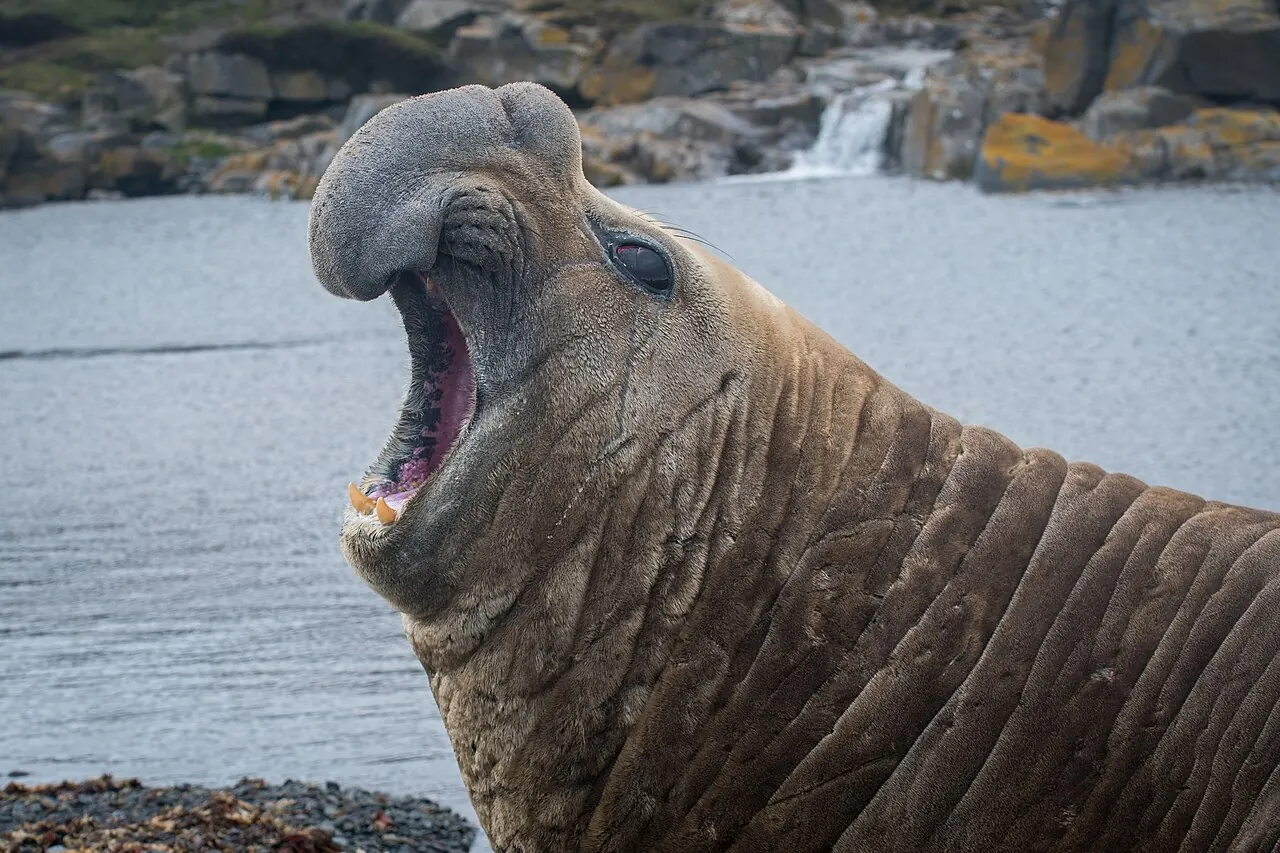
Southern Elephant Seal
Mirounga leonina
A giant Southern Ocean seal that dives for up to 2 hours; bird flu killed most pups in some colonies, and the IUCN uplisted it in 2026.
Photo: Antoine Lamielle / CC BY-SA 4.0
3 things to know
- Bulls can weigh up to 3,000 kg (6,600 lb).
- Most dives last about 30 minutes and reach 300–800 m (980–2,600 ft).
- In April 2026 the IUCN moved it from Least Concern to Vulnerable because of H5N1 bird flu.
- Scientific name
- Mirounga leonina
- Depth
- 0 m – 800 m
0 – 2,625 ft - Size
- About 2.8–6 m (9–20 ft); males far larger than females
- Weight
- Males up to 3,000 kg (6,600 lb); females about 300–900 kg (660–2,000 lb)
- Lifespan
- Males up to about 14 years, females up to about 20; average about 9.5
- Diet
- Squid and fish
- Where
- Southern Ocean; breeds on sub-Antarctic islands and at Península Valdés, Argentina
- IUCN status
- Vulnerable
- Depth zones
- Sunlight · Twilight
A bull southern elephant seal can weigh up to 3,000 kilograms (6,600 pounds), several times as much as a female, which weighs 300 to 900 kilograms (660 to 2,000 pounds) just before giving birth. The species is named for the adult male's large proboscis, or nose, which he uses to make loud roars, especially in the mating season.
Clumsy on land, they are superb divers. According to the Australian Antarctic Division, most dives last about 30 minutes and reach 300 to 800 meters (980 to 2,600 feet), and the seals dive almost constantly while at sea, spending about 2 minutes at the surface between dives. Biologists have recorded them as deep as 2 kilometers (1.2 miles) and holding their breath for up to 2 hours. They carry a huge volume of blood, packed with red blood cells, and so much oxygen-storing myoglobin in their muscles that the muscles look black. After breeding or molting they head south toward Antarctica to feed on squid and fish, the males mainly over the continental shelf and the females in more open water, sometimes several thousand kilometers from their breeding islands.
They breed in dense colonies on beaches of sub-Antarctic islands, and at Península Valdés in Argentina, from late September to early November. Bulls hold harems of females and do not leave their territory to feed, living off their blubber. A pup weighs about 40 kilograms (88 pounds) at birth and averages 120 kilograms (265 pounds) when it is weaned at 24 days. In the 19th and early 20th centuries, sealers killed them for oil and nearly wiped out many populations.
The newest threat is H5N1 bird flu, which has become far more common around the world since 2020 and has spread to mammals. In 2023 it reached Península Valdés, and a study co-led by the UC Davis School of Veterinary Medicine with Wildlife Conservation Society scientists, among them Claudio Campagna, found it killed 70 percent of the pups born that season. In surveyed areas, pup deaths reached at least 96 percent by early November. In April 2026 the IUCN moved the species from Least Concern to Vulnerable, noting that the disease had hit four of the five major subpopulations, killed more than 90 percent of newborn pups in some colonies and seriously affected adult females, which spend more time on the beaches than males.
Sources
- web.archive.org/web/20220707051834/https://www.antarctica.gov.au/about-antarctica/anima…
- animaldiversity.org/accounts/Mirounga_leonina
- iucn.org/press-release/202604/emperor-penguin-and-antarctic-fur-seal-now-endangered-due…
- Study: doi:10.2305/IUCN.UK.2026-1.RLTS.T13583A95970952.en
- Study: doi:10.1111/mms.13101
- ucdavis.edu/climate/blog/elephant-seal-die-argentina-caused-bird-flu



