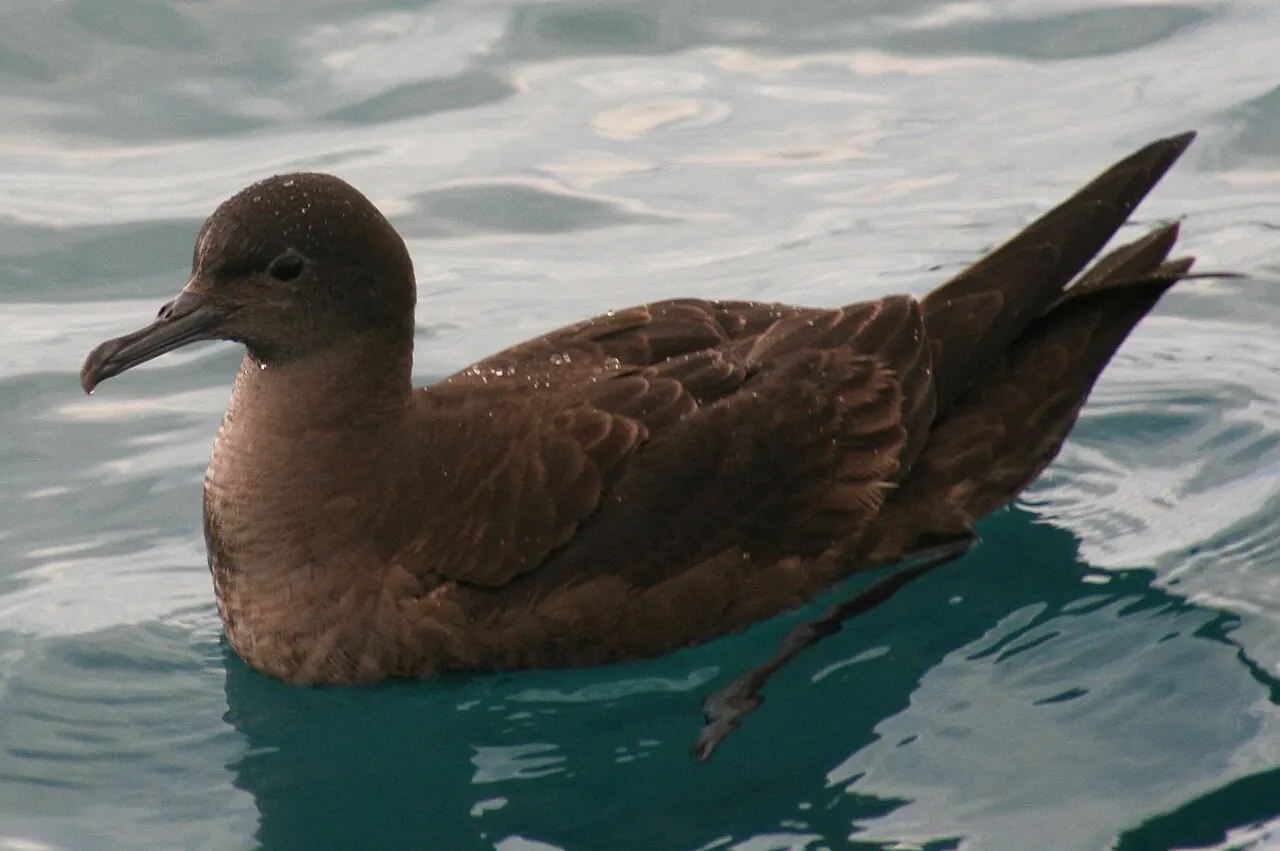
Sooty Shearwater
Ardenna grisea
A dark seabird from New Zealand that loops the whole Pacific in a yearly figure eight and fills summer seas off California.
Photo: Sabine's Sunbird / CC BY-SA 3.0
3 things to know
- Tracked birds flew about 64,000 km (40,000 mi) on a round trip across the Pacific.
- Its dives average about 16 m (52 ft), and the deepest tracked reached 68 m (223 ft).
- Descendants of Rakiura Māori harvest about 400,000 chicks a year as tītī, or muttonbirds.
- Scientific name
- Ardenna grisea
- Depth
- 0 m – 68 m
0 – 223 ft - Size
- 40–46 cm (16–18 in) long, with a wingspan of 1–1.2 m (3.3–3.9 ft)
- Weight
- 650–950 g (1.4–2.1 lb)
- Lifespan
- More than 25 years
- Diet
- Fish, squid and krill, plus offal from fishing boats
- Where
- Breeds on islands off New Zealand, Australia and southern South America; migrates into the North Pacific and North Atlantic, including US waters
- IUCN status
- Near Threatened
- Depth zones
- Sunlight
A sooty shearwater is sooty brown above and slightly grayer below, with a silvery-gray flash on each underwing. It is 40 to 46 centimeters (16 to 18 inches) long and weighs 650 to 950 grams (1.4 to 2.1 pounds), with wings spanning about 1 to 1.2 meters (3.3 to 3.9 feet).
Sooty shearwaters nest in burrows on islands in the Southern Hemisphere. New Zealand's big colonies are all around Stewart Island or on The Snares, and New Zealand's population has been estimated at about 21 million birds. A pair lays a single white egg between late November and mid-December and incubates it for 53 to 56 days, and the chick fledges at about 86 to 106 days old. Descendants of Rakiura Māori harvest chicks at traditional sites around Stewart Island, an estimated 400,000 a year, as tītī, or muttonbirds.
After breeding they head north. Scott Shaffer and colleagues tracked shearwaters from New Zealand with tags that logged position, dive depth and water temperature, and in 2006 reported that the birds crossed the entire Pacific in a figure eight, covering about 64,000 kilometers (40,000 miles) on the round trip. Each bird spent the northern summer off Japan, Alaska or California, then returned through a narrow corridor in the central Pacific. They fed from the surface down to 68 meters (223 feet), though NZ Birds Online gives an average dive of about 16 meters (52 feet). Audubon calls the species often the most abundant seabird off California.
On August 18, 1961, the Santa Cruz Sentinel reported dead and stunned sooty shearwaters hitting homes and littering streets around Monterey Bay. Alfred Hitchcock was visiting the area, and the event, along with a Daphne du Maurier story, likely helped inspire his 1963 film The Birds. Writing in Nature Geoscience, Sibel Bargu of Louisiana State University and colleagues, including Mark Ohman of Scripps Institution of Oceanography, examined zooplankton netted off Monterey five weeks before the event and stored in a Scripps collection. Every gut they checked held Pseudo-nitzschia, algae that make the nerve toxin domoic acid.
The IUCN lists the sooty shearwater as Near Threatened, in a 2019 assessment, because of declines. Fishing gear kills many, introduced mammals have wiped out most colonies on New Zealand's mainland, and Audubon notes that numbers off parts of the North American west coast have fallen significantly.



