Snow Crab
Chionoecetes opilio
A cold-water crab that vanished by the billions from the Bering Sea after a marine heat wave, leaving room for hybrids.
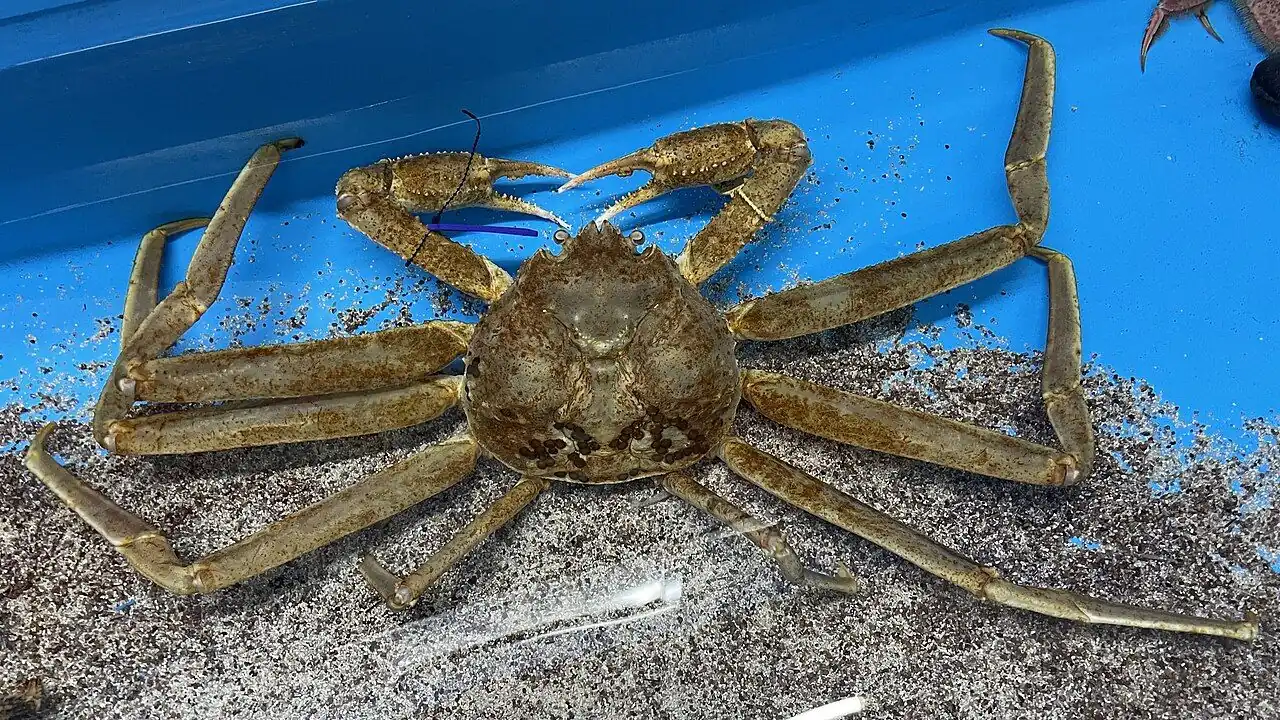
Photo: Totti / CC BY-SA 4.0
3 things to know
- After a final terminal molt at maturity, a snow crab never molts again.
- More than 10 billion snow crabs disappeared from the eastern Bering Sea after 2018.
- Snow-Tanner hybrids made up 41.7 percent of commercial-sized males in the 2025 Bering Sea survey.
- Scientific name
- Chionoecetes opilio
- Depth
- 100 m – 300 m
328 – 984 ft - Size
- Males up to about 15 cm (6 in) across the shell; females seldom over 7.5 cm (3 in)
- Weight
- Heaviest published about 0.86 kg (1.9 lb)
- Lifespan
- Up to about 20 years (NOAA estimate)
- Diet
- Fish, shrimp, crabs, worms, clams, brittle stars, snails, algae and sponges; also scavenges
- Where
- North Pacific, North Atlantic and Arctic, including the Bering, Chukchi and Beaufort Seas; introduced to the Barents and Kara Seas
- IUCN status
- Not Evaluated
- Depth zones
- Sunlight · Twilight
Snow crabs have a hard, rounded shell, brownish on top and lighter underneath, green or blue-green eyes, and four pairs of walking legs behind a pair of claws. Males reach about 15 centimeters (6 inches) across the shell, while females seldom pass 7.5 centimeters (3 inches). The species lives on soft sand and mud across the North Pacific, the North Atlantic and the Arctic, and it has been introduced to the Barents and Kara Seas. SeaLifeBase gives a usual depth of 100 to 300 meters; in Alaska, where it lives in the Bering, Chukchi and Beaufort Seas, NOAA says it is typically found shallower than 200 meters (650 feet).
It eats almost anything it can break open, and scavenges. Females carry up to nearly 100,000 eggs and hatch them in spring. Crabs grow only by molting until they mature, when both sexes make a final "terminal molt" and never molt again. NOAA estimates they may live up to 20 years. In 2012 Raouf Kilada and colleagues counted up to 10 yearly growth bands in the eyestalks and stomach grinders of snow crabs.
In a 2023 paper in Science, Cody Szuwalski and colleagues reported that more than 10 billion snow crabs vanished from the eastern Bering Sea after 2018, and the population fell to historical lows in 2021. They tied the collapse to a marine heat wave in 2018 and 2019. The water was not beyond the crabs' thermal limits, but it raised their calorie needs while their range shrank, and starvation appears to have played a role. In a 2025 study, a NOAA team led by Erin Fedewa found that juveniles' energy reserves crashed during the collapse, and that water colder than 0°C (32°F) seems to matter for their survival. The fishery was closed for the 2022 and 2023 fishing years, and a rebuilding plan targets 2029.
In an October 2026 paper in PNAS, Fedewa's team reported that snow-Tanner hybrid crabs, once rare, had become 13.4 times more abundant than their historical average. NOAA says hybrids made up 41.7 percent of commercial-sized males in the 2025 survey. The team's causal models traced the surge to the snow crab collapse, and NOAA says indirect effects of the collapse, likely less competition and predation, accounted for 76 percent of the hybrid and Tanner crab increase.
The species has not been assessed for the IUCN Red List.
Sources
- fisheries.noaa.gov/species/alaska-snow-crab
- sealifebase.se/summary/Chionoecetes-opilio.html
- Study: doi:10.1126/science.adf6035
- fisheries.noaa.gov/feature-story/snow-crab-collapse-linked-energetic-limitations-during…
- fisheries.noaa.gov/feature-story/marine-heatwave-triggered-hybrid-crab-surge-bering-sea
- Study: doi:10.1139/cjfas-2012-0254
- Study: doi:10.1139/cjfas-2025-0099
- Study: doi:10.1073/pnas.2625670123



