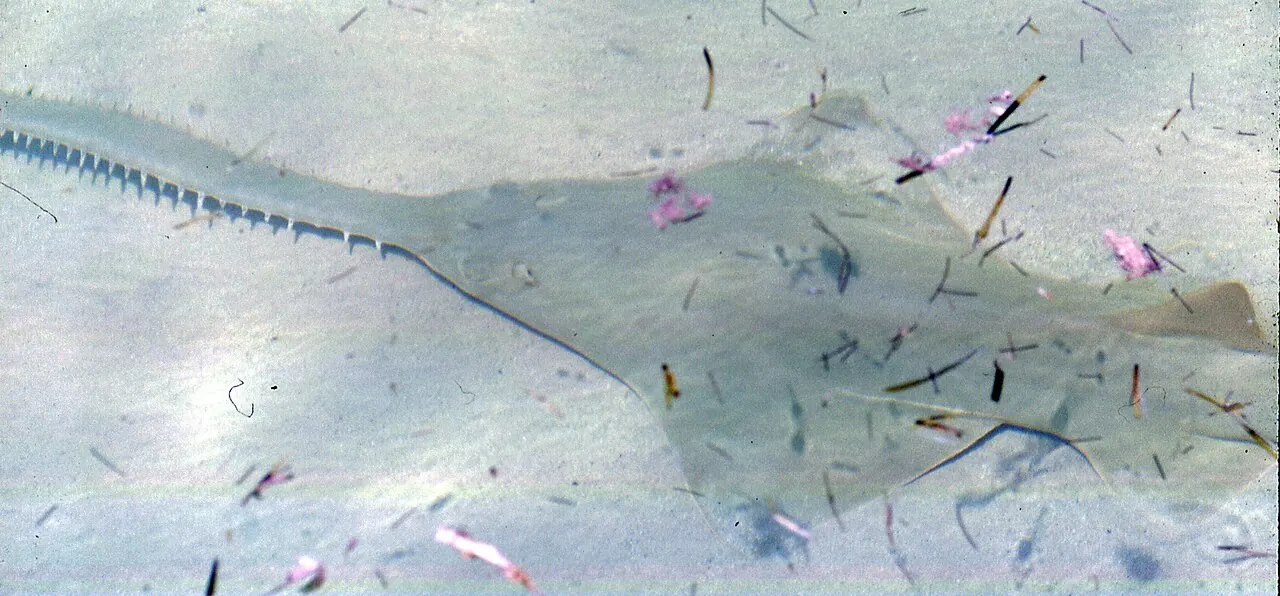
Smalltooth Sawfish
Pristis pectinata
A critically endangered ray with a toothed saw for a snout, now found in US waters mostly off southwest Florida.
Photo: James St. John / CC BY 2.0
3 things to know
- Its saw carries 22 to 29 teeth on each side.
- In 2003 it became the first marine fish protected as endangered under the US Endangered Species Act.
- A newborn pup's saw is soft and sheathed so it does not injure the mother.
- Scientific name
- Pristis pectinata
- Depth
- 0 m – 122 m
0 – 400 ft - Size
- Up to about 4.9 m (16 ft) by NOAA's figure; FishBase lists a maximum of 7.6 m (25 ft)
- Weight
- Up to several hundred pounds; heaviest published 350 kg (770 lb)
- Lifespan
- Not well known; NOAA says likely several decades
- Diet
- Mainly fish; also shrimp and crabs
- Where
- Warm coastal waters and estuaries of the Atlantic; in the US now mostly off southwest Florida
- IUCN status
- Critically Endangered
- Depth zones
- Sunlight
Sawfish look like sharks, but their gills and mouths sit on the underside of the body, which makes them rays. The smalltooth sawfish is olive gray to brown above and white below, and its long, flat snout, the rostrum, carries 22 to 29 teeth along each side. NOAA puts its length at up to about 4.9 meters (16 feet).
It lives in warm coastal waters and estuaries of the Atlantic and sometimes swims into the lower reaches of rivers. In the United States it once ranged from North Carolina to Texas, but today most are found off southwest Florida, from Charlotte Harbor through the Everglades to the Florida Keys. Young sawfish spend their first two or three years in water less than a meter (3 feet) deep along mangrove shorelines, then move into deeper coastal water as they grow. The IUCN assessment lists it from the surface down to 122 meters (400 feet).
The saw is a hunting tool. A sawfish swings it from side to side through a school of fish to stun and impale prey, and sensors in the rostrum pick up the weak electric fields that other animals give off. It also eats shrimp and crabs. Females carry their young for about a year and give birth every other year to 7 to 14 pups, each about 60 centimeters (2 feet) long. A pup's saw is soft and wrapped in a gel-like sheath at birth, which dissolves soon after.
Coastal development and bycatch drove numbers down in the second half of the 20th century. In 2003 the US population became the first marine fish listed as endangered under the Endangered Species Act, and the IUCN rates the species Critically Endangered.
In 2024, Florida wildlife officials documented reports of fish spinning in the Lower Florida Keys, and sawfish were among them. By late April, NOAA counted 179 affected sawfish and 44 confirmed deaths, all large juveniles and adults. On April 5 a team pulled an 11-foot male out of Cudjoe Bay, the first attempt ever made to rescue and rehabilitate a wild smalltooth sawfish. At Mote Marine Laboratory in Sarasota it stopped showing neurological symptoms but never fed on its own, and it died after more than 20 days of care. Adam Brame, NOAA's sawfish recovery coordinator, said the true toll was probably higher, because dead sawfish sink.



