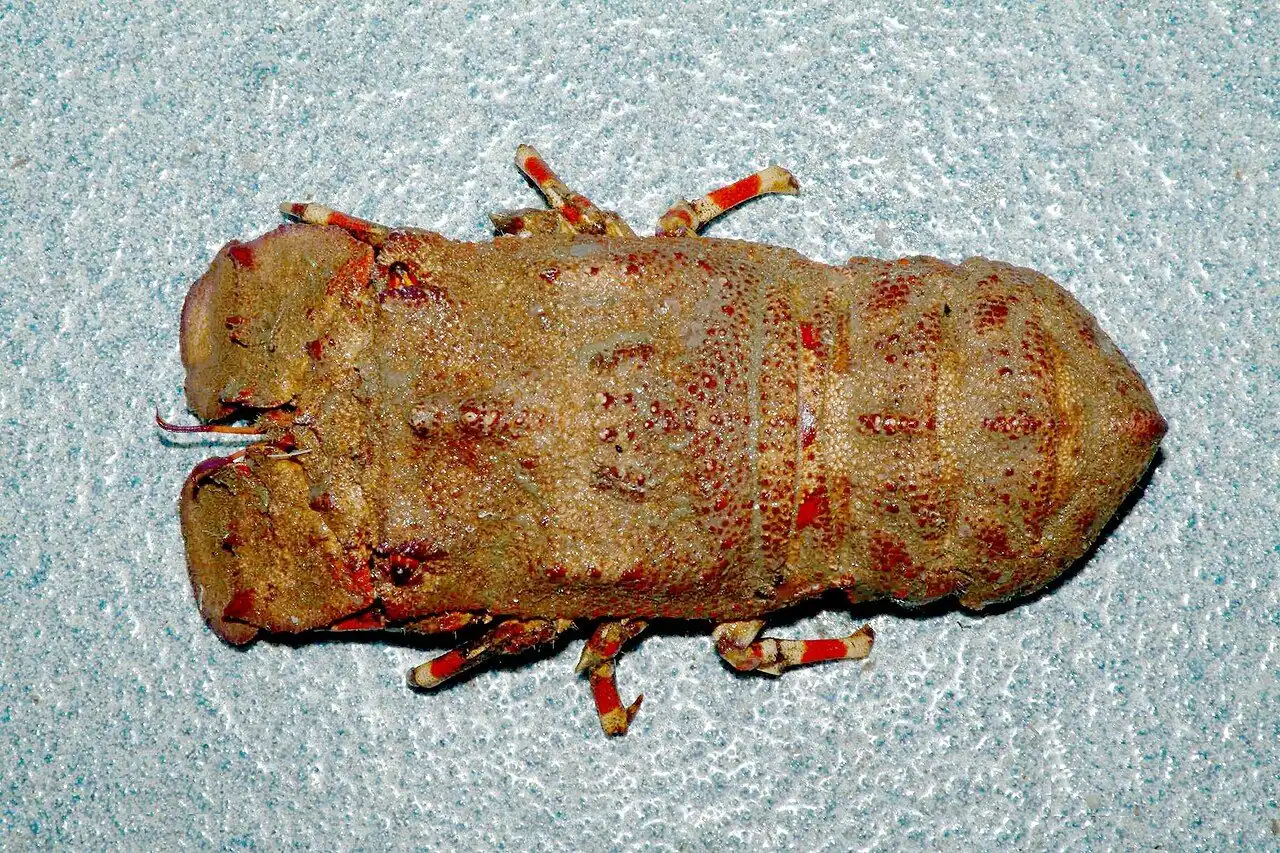
Slipper Lobster
Family Scyllaridae (about 90 species)
Flat, clawless lobsters with shovel-like antennae, whose leaf-shaped larvae ride and eat jellyfish, even the Portuguese man o' war.
Photo: SEFSC Pascagoula Laboratory; Collection of Brandi Noble, NOAA/NMFS/SEFSC / Public domain
3 things to know
- The broad plates at the front of the head are flattened antennae, not claws.
- Its see-through larvae cling to jellyfish and eat them.
- The Spanish slipper lobster is usually found 1 to 64 m (3 to 210 ft) down.
- Scientific name
- Family Scyllaridae (about 90 species)
- Depth
- 1 m – 64 m
3 – 210 ft - Size
- Mostly small; the Mediterranean slipper lobster reaches about 45 cm (18 in)
- Weight
- Unknown
- Lifespan
- Unknown
- Diet
- Bivalves, limpets and other mollusks, plus dead animals and detritus
- Where
- Mainly tropical seas worldwide, including the western Atlantic, the Mediterranean and Hawaii
- IUCN status
- Varies by species (Spanish, ridged and blunt slipper lobsters Least Concern; Mediterranean slipper lobster Data Deficient)
- Depth zones
- Sunlight
A slipper lobster has no claws, and the two broad plates sticking out in front of its eyes are not claws either. They are its antennae, flattened into wide shovels, on a flattened body. The World Register of Marine Species lists about 90 living species in the family Scyllaridae. Britannica describes most as short and small, though the Mediterranean slipper lobster reaches about 45 centimeters (18 inches), according to SeaLifeBase.
They live mainly in warm seas, on sand, rock and reef. The Spanish slipper lobster of the western Atlantic is usually found 1 to 64 meters (3 to 210 feet) down; L. B. Holthuis's catalog of the world's lobsters, as summarized by SeaLifeBase, describes it as sluggish and nocturnal, burying itself in sand and feeding on dead animals and detritus. The blunt slipper lobster, found from South Africa and Japan east to Hawaii, pries bivalves open by wedging the shells apart with its walking legs, and the Mediterranean species eats limpets.
The strangest stage is the larva. Slipper lobsters hatch as phyllosomas, thin, flat, see-through drifters with spindly legs, and these larvae have been found riding on jellyfish and eating them. Kaori Wakabayashi, now at Hiroshima University, found that their walking legs carry hard spikes for gripping a jelly. In feeding trials, the larvae ate everything from harmless moon jellies to the Portuguese man o' war without harm, because a lining of chitin protects nearly the whole intestine from the stinging cells. On a diet of nothing but jellyfish, larvae of the Japanese species Ibacus novemdentatus skipped one development stage, shortening a drifting phase that usually lasts 1.5 to 2 months. She has raised three species through the larval stage, as a step toward farming them.
Several species are fished for their tail meat. In 2000, NOAA closed that year's commercial lobster season in the Northwestern Hawaiian Islands, a fishery for both spiny and slipper lobsters, over concern about possible overfishing. On the IUCN Red List, the Spanish, ridged and blunt slipper lobsters were assessed as Least Concern in 2009, and the Mediterranean slipper lobster as Data Deficient.
Sources
- britannica.com/animal/slipper-lobster
- marinespecies.org/aphia.php
- sealifebase.se/summary/Scyllarides-aequinoctialis.html
- sealifebase.se/summary/Scyllarides-squammosus.html
- sealifebase.se/summary/Scyllarides-latus.html
- sealifebase.se/summary/Scyllarides-nodifer.html
- hiroshima-u.ac.jp/node/82400
- govinfo.gov/content/pkg/FR-2000-06-26/pdf/00-16111.pdf
- iucnredlist.org/species/170075/6726084



