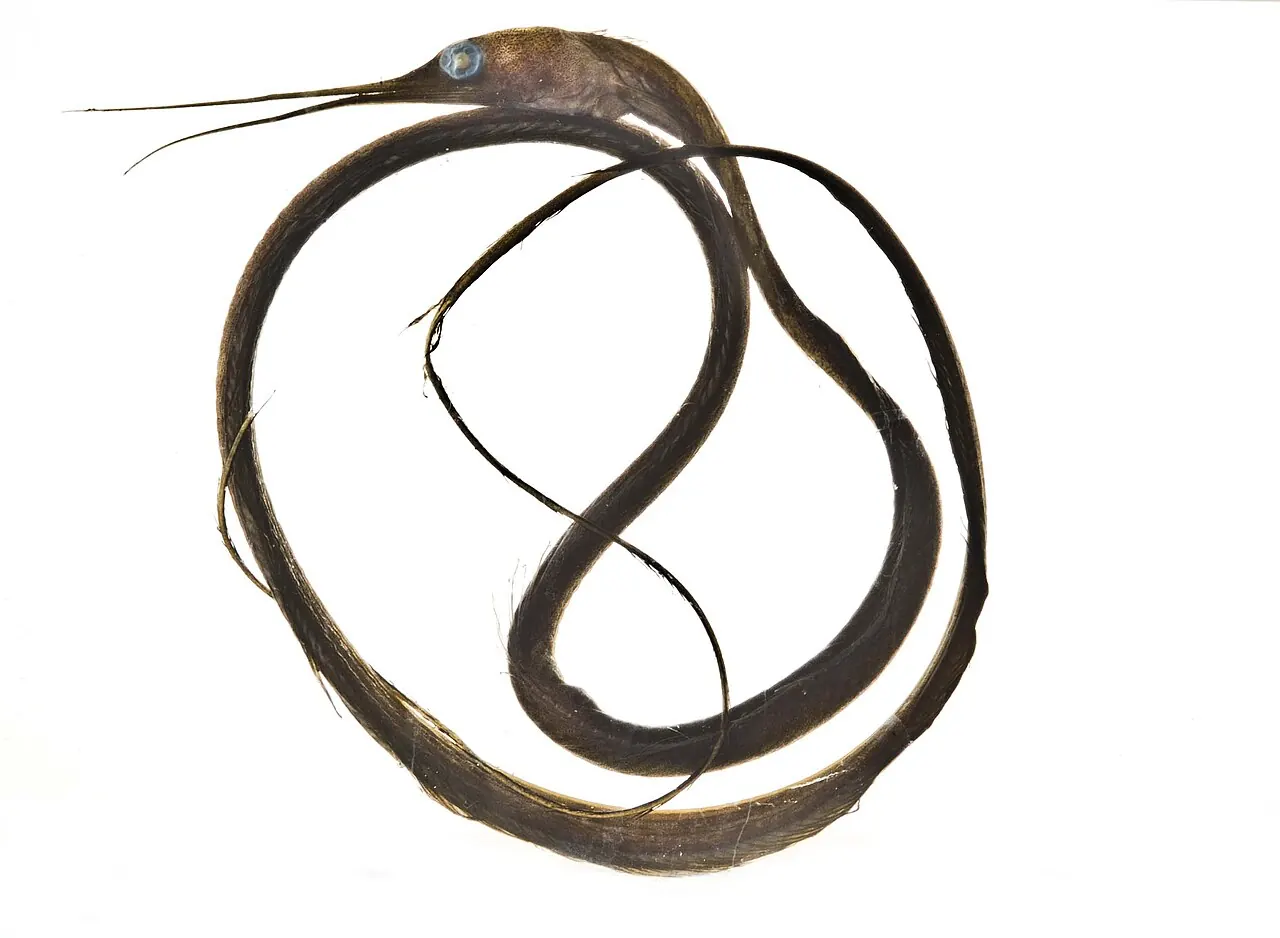
Slender Snipe Eel
Nemichthys scolopaceus
A thread-thin midwater eel with beak-like jaws that stay open as it swims, and more vertebrae than any other known animal.
Photo: Sandra Raredon/Smithsonian Institution / Public domain
3 things to know
- It averages about 750 vertebrae, more than any other known animal.
- Its beak-like jaws curve upward and stay permanently open.
- As males mature, their jaws shorten and they lose their teeth.
- Scientific name
- Nemichthys scolopaceus
- Depth
- 100 m – 1,000 m
328 – 3,281 ft - Size
- Up to about 1.3 m (4.3 ft) long
- Weight
- Not well known
- Lifespan
- Unknown (adults may spawn once and die)
- Diet
- Small crustaceans
- Where
- Tropical and temperate seas worldwide, including the western Atlantic from Nova Scotia to Brazil and the eastern Pacific from Alaska to Chile
- IUCN status
- Least Concern
- Depth zones
- Sunlight · Twilight
Picture a length of dark string with a bird's bill at one end. The slender snipe eel's jaws are long and thin, and they curve upward toward the tips, so they stay open all the time. Behind the head the body tapers into a long filament with no recognizable tail fin, edged by a dorsal fin of about 350 rays and an anal fin of about 320. It is dark brown or gray, often darker below, and FishBase gives a maximum length of 1.3 meters (4.3 feet). The back half is so narrow that, as the Woods Hole Oceanographic Institution (WHOI) points out, the only place the anus fits is on the slightly wider throat.
It lives in midwater in tropical and temperate seas worldwide, usually 100 to 1,000 meters (330 to 3,300 feet) down and mostly below 400 meters, though it comes into shallower water in the north of its range. FishBase records it as deep as 4,337 meters (14,230 feet). In the western Atlantic it ranges from Nova Scotia and the northern Gulf of Mexico to Brazil, and in the eastern Pacific from Alaska to Chile.
The eel feeds on crustaceans while swimming with its mouth open. WHOI describes the curved jaws as permanently agape, so that sooner or later a small crustacean ends up between them, where tiny backward-pointing teeth stop it from escaping.
Thin as it is, this eel has the most vertebrae of any known animal. WHOI gives an average of 750. The Smithsonian, which X-rayed a specimen collected more than 2,000 meters (6,560 feet) down in the North Atlantic, says over 700.
Males change shape as they mature: their jaws shorten and their teeth fall out, which WHOI suggests may signal that they are ready to breed. FishBase notes degenerative changes in both sexes, a sign that they may spawn once and die. The eggs hatch into drifting larvae called leptocephali. How long the eels live is unknown, and the IUCN lists the species as Least Concern.



