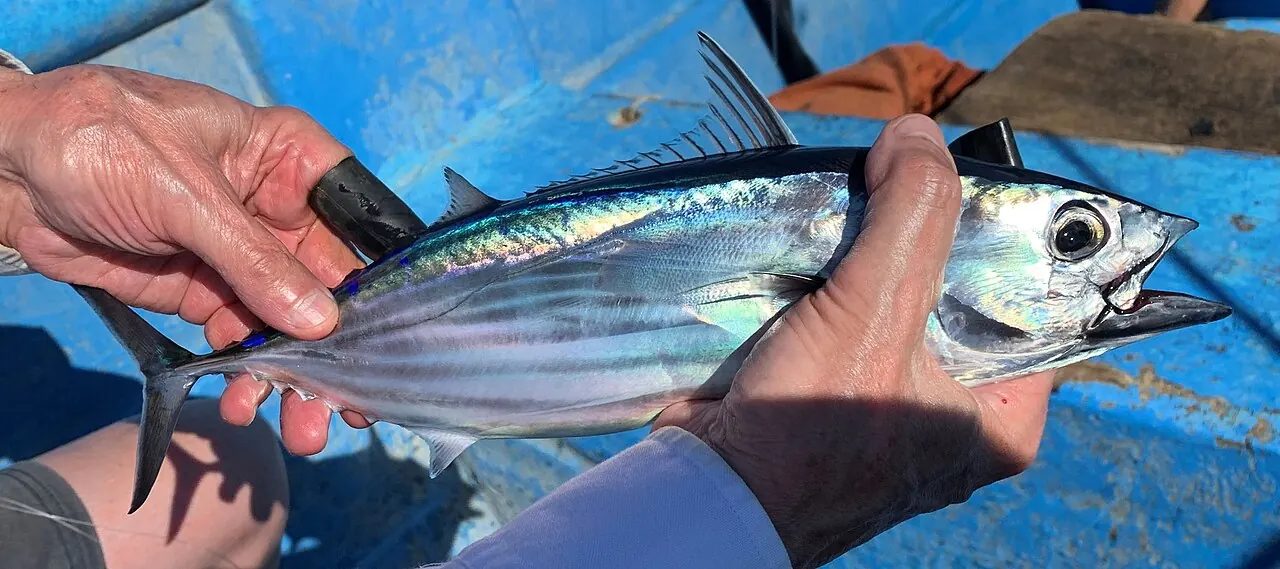
Skipjack Tuna
Katsuwonus pelamis
A small, striped, fast-breeding tuna that spawns almost daily in the tropics and is notoriously hard for fishery scientists to count.
Photo: cotterh / CC BY 4.0
3 things to know
- Apart from a band behind the head and the lateral line, its body has no scales.
- Some females spawn almost every day, and the eggs hatch in about a day.
- Its schools often travel with seabirds, sharks and whales.
- Scientific name
- Katsuwonus pelamis
- Depth
- 0 m – 260 m
0 – 853 ft - Size
- Commonly about 80 cm (2.6 ft); up to about 1.1 m (3.6 ft) long
- Weight
- Up to about 34 kg (76 lb)
- Lifespan
- Short for a tuna: about 7 years in the Atlantic, 8 to 12 years at most in the Pacific
- Diet
- Fish, crustaceans, squid and other molluscs, sometimes other skipjack
- Where
- Tropical, subtropical and warm temperate waters of all oceans
- IUCN status
- Least Concern
- Depth zones
- Sunlight · Twilight
Look at a skipjack's belly, not its back. A skipjack has four to six dark stripes running lengthwise along its lower sides, sometimes broken into lines of blotches. The back is dark purplish blue. The body is bare of scales except for the corselet, a band of thick scales behind the head, and the lateral line. It is a small tuna, commonly about 80 centimeters (2.6 feet) long, with FishBase listing a maximum of 1.1 meters and 34.5 kilograms (76 pounds). It also goes by the names aku and katsuo.
Skipjack live in tropical, subtropical and warm temperate waters of every ocean. In the western Atlantic they range from Massachusetts to Brazil, and in the Pacific they reach the US West Coast and the US Pacific Islands. By day they school from the surface down to about 260 meters (850 feet), and at night they generally stay near the surface. FishBase notes that schools often travel with birds, drifting objects, sharks and whales, and splash and churn the water as they feed. They eat fish, crustaceans, squid and other molluscs, and cannibalism is common.
Everything about the skipjack runs fast. In the eastern Atlantic they can breed at 1 year old. In the tropics they spawn year-round, and some females spawn almost every day, releasing 100,000 to 2 million eggs each time depending on their size. The eggs hatch in about a day. NOAA puts the lifespan at around 7 years in the Atlantic and 8 to 12 years in the Pacific.
That speed is a headache for the people who count them. NOAA calls skipjack "a notoriously difficult species to assess," because its high and variable productivity makes it hard to measure what fishing is doing to the population, especially in the eastern tropical Pacific where data are limited. The latest assessments it cites found neither Pacific stock nor the Atlantic stock overfished. Most of the world's Pacific skipjack catch comes from the western and central Pacific, mainly by purse seiners, many of them working around fish aggregating devices, floating objects set out to draw tuna in. NOAA's figures for 2024 show US recreational anglers landing 1.7 million pounds of Pacific skipjack, while US commercial landings, which leave out fish landed outside the US, came to 267,000 pounds. The IUCN kept the species at Least Concern in its 2021 reassessment.



