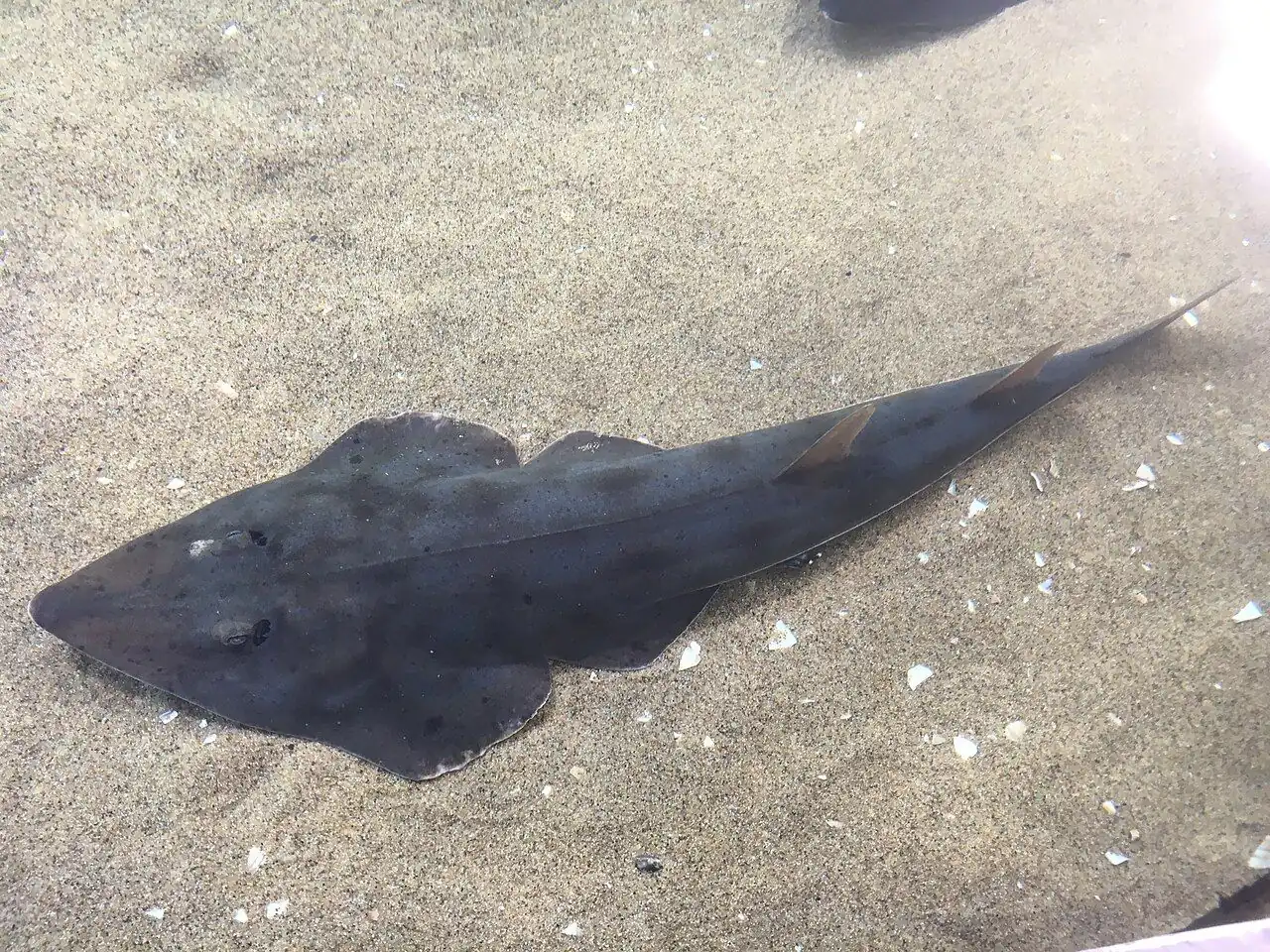
Shovelnose Guitarfish
Pseudobatos productus
A shark-shaped ray of California bays and beaches that hunts buried crabs and clams at night and returns to La Jolla every summer.
Photo: Coughdrop12 / CC BY-SA 4.0
3 things to know
- A single litter can hold anywhere from 6 to 28 pups.
- Females are mature by about 7 years old.
- Guitarfish tagged at La Jolla traveled as far as Santa Barbara, 221 km (137 miles) away, and came back.
- Scientific name
- Pseudobatos productus
- Depth
- 1 m – 13 m
3 – 43 ft - Size
- Females up to about 1.7 m (5.6 ft) long; males up to about 1.2 m (3.9 ft)
- Weight
- Up to about 9.8 kg (22 lb)
- Lifespan
- About 11–16 years
- Diet
- Crabs, worms, clams and small fish
- Where
- Eastern Pacific, from San Francisco to the Gulf of California
- IUCN status
- Near Threatened
- Depth zones
- Sunlight
A shovelnose guitarfish swims with its long tail and looks more like a shark than a ray. The flattened front end is longer than it is wide and tapers into a long, pointed snout with a rounded tip, behind which comes a thick, shark-like tail with a sizable tail fin. The species name, productus, is Latin for drawn out, after that snout. The body is brownish gray and fairly smooth, with a single row of thorns around the eyes and along the back and tail, and the mouth holds small, rounded, pebble-like teeth.
It lives only in the eastern Pacific, from San Francisco to the Gulf of California, on sand or mud in bays, seagrass beds and estuaries and near rocky reefs. It is usually found 1 to 13 meters (3 to 43 feet) deep and has been recorded to 91 meters (300 feet). By day it lies buried in the sand. At night it hunts crabs, worms, clams and small fish.
Instead of laying eggs, the female carries her young for about a year, nourishing them first with yolk and then with fluid from the uterus. A litter holds 6 to 28 pups, born 20 to 24 centimeters (8 to 9.5 inches) long. Females mature by about age 7, and California Sea Grant puts the lifespan at about 11 to 16 years. Adults gather in shallow bays and estuaries to breed.
One such gathering place lies off La Jolla. In a study published in 2023, Gong, Nosal, Lowe and colleagues tagged 12 guitarfish there with acoustic transmitters and followed them for an average of about 850 days. Receivers between Point Conception and Baja California picked them up as far north as Santa Barbara, 221 kilometers (137 miles) away, but they came back to La Jolla every year, especially in July. The authors think the site serves as a gestating ground and possibly a mating and pupping ground too. It lies inside a no-take reserve.
Once tossed back as a "trash fish," the guitarfish now has a market and is usually sold as "shark steak," or as fish and chips in Santa Barbara. California Sea Grant warns that its slow maturity and slow breeding, along with pregnant females in shallow water, leave it vulnerable to overfishing. The IUCN lists it as Near Threatened, and FishBase notes it is on CITES Appendix II, which regulates international trade.



