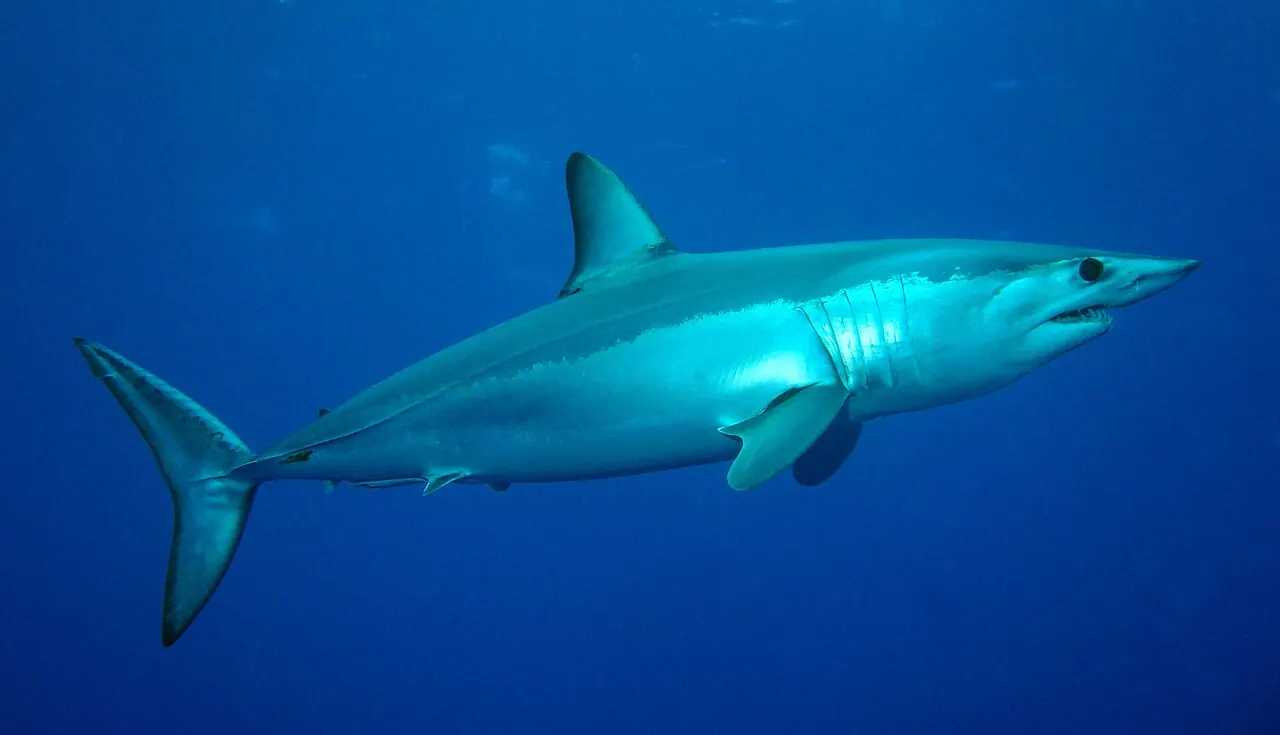
Shortfin Mako Shark
Isurus oxyrinchus
Often called the fastest shark, a metallic-blue ocean hunter of tuna and swordfish that grows slowly and is now Endangered.
Photo: Patrick Doll / CC BY-SA 3.0
3 things to know
- The Florida Museum gives its burst speed as up to 70 km/h (43 mph).
- Females are not mature until at least 18 years old.
- A litter of 4 to 25 pups is born after a pregnancy of 15 to 18 months.
- Scientific name
- Isurus oxyrinchus
- Depth
- 0 m – 150 m
0 – 492 ft - Size
- Commonly about 2.7 m (9 ft) long; the largest reported 4.45 m (14.6 ft)
- Weight
- Up to about 506 kg (1,115 lb)
- Lifespan
- At least 32 years (maximum reported age)
- Diet
- Fast fishes such as tuna and swordfish, other sharks and squid; large individuals also take billfish and small cetaceans
- Where
- Tropical and temperate oceans worldwide; in the Americas from the Grand Banks to Argentina, including the Gulf of Mexico, and from California to Chile
- IUCN status
- Endangered
- Depth zones
- Sunlight
Built like a torpedo, the shortfin mako has a cone-shaped, pointed snout, large black eyes and a crescent tail with a prominent keel at its base. Its back is deep metallic blue and its belly white, with a sharp line between them. The area around the mouth is white too, which separates it from the darker-mouthed longfin mako. On large sharks the long, slender teeth often stick out of the mouth. Adults are commonly about 2.7 meters (9 feet) long.
Makos live in tropical and temperate oceans worldwide, mostly offshore, though they come close to the coast where the continental shelf is narrow. In the Americas they range from the Grand Banks off Canada to Argentina, including the Gulf of Mexico and the Caribbean, and from California to Chile. They usually stay between the surface and about 150 meters (490 feet), in water warmer than 16°C (60°F), and FishBase lists a deepest record of 888 meters (2,913 feet).
The Florida Museum describes the mako as the fastest shark in the world, with bursts up to 70 kilometers per hour (43 mph), and it often leaps clear of the water while feeding. It chases other fast fish, including tuna, swordfish and other sharks, along with squid. Big makos sometimes take billfish and small cetaceans.
Makos grow up slowly. Males mature at 7 to 9 years and females not before 18. Embryos feed on unfertilized eggs inside the mother, and after 15 to 18 months she gives birth to 4 to 25 pups, then breeds again only about every three years. Some early studies assumed makos add two growth rings a year and underestimated their age; FishBase now gives a maximum reported age of 32 years.
That slow pace makes makos easy to overfish. They are caught for meat and fins, by anglers, and as bycatch on tuna and swordfish longlines, and the IUCN lists the species as Endangered. In November 2022 NOAA Fisheries decided the species did not warrant listing under the Endangered Species Act. The same year it set the retention limit at zero for all US Atlantic highly migratory species fisheries, in line with a 2021 measure from the International Commission for the Conservation of Atlantic Tunas, and a May 2026 federal rule notes that the limit is still zero.
Sources
- floridamuseum.ufl.edu/discover-fish/species-profiles/isurus-oxyrinchus
- fishbase.se/summary/Isurus-oxyrinchus.html
- fisheries.noaa.gov/species/shortfin-mako-shark
- fisheries.noaa.gov/feature-story/zero-atlantic-shortfin-mako-shark-retention-limit
- federalregister.gov/documents/2026/05/20/2026-10096/atlantic-highly-migratory-species-p…



