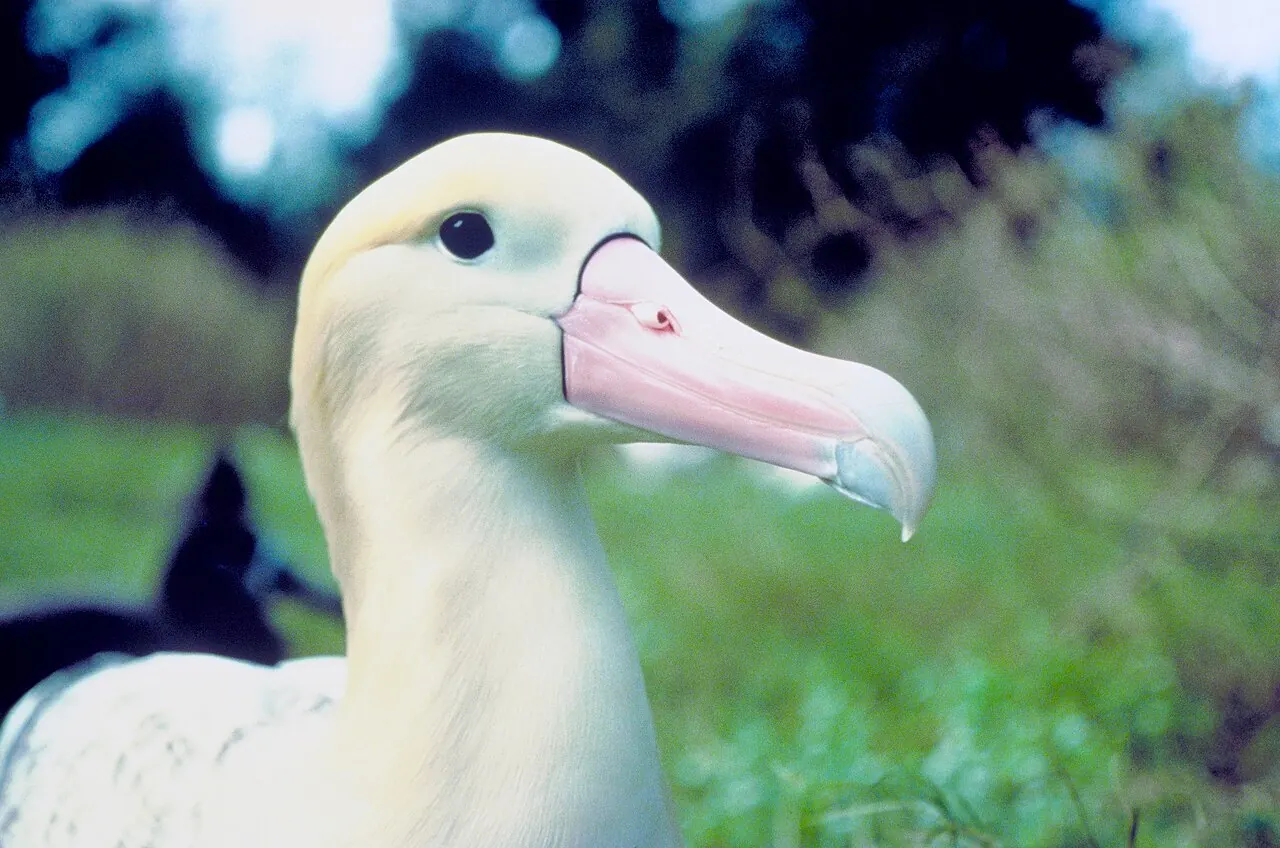
Short-tailed Albatross
Phoebastria albatrus
The largest albatross of the North Pacific, hunted almost to extinction for its feathers and now slowly coming back, including at Midway.
Photo: U.S. Fish and Wildlife Service / Public domain
3 things to know
- By 1949 it was thought to be extinct, until a few birds were seen nesting on Torishima, Japan, in the early 1950s.
- In 2011 a pair at Midway Atoll raised the first chick known to hatch outside Japan, and it survived that March's tsunami.
- It feeds by seizing prey at the surface and does not dive.
- Scientific name
- Phoebastria albatrus
- Depth
- At the surface
- Size
- About 84–94 cm (33–37 in) long, with a wingspan of 2.1–2.3 m (7–7.5 ft)
- Weight
- Not well known
- Lifespan
- Up to about 50 years, according to the US Fish and Wildlife Service
- Diet
- Mainly squid, plus shrimp, fish, flying fish eggs and other crustaceans; also offal behind fishing boats
- Where
- North Pacific; breeds mainly on Torishima, Japan, and in the Senkaku Islands, with a few pairs on Mukojima and at Midway Atoll; forages north to the Bering Sea and Alaska
- IUCN status
- Vulnerable
- Depth zones
- Sunlight
Adult short-tailed albatrosses are white with black flight feathers, a dark band at the tip of the tail and a yellow wash over the head and nape, and they carry a huge pink bill with a bluish tip. Young birds start out chocolate brown all over and take years to turn white. At 84 to 94 centimeters (33 to 37 inches) long, with wings up to about 2.3 meters (7.5 feet) across, it is the largest albatross in the North Pacific.
It was once the most abundant albatross there, too. Feather hunters killed millions around the turn of the 20th century, and by 1949 the species was thought to be extinct. A few birds were then seen nesting on Torishima, a volcanic island in Japan's Izu chain, in the early 1950s; BirdLife International counts 25 there in 1954. Protection followed. BirdLife estimated about 4,200 birds in 2013–14, and a 2020 review by the US Fish and Wildlife Service put the total at 7,365. The service has listed the species as endangered throughout its range since 2000, and the IUCN lists it as Vulnerable.
Most birds still nest on Torishima, an active volcano, and in the Senkaku Islands. In 2020 Masaki Eda and colleagues argued that the two colonies, which differ genetically and in body shape, are really two cryptic species. To spread the risk, biologists moved 70 chicks from Torishima to Mukojima in the Bonin Islands between 2008 and 2012 and hand-reared them there, Tomohiro Deguchi and colleagues reported in Oryx in 2013; a breeding pair that included one of those birds appeared on Mukojima within five years of the first move.
Other birds found a new home on their own. A pair banded as chicks on Torishima nested among decoys on Eastern Island, Midway Atoll, and their chick hatched on January 14, 2011, the first known to hatch outside Japan. The tsunami of March 2011 washed it out of its nest, but it fledged that June.
Short-tails eat mainly squid, which they seize at the surface; the Fish and Wildlife Service notes they do not dive. Outside the breeding season they range across the North Pacific to the Bering Sea and the Aleutian Islands, where longline fishing gear is the main threat today. Eruptions on Torishima are another.
Sources
- fws.gov/species/short-tailed-albatross-phoebastria-albatrus
- audubon.org/field-guide/bird/short-tailed-albatross
- datazone.birdlife.org/species/factsheet/short-tailed-albatross-phoebastria-albatrus/text
- iucnredlist.org/species/22698335/132642113
- papahanaumokuakea.gov/news/short_tailed_albatross_hatches.html
- acap.aq/news/news-archive/2011-news-archive/midway-atolls-first-ever-short-tailed-albat…
- audubon.org/news/first-short-tailed-albatross-chick-born-usa-survives-tsunami-wings-it
- Study: doi:10.1017/S0030605313000094
- Study: doi:10.3354/esr01078
- en.wikipedia.org/wiki/Short-tailed_albatross



