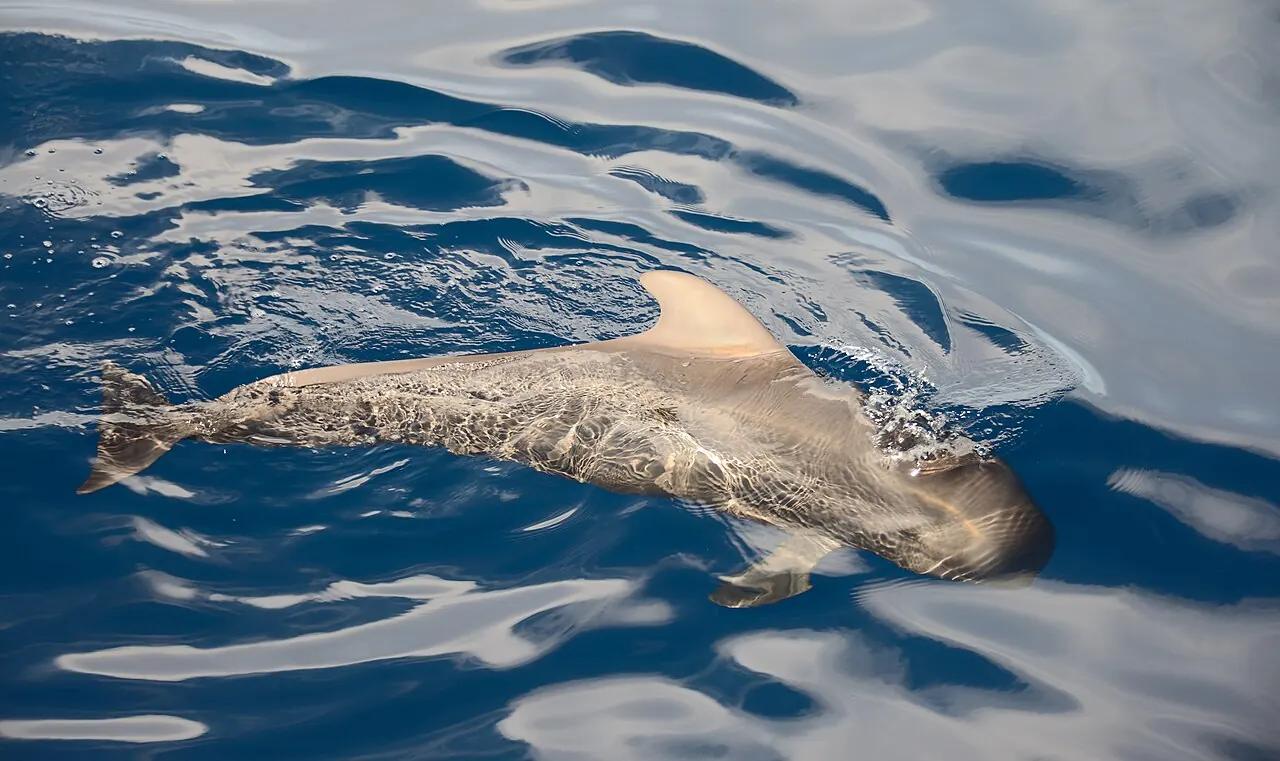
Short-finned Pilot Whale
Globicephala macrorhynchus
A squid-hunting member of the dolphin family that lives in close family groups and sprints after prey hundreds of meters down.
Photo: Cayambe / CC BY-SA 3.0
3 things to know
- Off Tenerife, hunting pilot whales sprinted at up to 9 m (30 ft) per second on dives deeper than 500 m.
- A mother may nurse her last calf for as long as 15 years.
- Like humans and killer whales, females go through menopause.
- Scientific name
- Globicephala macrorhynchus
- Depth
- 0 m – 1,000 m
0 – 3,281 ft - Size
- About 3.7–7.3 m (12–24 ft) long; males much larger than females
- Weight
- About 1,000–3,000 kg (2,200–6,600 lb)
- Lifespan
- Up to about 60 years for females and 45 for males
- Diet
- Mainly squid, plus octopus and fish
- Where
- Tropical and temperate oceans worldwide
- IUCN status
- Least Concern
- Depth zones
- Sunlight · Twilight
A bulbous, beakless head and a low, broad-based dorsal fin set well forward mark the short-finned pilot whale, a large member of the dolphin family. The body is black to dark grayish-brown, with a gray saddle behind the fin and a pale, anchor-shaped patch on the chest. Adult males are much bigger than females, with larger heads and big, hooked fins. NOAA Fisheries gives a length of 3.7 to 7.3 meters (12 to 24 feet) and a weight of 1,000 to 3,000 kilograms (2,200 to 6,600 pounds). At sea it is very hard to tell from the long-finned pilot whale, but its flippers are shorter and it prefers warmer tropical and temperate water.
Family is the core of its life. Females live in stable groups of about 15 to 30 close relatives; males usually leave, while females may stay in their birth group for life. Pregnancy lasts about 15 months, calves nurse for at least two years, and a mother's last calf may nurse for as long as 15 years. Females can live to about 60 and, like humans and killer whales, go through menopause; males reach about 45. NOAA suggests those strong bonds may be why pilot whales often strand in groups.
They eat mainly squid, caught in water 300 meters (1,000 feet) deep or more. Off Tenerife in Spain's Canary Islands, Natacha Aguilar Soto and colleagues attached sound-and-motion tags to 23 pilot whales and in 2008 described how they hunt. Foraging dives reached 1,018 meters (3,340 feet). On most deep daytime dives with a capture attempt, a downward sprint of up to 9 meters per second (about 20 miles per hour) came just before it, at the deepest point of the dive. The team compared the tactic to a cheetah's chase and suggested it targets large, fast, energy-rich prey, perhaps including giant squid.
Five stocks live in US waters, off the East and West Coasts, around Hawaii and around Puerto Rico and the US Virgin Islands, and NOAA puts the Hawaiian stock at about 19,000. Off Southern California, an apparently resident group near Santa Catalina Island virtually disappeared after the strong El Niño of 1982 and 1983. The IUCN's 2018 assessment lists the species as Least Concern, with available estimates adding up to about 700,000. It is hunted in Japan and the Lesser Antilles and gets caught in gillnets, longlines and trawls.



