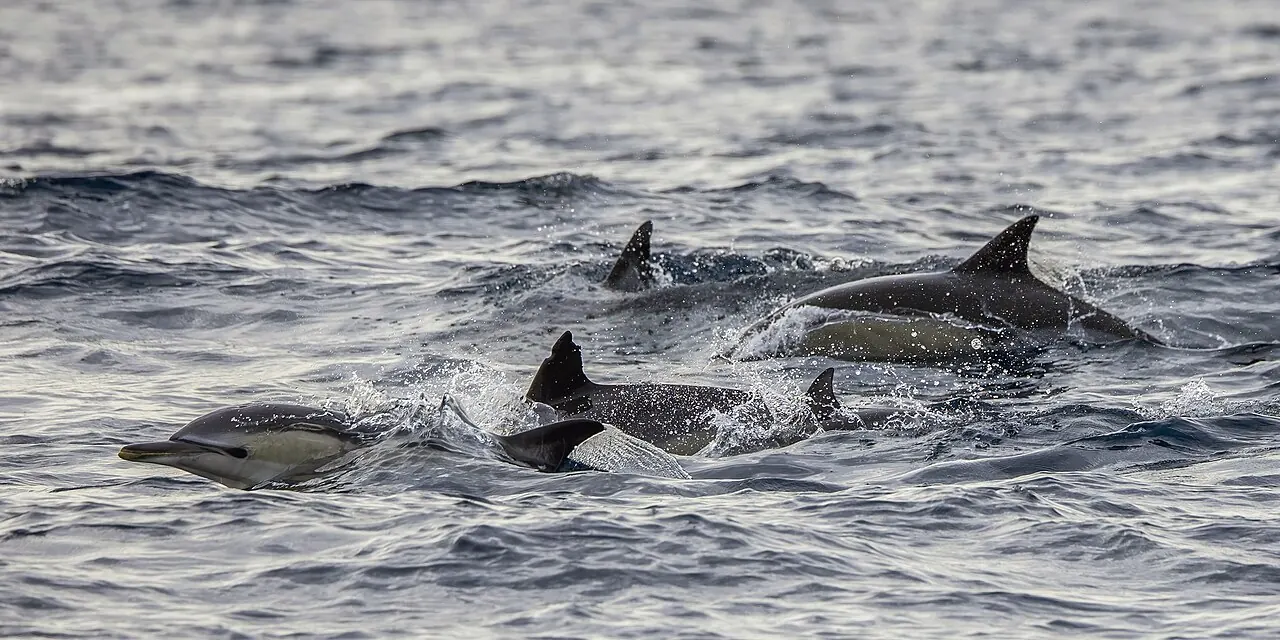
Short-beaked Common Dolphin
Delphinus delphis
One of the world's most abundant dolphins, marked with a tan and gray hourglass, that travels in groups of hundreds to thousands.
Photo: Charles J. Sharp / CC BY-SA 4.0
3 things to know
- Groups sometimes merge into mega-pods of up to 10,000 dolphins.
- It usually rests by day and feeds at night.
- It is found off California all year, from near shore to about 480 kilometers (300 miles) out.
- Scientific name
- Delphinus delphis
- Depth
- 0 m – 305 m
0 – 1,001 ft - Size
- About 1.8–2.4 m (6–8 ft) long
- Weight
- Average about 77 kg (170 lb)
- Lifespan
- Up to about 35–40 years
- Diet
- Schooling fish and squid
- Where
- Subtropical to temperate waters worldwide, mostly offshore over the continental slope
- IUCN status
- Least Concern
- Depth zones
- Sunlight · Twilight
Look at the side of a short-beaked common dolphin and you see an hourglass. A dark gray cape runs along the back and dips into a V below the dorsal fin, with a yellow-tan panel in front of the fin and a light gray one behind it. A dark stripe runs from the lower jaw to the flipper, and a dark patch rings the eye. Adults are 1.8 to 2.4 meters (6 to 8 feet) long and average about 77 kilograms (170 pounds), with 40 to 57 pairs of small, sharp teeth in each jaw.
These are among the most abundant dolphins in the world. They live in subtropical to temperate seas, mostly offshore along the continental slope, and gather where underwater ridges and seamounts push cold, nutrient-rich water up toward the surface. Off the US West Coast they are tied to the California Current and are found off California all year, from near shore to about 480 kilometers (300 miles) out. In the Atlantic they are more common north of Cape Hatteras, and large groups gather on Georges Bank from summer through autumn.
They usually rest during the day and feed at night on schooling fish and squid that rise toward the surface in the dark. Most feeding dives go to about 30 meters (100 feet), though they can reach about 300 meters (1,000 feet). In the Bay of Biscay, Johanna Faure and colleagues analyzed the stomach contents of dolphins collected between 1999 and 2019 and found pilchards, horse mackerel and anchovy at the core of the diet throughout those two decades.
Groups usually number in the hundreds and are thought to be built from smaller units of 20 to 30 animals. Now and then they merge into mega-pods of thousands, up to 10,000 dolphins. They leap, somersault, and ride the bow waves of ships and even large whales. Females give birth every two to three years. They have the highest death rate of any whale or dolphin caught in California's drift gillnet fishery, and in the Bay of Biscay, Faure's team notes, bycatch has risen sharply since 2016. The IUCN lists the species as Least Concern. NOAA still treats the long-beaked common dolphin as a separate species, but the Society for Marine Mammalogy's taxonomy committee merged all common dolphins into this one species in 2016, and the IUCN assessment covers them all.



