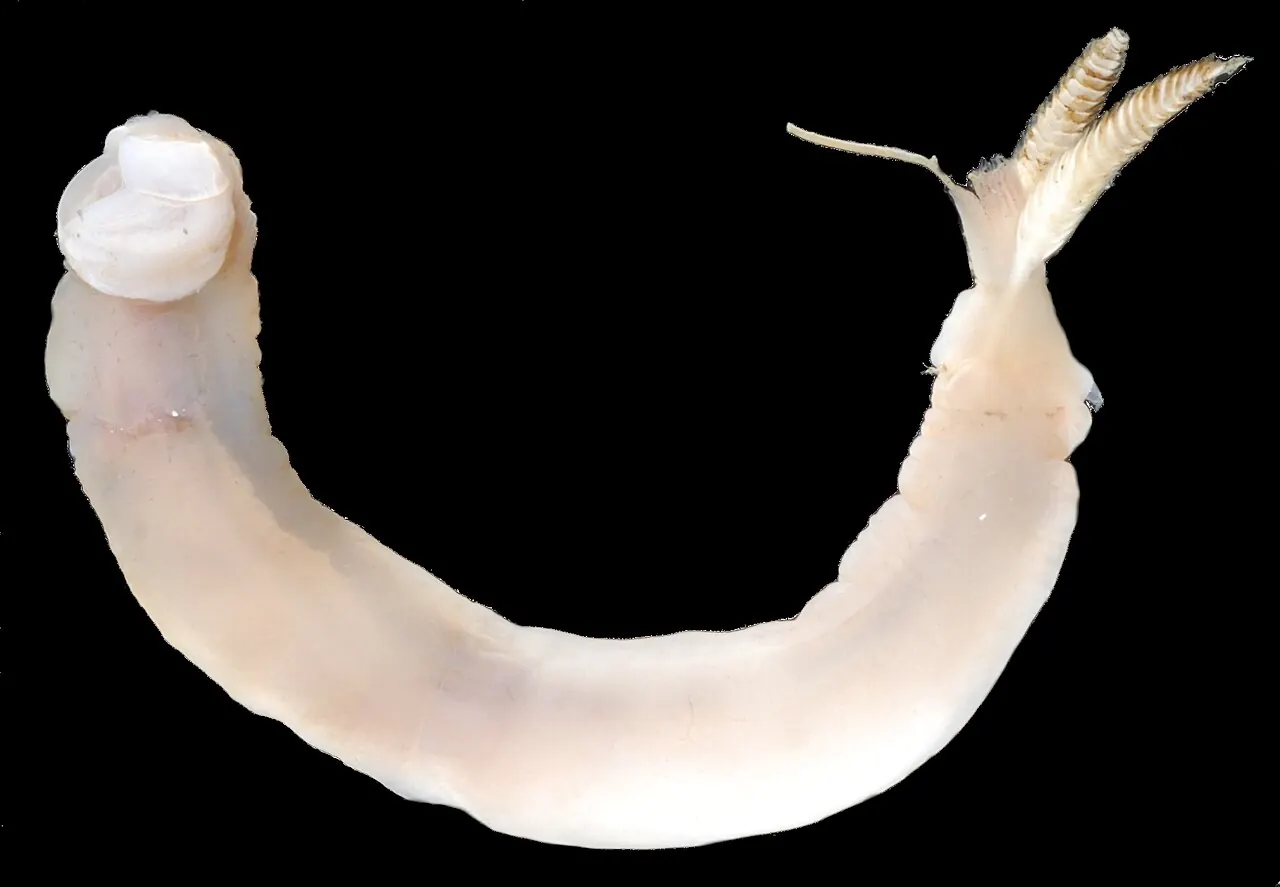
Shipworm
Family Teredinidae (18 genera as of 2019, including Teredo, Bankia and Kuphus)
Clams with tiny drilling shells and long, worm-like bodies that tunnel through wood, and once did heavy damage to San Francisco Bay's waterfront.
Photo: Robert Aguilar, Smithsonian Environmental Research Center / CC BY 2.0
3 things to know
- A shipworm is a clam whose two small shells work as a drill at the front of a long, soft body.
- In the 1920s, Teredo navalis caused an estimated $615 million in damage (in 1992 dollars) in San Francisco Bay.
- One Philippine species, described in 2019, bores into limestone and swallows the rock.
- Scientific name
- Family Teredinidae (18 genera as of 2019, including Teredo, Bankia and Kuphus)
- Depth
- 0 m – 20 m
0 – 66 ft - Size
- Teredo navalis usually reaches a maximum of about 37–60 cm (15–24 in); the giant shipworm Kuphus polythalamius up to 155 cm (5 ft)
- Weight
- Not well known
- Lifespan
- Not well known
- Diet
- Wood, digested with help from bacteria in the gills, plus plankton filtered from the water; the giant shipworm relies on sulfur bacteria instead
- Where
- Teredo navalis alone is recorded in temperate to tropical waters of the Pacific and Atlantic, the Baltic and the Mediterranean, and is established on both US coasts
- IUCN status
- Not Evaluated (for the species we checked)
- Depth zones
- Sunlight
Despite the name, a shipworm is a clam. Its two shell valves are tiny, up to about 2 centimeters (0.8 inch) in the naval shipworm, Teredo navalis, and they sit at the front of a long, soft, worm-like body, where they work as a rasp. The animal bores by rocking the valves to grind away wood fibers, and it lines its burrow with a chalky tube. Two siphons at the rear reach out to the water, and when they pull in, a pair of hard, paddle- or feather-shaped plates called pallets, found in no other family, plugs the entrance.
Shipworms swallow the wood they scrape away. Bacteria living in special cells in their gills supply enzymes that digest it, and at least one species has been shown to grow and breed with wood as its only food, according to Daniel Distel's team at Northeastern University. They also filter plankton from the water, and a 2013 study by Paalvast and van der Velde suggested that plankton may supply most of their nutrition.
That appetite makes them pests of piers, pilings and wooden boats. Teredo navalis, whose native home is unknown, usually lives in the top 20 meters (66 feet) but has been found to 150 meters (490 feet). It was first reported on the US West Coast in 1913 at Mare Island in San Pablo Bay, and by 1920 it had badly damaged wooden structures around much of San Francisco Bay. The Smithsonian's invasive species database puts the cost of that 1920s outbreak at an estimated $615 million in 1992 dollars. In New York Harbor, pollution once kept shipworms out; cleaner water brought them back, and the city planned to spend $200 million over several decades to encase and protect its piers.
Not every shipworm eats wood. The giant shipworm, Kuphus polythalamius of the Philippines, reaches 155 centimeters (5 feet), the greatest length of any living bivalve, and burrows into organic-rich mud. In 2017, Distel and colleagues reported that it lacks the wood-storing pouch of other shipworms and instead relies on gill bacteria that draw energy from hydrogen sulfide. Two years later, the same group described Lithoredo abatanica from the Abatan River on the island of Bohol, a freshwater shipworm that bores into limestone and swallows the rock as it goes. None of the shipworms we checked has been assessed by the IUCN.
Sources
- sealifebase.se/summary/Teredo-navalis.html
- invasions.si.edu/nemesis/species_summary/81862
- Study: doi:10.1073/pnas.1620470114
- pmc.ncbi.nlm.nih.gov/articles/PMC5422788
- Study: doi:10.1098/rspb.2019.0434
- pmc.ncbi.nlm.nih.gov/articles/PMC6599978
- api.gbif.org/v1/species/2288847/iucnRedListCategory
- api.gbif.org/v1/species/4948619/iucnRedListCategory



