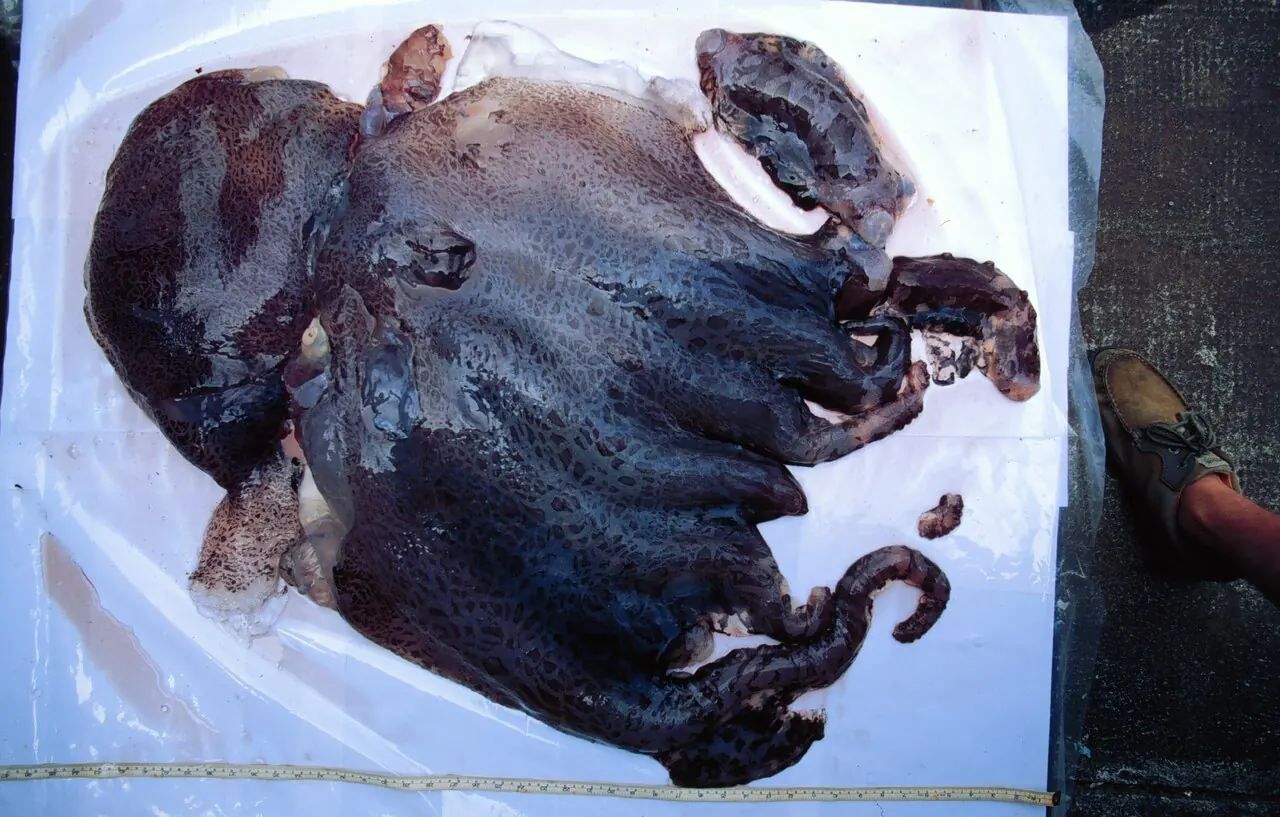
Seven-Arm Octopus
Haliphron atlanticus
A giant, jelly-bodied octopus of the open ocean that feeds on jellyfish. Males hide one arm, so they seem to have seven.
Photo: João Manuel Gonçalves Cabral / CC BY 4.0
3 things to know
- Males keep the arm used for mating coiled in a sac beneath the right eye, so they appear seven-armed.
- Females may reach about 4 m (13 ft) and 75 kg (165 lb).
- A robot filmed one holding an egg-yolk jelly with its beak pushed through the bell.
- Scientific name
- Haliphron atlanticus
- Depth
- 0 m – 1,200 m
0 – 3,937 ft - Size
- Females up to about 4 m (13 ft) long; males much smaller
- Weight
- Females may reach about 75 kg (165 lb)
- Lifespan
- Unknown
- Diet
- Jellyfish, salps and other gelatinous animals
- Where
- Tropical and temperate waters worldwide, often near continental slopes
- IUCN status
- Least Concern
- Depth zones
- Sunlight · Twilight · Midnight
Count the arms on a male Haliphron atlanticus and you will probably get seven. The eighth, the arm a male uses to pass sperm, develops coiled up in a sac beneath his right eye, where thick, jelly-like tissue hides it. In 1929 one such male was even described as a new genus and species, Heptapus danae, on the strength of its apparent seven arms, the Tree of Life Web Project notes. The hidden arm breaks off at mating.
Females are giants. MBARI gives them a length of up to 4 meters (13 feet) and a weight of up to 75 kilograms (165 pounds), which puts the species among the largest octopuses; males are much smaller. The body is soft and gelatinous, with a short, broad mantle, large eyes and short arms joined by a deep web. In 2002 Steve O'Shea of New Zealand's National Institute of Water and Atmospheric Research reported an incomplete specimen, trawled off the Chatham Islands, that still measured 2.6 meters (8.5 feet); he said it could have been a meter longer intact. His 2004 description called it the first validated record of Haliphron from the South Pacific and possibly the largest specimen of the species known.
It lives in tropical and temperate waters worldwide, from the surface to about 1,200 meters (3,900 feet), often near continental slopes, and has turned up in bottom trawls as deep as 3,173 meters. Its diet was long a guess. In July 2013 an MBARI remotely operated vehicle filmed a large female holding an egg-yolk jelly that had lost its oral arms and most of its tentacles; the octopus seemed to have bitten through the bell from outside. Henk-Jan Hoving and Steven Haddock then examined five museum specimens in Hamburg and found remains of gelatinous animals in all five: jellies, a siphonophore and a chain of salps. MBARI suggests the octopus may keep the stinging tentacles for defense.
Sperm whales, blue sharks and swordfish eat it in turn. Females are reported to brood their eggs near the mouth, though Hoving and Haddock wrote that one large female seen by an MBARI robot with a yellow mass in her arms, thought to be brooding, may have to be reinterpreted in light of their jelly-eating observation. MBARI has met the species only four times in nearly 40 years of robot dives. The IUCN lists it as Least Concern, from a 2014 assessment.
Sources
- mbari.org/animal/seven-arm-octopus
- tolweb.org/Haliphron_atlanticus/20200
- Study: doi:10.1038/srep44952
- pmc.ncbi.nlm.nih.gov/articles/PMC5366804
- Study: doi:10.1080/03014223.2004.9518353
- nzherald.co.nz/nz/chathams-find-is-biggest-octopus-ever/NPNRPLOOZSJMDIUFMIHJX5V2ZM
- sealifebase.se/summary/Haliphron-atlanticus.html
- iucnredlist.org/species/163207/983527
- Study: doi:10.2305/IUCN.UK.2014-3.RLTS.T163207A983527.en



