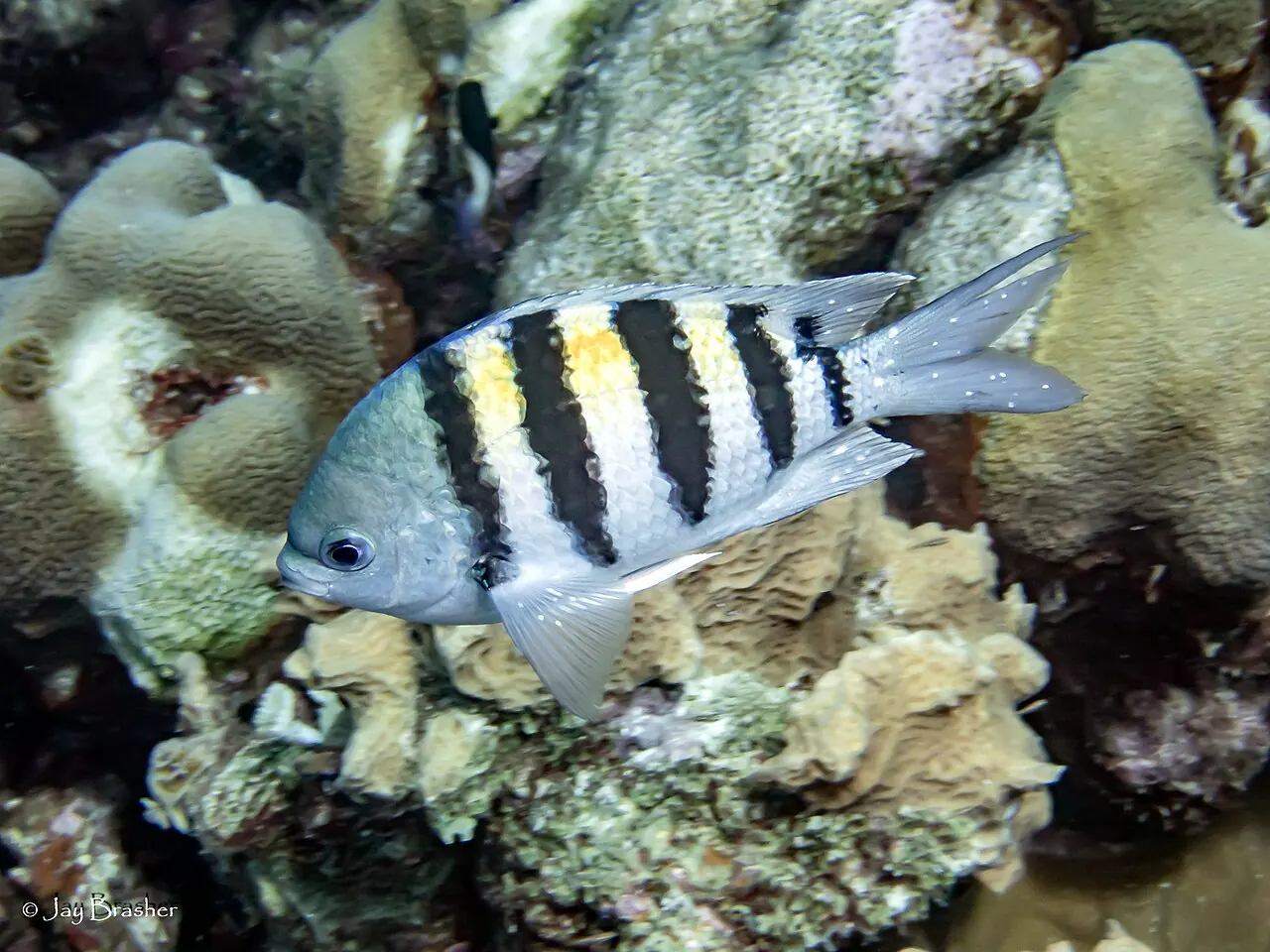
Sergeant Major
Abudefduf saxatilis
A striped Atlantic damselfish that schools over shallow reefs, guards its eggs, and has been seen eating spinner dolphin waste.
Photo: Jay Brasher / CC BY 4.0
3 things to know
- Its five black bars are named for the stripes on a military sleeve.
- Males turn dark bluish while they guard their eggs.
- In Brazil it has been recorded feeding on spinner dolphins' feces and vomit.
- Scientific name
- Abudefduf saxatilis
- Depth
- 0 m – 15 m
0 – 49 ft - Size
- Up to about 23 cm (9 in) long
- Weight
- Up to about 200 g (7 oz)
- Lifespan
- Unknown
- Diet
- Algae, plankton, small crustaceans, invertebrate larvae and small fish
- Where
- Atlantic: Rhode Island to Uruguay in the west, abundant in the Caribbean; mid-Atlantic islands; West Africa from Cape Verde to Angola
- IUCN status
- Least Concern
- Depth zones
- Sunlight
Five black bars on a silvery body, with a yellow wash across the back, give the sergeant major its name, after the stripes on a military sleeve. It is a damselfish, small and deep-bodied, reaching about 23 centimeters (9 inches) and 200 grams (7 ounces). Over sand or open reef it keeps this pale look. Hiding in a cave or crevice it turns dark gray or bluish, sometimes dark enough to hide the bars, and males take on the same bluish shade while they guard eggs.
It is strictly an Atlantic fish. In the west it ranges from Rhode Island to Uruguay and is abundant on Caribbean reefs; it also lives around mid-Atlantic islands and along West Africa from Cape Verde to Angola. In the Indo-Pacific a close relative, Abudefduf vaigiensis, takes its place. Adults gather over shallow reef tops in feeding schools of up to several hundred, mostly within 15 meters (50 feet) of the surface, while juveniles live in tide pools, mangroves and drifting sargassum. One has even turned up in the Mediterranean: a recreational diver photographed it off Tarragona, Spain, in August 2009, and Ernesto Azzurro and colleagues published it in 2013 as the first record for that sea.
Sergeant majors eat almost anything small, including algae, plankton, small crustaceans, invertebrate larvae and small fish. Some meals are less ordinary. FishBase, drawing on studies at Brazil's Fernando de Noronha archipelago, records them feeding on the feces and vomit of spinner dolphins. Juveniles have also been recorded cleaning green sea turtles, grazing algae and nipping molted skin and parasites, most often from the flippers. They are attracted to divers who feed fish.
Breeding is a male job after spawning. A male prepares a nest site on rock, a shipwreck, a piling or a reef outcrop, and the female lays eggs that stick to the surface by an adhesive filament. He guards and aerates them until they hatch, about 155 to 160 hours (six and a half days) after fertilization, according to the Florida Museum.
The species is taken in small fisheries and sold fresh, and it is shown in public aquariums. The IUCN lists it as Least Concern, from a 2010 assessment.



