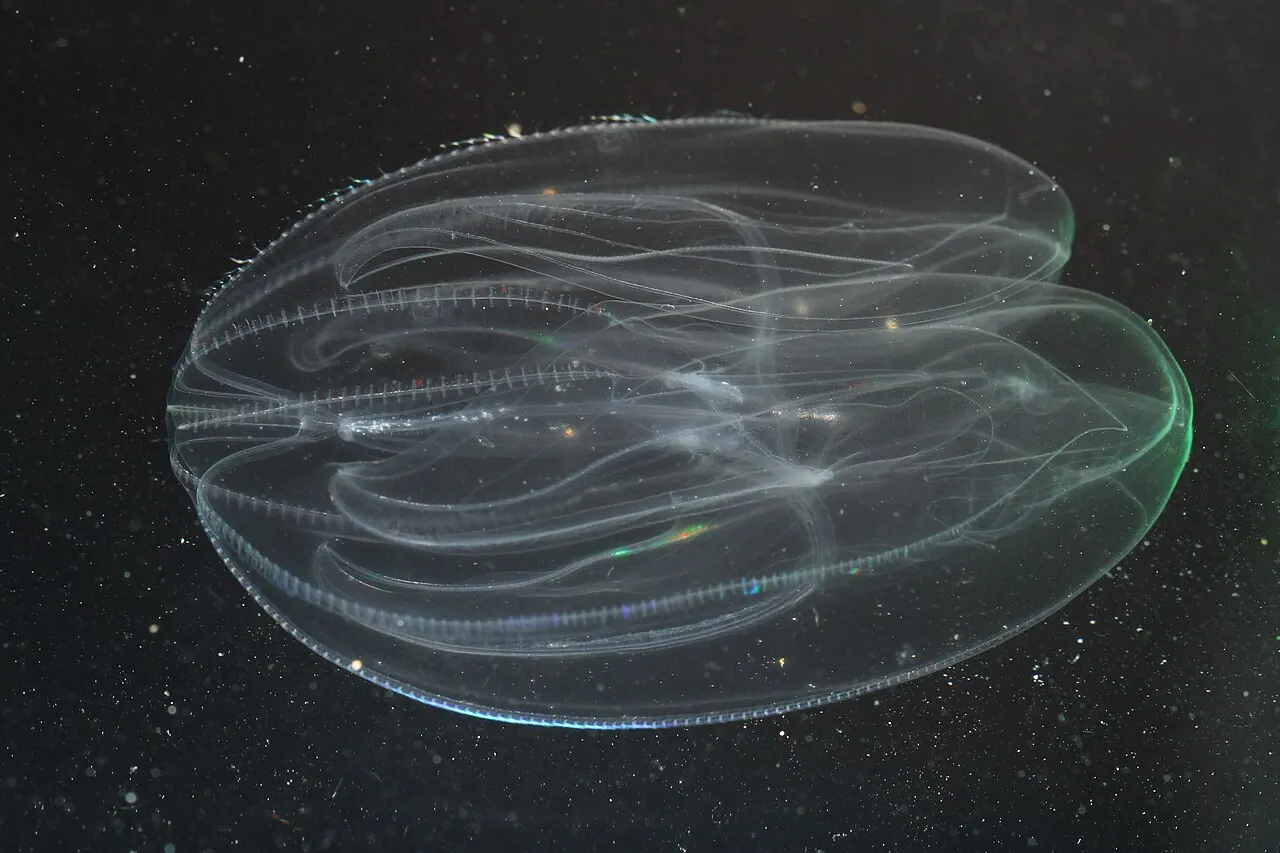
Sea Walnut
Mnemiopsis leidyi
A see-through comb jelly from US Atlantic waters that devastated the Black Sea as an invader and can turn itself back into a juvenile.
Photo: Holger Krisp / CC BY 3.0
3 things to know
- It is a comb jelly, or ctenophore, and has no stinging cells.
- Its anal pore appears only when it defecates, then closes over again.
- Some stressed adults have reverted to the juvenile form and grown up a second time.
- Scientific name
- Mnemiopsis leidyi
- Depth
- 5 m – 200 m
16 – 656 ft - Size
- About 8–13 cm (3–5 in) long; SeaLifeBase lists up to 18 cm (7 in)
- Weight
- Not well known
- Lifespan
- Thought to be weeks to months in the wild
- Diet
- Zooplankton, including copepods, fish eggs and fish larvae
- Where
- Native to the western Atlantic, from Buzzards Bay on the US East Coast through the Gulf of Mexico and Caribbean to Argentina; invasive in the Black, Caspian, Mediterranean and North seas
- IUCN status
- Not Evaluated
- Depth zones
- Sunlight
A sea walnut has no stinging cells at all. It is a comb jelly, or ctenophore, a separate phylum from true jellyfish. Its clear, walnut-shaped body carries eight rows of tiny hairs, the combs, which beat to drive it along and scatter light into moving rainbows. Adults have two large lobes, no tentacles, and grow to about 10 centimeters (4 inches). Disturb one at night and it lights up green; the Virginia Institute of Marine Science says sea walnuts are often seen flashing in boat wakes.
The species is native to the western Atlantic, from Buzzards Bay on the US East Coast through the Gulf of Mexico and the Caribbean to Argentina. It is very common in most of Chesapeake Bay year-round, living near the surface in shallow and deep water. SeaLifeBase gives a depth range of 5 to 200 meters (16 to 660 feet). It eats zooplankton, fish eggs and fish larvae, and the Chesapeake Bay Program says the bay's comb jellies can eat almost 500 copepods an hour. Each has both male and female organs and can fertilize itself, releasing about 8,000 eggs at a time, and the young can breed 13 days after hatching.
In the early 1980s it reached the Black Sea, probably in ships' ballast water, and was first reported there in 1982. Its numbers peaked in 1988 and 1989, as the pelagic fishery, led by anchovy, fell sharply. Ahmet Kideys and colleagues, writing in Oceanography in 2005, blamed the comb jelly for much of that, though others point to overfishing and climate. Numbers dropped after Beroe ovata, a comb jelly that eats other comb jellies, arrived in the late 1990s. The sea walnut has also become invasive in the Caspian, Mediterranean and North seas.
In 2019 Sidney Tamm reported that its anal pore is not a permanent opening. It appears when the animal defecates, about every 10 minutes in small larvae and about once an hour in large adults, and then disappears. In 2024 Joan Soto-Angel and Pawel Burkhardt of the University of Bergen in Norway starved or injured adults and then fed them, and 13 of 65 shrank back into the tentacled juvenile form before growing up again. Until then, the "immortal jellyfish," Turritopsis dohrnii, was the only species known to reverse its development after reaching sexual maturity. It has not been assessed for the IUCN Red List.
Sources
- sealifebase.se/summary/Mnemiopsis-leidyi.html
- chesapeakebay.net/discover/field-guide/entry/comb_jellies
- vims.edu/bayinfo/jellyfish/guide/mnemiopsis.php
- mbl.edu/research/research-organisms/comb-jelly
- tos.org/oceanography/assets/docs/18-2_kideys.pdf
- Study: doi:10.1101/511576
- Study: doi:10.1111/ivb.12236
- Study: doi:10.1073/pnas.2411499121
- pmc.ncbi.nlm.nih.gov/articles/PMC11551415
- api.gbif.org/v1/species/2501248/iucnRedListCategory



