Sea Sapphire
Sapphirina spp. (family Sapphirinidae)
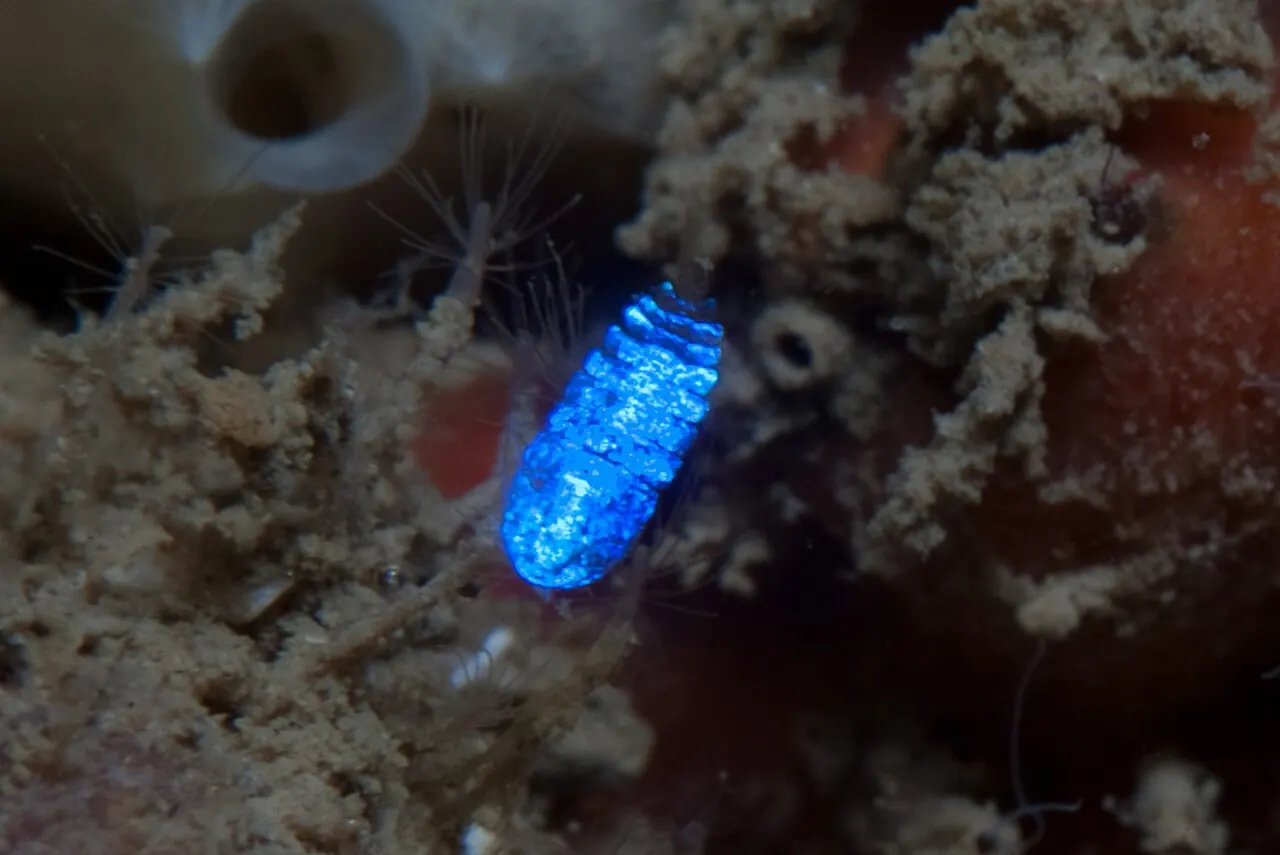
A tiny copepod whose males glitter blue, gold or violet from stacked crystals in their skin, and can vanish from view by turning at an angle.
Photo: seastung / CC BY-SA 4.0
3 things to know
- Sea sapphires are copepods, a group of tiny crustaceans.
- Only the males shine; the females are transparent.
- Tilted about 45 degrees to the light, some blue males reflect ultraviolet instead and seem to disappear.
- Scientific name
- Sapphirina spp. (family Sapphirinidae)
- Depth
- 0 m – 200 m
0 – 656 ft - Size
- About 1 mm to several mm long; genus averages about 2.5 mm (females) and 2.8 mm (males)
- Weight
- Not well known
- Lifespan
- Unknown
- Diet
- Lives in or on salps and doliolids; adults of one species prey on doliolids, eating their internal tissues
- Where
- Tropical and subtropical open ocean; also seen off South Africa, California and Rhode Island
- IUCN status
- Not Evaluated
- Depth zones
- Sunlight
A sea sapphire is a copepod, one of the tiny crustaceans that crowd the ocean's plankton, and the males of the genus Sapphirina flash blue, violet, gold or green depending on the species. Most are between a millimeter and a few millimeters long. The females are transparent.
The color is structural. In 2015, Dvir Gur, Lia Addadi, Steve Weiner and colleagues at Israel's Weizmann Institute of Science reported in the Journal of the American Chemical Society that a male's back holds stacked layers of thin, transparent crystals of guanine, the same compound that serves as one of the bases in DNA. Light bouncing off the evenly spaced layers interferes with itself, and the spacing sets the hue: the closer the plates, the bluer the reflection. Rebecca Helm, then at Brown University, put the gap in a blue sea sapphire at about four ten-thousandths of a millimeter, close to the wavelength of blue light.
The same structure lets some of them vanish. When males of certain species tilt their backs about 45 degrees to the light during a spiraling swim, the reflected light shifts out of the visible range into ultraviolet, and a blue animal turns nearly invisible. The Weizmann team suggested this could help males dodge predators while still showing off to females or rivals.
Sea sapphires live mainly in the upper 200 meters (660 feet) of tropical and subtropical seas. In plankton samples from the eastern Indian Ocean, the South China Sea and the western Pacific, Jinho Chae and Shuhei Nishida found that several species move up by day and down at night, the reverse of the usual pattern, and proposed that daylight, the males' iridescence and the copepods' well-developed eyes work together as a way of finding mates. Helm has seen them off Rhode Island and California, and she writes that Japanese fishermen once called water sparkling with them tama-mizu, jeweled water.
Females make their homes inside salps, barrel-shaped gelatinous animals, while males swim free. Adults of one species, Sapphirina nigromaculata, hunt doliolids. Around the Kuroshio Extension in the northwest Pacific, a team led by Kazutaka Takahashi watched them enter doliolids' body cavities and eat the inner tissues, leaving telltale bite marks, and found young copepods clinging to doliolid chains. No sea sapphire species has been assessed by the IUCN.
Sources
- eurekalert.org/news-releases/522153
- sciencedaily.com/releases/2015/09/150902102314.htm
- Study: doi:10.1021/jacs.5b05289
- theconversation.com/sea-sapphire-the-most-beautiful-animal-youve-never-seen-23750
- copepodes.obs-banyuls.fr/en/fichefam.php
- Study: doi:10.3354/meps119111
- int-res.com/abstracts/meps/v119/p111-124
- Study: doi:10.1017/S0025315498000563
- Study: doi:10.4319/lo.2013.58.6.1972
- api.gbif.org/v1/species/2110654/iucnRedListCategory



