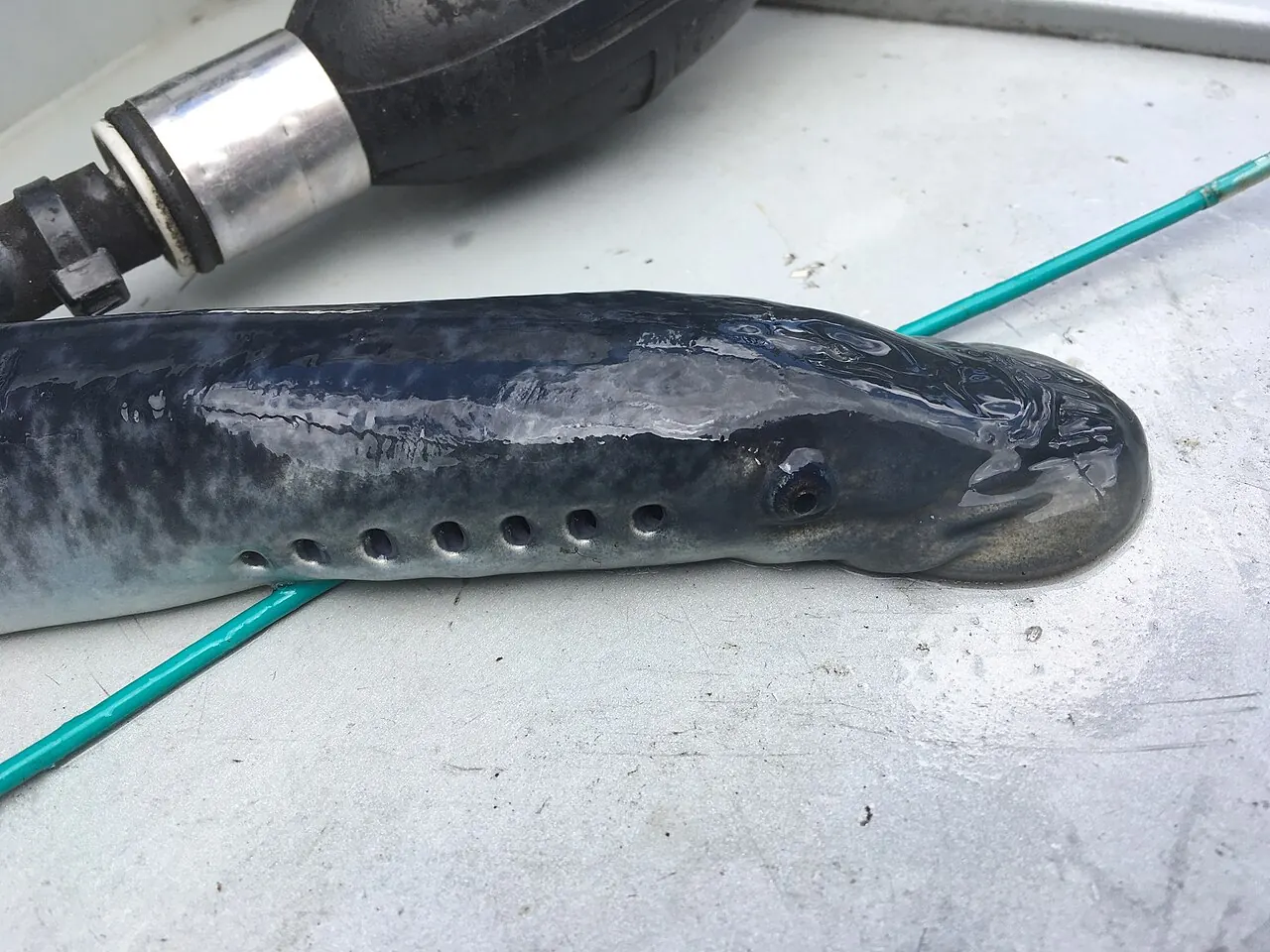
Sea Lamprey
Petromyzon marinus
A jawless, blood-feeding fish with a sucker mouth full of teeth. Native to the Atlantic, it invaded the Great Lakes and wrecked their fisheries.
Photo: brendanboyd / CC BY 4.0
3 things to know
- It has no jaws: it clamps on with a round sucking disk full of horn-shaped teeth and rasps through skin with its tongue.
- In the Great Lakes, a single sea lamprey can kill up to 40 pounds of fish during its 12 to 18 months of feeding.
- In a Gulf of Maine video survey, 40 of the 46 juvenile sea lampreys seen were riding on Atlantic mackerel.
- Scientific name
- Petromyzon marinus
- Depth
- 32 m – 133 m
105 – 436 ft - Size
- Most adults 60–75 cm (24–30 in); up to 120 cm (47 in). Landlocked Great Lakes adults reach about 60 cm (24 in)
- Weight
- Up to about 2.5 kg (5.5 lb)
- Lifespan
- Several years, most of them as a burrowing larva: usually at least 5 years in streams, then about 2 years as a parasite before spawning once and dying
- Diet
- Larvae filter algae and detritus; adults feed on the blood and body fluids of fish and sometimes whales and dolphins
- Where
- North Atlantic: North America from Labrador to Florida, and Europe from Norway and Iceland to North Africa and the western Mediterranean; landlocked and invasive in the Great Lakes
- IUCN status
- Least Concern
- Depth zones
- Sunlight
A sea lamprey's mouth is a large round sucking disk lined with sharp, horn-shaped teeth around a rasping tongue. There are no jaws: along with the hagfishes, lampreys are the only jawless fishes alive today. The skeleton is cartilage, with no bone. The body is eel-shaped, olive or yellow-brown with dark marbling, with seven gill openings in a row behind each eye and no paired fins. Most adults are 60 to 75 centimeters (24 to 30 inches) long.
It clamps onto a fish, rasps through scales and skin, and feeds on blood and body fluids, releasing a substance that keeps the blood from clotting. At sea it also latches onto whales and dolphins. In its native Atlantic, the Great Lakes Fishery Commission says, it usually does not kill its host.
Its life begins and ends in fresh water. Larvae hatch in gravel nests in streams, then burrow into soft mud and filter-feed on algae and debris, usually for at least 5 years and sometimes for 19 or more. They then transform, grow eyes and a sucker, and head to sea. Adults return to rivers in spring to spawn once and die. Little is known about the ocean years. In a video survey of the western Gulf of Maine from 2019 to 2024, a UMass Dartmouth team led by Nicholas Calabrese saw 46 juvenile sea lampreys at 32 to 133 meters (105 to 436 feet); 45 were attached to fish, 40 of them to Atlantic mackerel. The depth range given here comes from that survey; FishBase says the species may reach 4,099 meters (13,448 feet).
In the Great Lakes, lampreys became a disaster. Improvements to the Welland Canal let them past Niagara Falls into Lake Erie by 1921 and Lake Superior by 1938. There, the commission says, a single lamprey can kill up to 40 pounds (18 kilograms) of fish. Along with overfishing and pollution, they helped cut the upper lakes' lake trout catch from about 15 million pounds a year to about 300,000 pounds by the early 1960s. Since the late 1950s the lampricide TFM, along with barriers and traps, has kept their numbers down.
The IUCN's 2022 global assessment lists the species as Least Concern, with a decreasing population.



