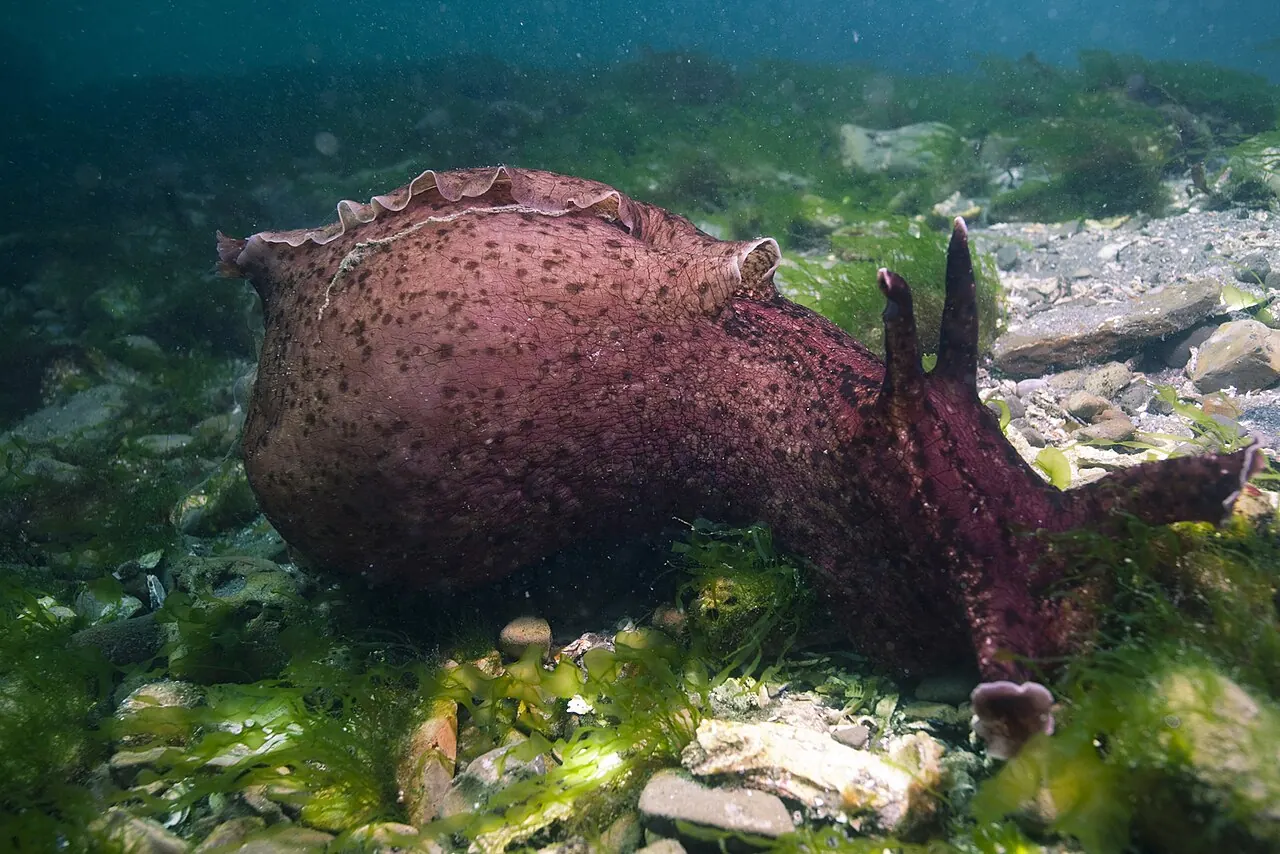
California Sea Hare
Aplysia californica
A big, seaweed-eating sea slug of the California coast that squirts purple ink and helped a Nobel laureate work out how memories form.
Photo: Chad King / NOAA MBNMS / Public domain
3 things to know
- Its nervous system has only about 20,000 nerve cells, many of them unusually large.
- When attacked, it releases purple ink and a sticky white secretion called opaline.
- Most live about a year and die after breeding.
- Scientific name
- Aplysia californica
- Depth
- 0 m – 18 m
0 – 59 ft - Size
- Usually about 20 cm (8 in) long; up to about 40 cm (16 in)
- Weight
- Usually about 1 kg (2.2 lb); SeaLifeBase gives a maximum published weight of 6.8 kg (15 lb)
- Lifespan
- About 1 year; most die after breeding
- Diet
- Seaweeds, mainly red algae, plus green algae such as Ulva
- Where
- Pacific coast from Humboldt Bay, California, to Baja California and the Gulf of California, Mexico
- IUCN status
- Not Evaluated
- Depth zones
- Sunlight
Two tall tentacles on its head, a little like a rabbit's ears, gave this slug its name. The California sea hare is a heavy, soft-bodied mollusk, usually about 20 centimeters (8 inches) long and 1 kilogram (2.2 pounds), and sometimes as long as 40 centimeters (16 inches); SeaLifeBase gives a maximum published weight of 6.8 kilograms (15 pounds). Its shell is a thin, flat plate hidden inside the body, and two wing-like flaps on its back, the parapodia, cover its gill.
It lives along the coast from Humboldt Bay in northern California to Baja California and the Gulf of California, most abundantly on sheltered rocky shores. Adults stay mainly in the middle and lower intertidal zone, while juveniles live deeper, down to about 18 meters (59 feet). It grazes seaweed, mostly red algae, and pigments from that diet tint both its mottled reddish-brown skin and its ink.
Pestered by a predator, it releases two secretions, a purple ink and a whitish, sticky one called opaline. In 2005, Cynthia Kicklighter, Charles Derby and colleagues at Georgia State University reported in Current Biology that against spiny lobsters the mixture works partly by deception. Its amino acids switch on the lobster's feeding responses, so the lobster attends to a false meal, while the sticky secretion overloads its chemical and touch senses. The authors called this phagomimicry.
Its nerve cells made it famous. Eric Kandel of Columbia University turned to Aplysia because its nervous system has relatively few cells, about 20,000 by the Nobel committee's count, and many of them are large enough to study one at a time. Working on a simple reflex that protects the gill, he showed that learning changes the strength of the connections between nerve cells and that long-term memory requires new proteins. He shared the 2000 Nobel Prize in Physiology or Medicine. The NIH-funded National Aplysia Resource at the University of Miami still raises sea hares for scientists and teachers.
Each sea hare is both male and female. In spring and summer they gather to mate, sometimes in a daisy chain in which each animal receives sperm from the one behind while passing sperm to the one in front. The eggs are laid in long pink strings that can hold millions of embryos, which hatch after about 12 days. Most sea hares live about a year and die after breeding. The IUCN has not assessed the species.
Sources
- animaldiversity.org/accounts/Aplysia_californica
- aplysia.earth.miami.edu/biology-and-production-of-aplysia/biological-description/index.…
- aplysia.earth.miami.edu/mission-and-scientific-importance/mission/index.html
- sealifebase.se/summary/Aplysia-californica.html
- Study: doi:10.1016/j.cub.2005.01.057
- nature.com/articles/laban.310
- nobelprize.org/prizes/medicine/2000/press-release
- api.gbif.org/v1/species/5191261/iucnRedListCategory



