Sea Gooseberry
Pleurobrachia pileus
A grape-sized comb jelly that fishes with two long sticky tentacles, and whose Pacific cousin's genome reopened a debate about the first animals.
Photo: Vsevolod Rudyi / CC BY 4.0
3 things to know
- It is a comb jelly, or ctenophore, and has no stinging cells.
- Its two fishing tentacles stretch to 15 to 20 times its body length and pull all the way back inside.
- Until the 1980s it was the only comb jelly in the Black Sea.
- Scientific name
- Pleurobrachia pileus
- Depth
- 0 m – 170 m
0 – 558 ft - Size
- Body 1–2.5 cm (0.4–1 in) high; two tentacles up to 50 cm (20 in) long
- Weight
- Unknown
- Lifespan
- Unknown
- Diet
- Zooplankton, especially copepods
- Where
- Temperate to polar waters; common around Britain and Ireland, and recorded from the Black Sea
- IUCN status
- Not Evaluated
- Depth zones
- Sunlight
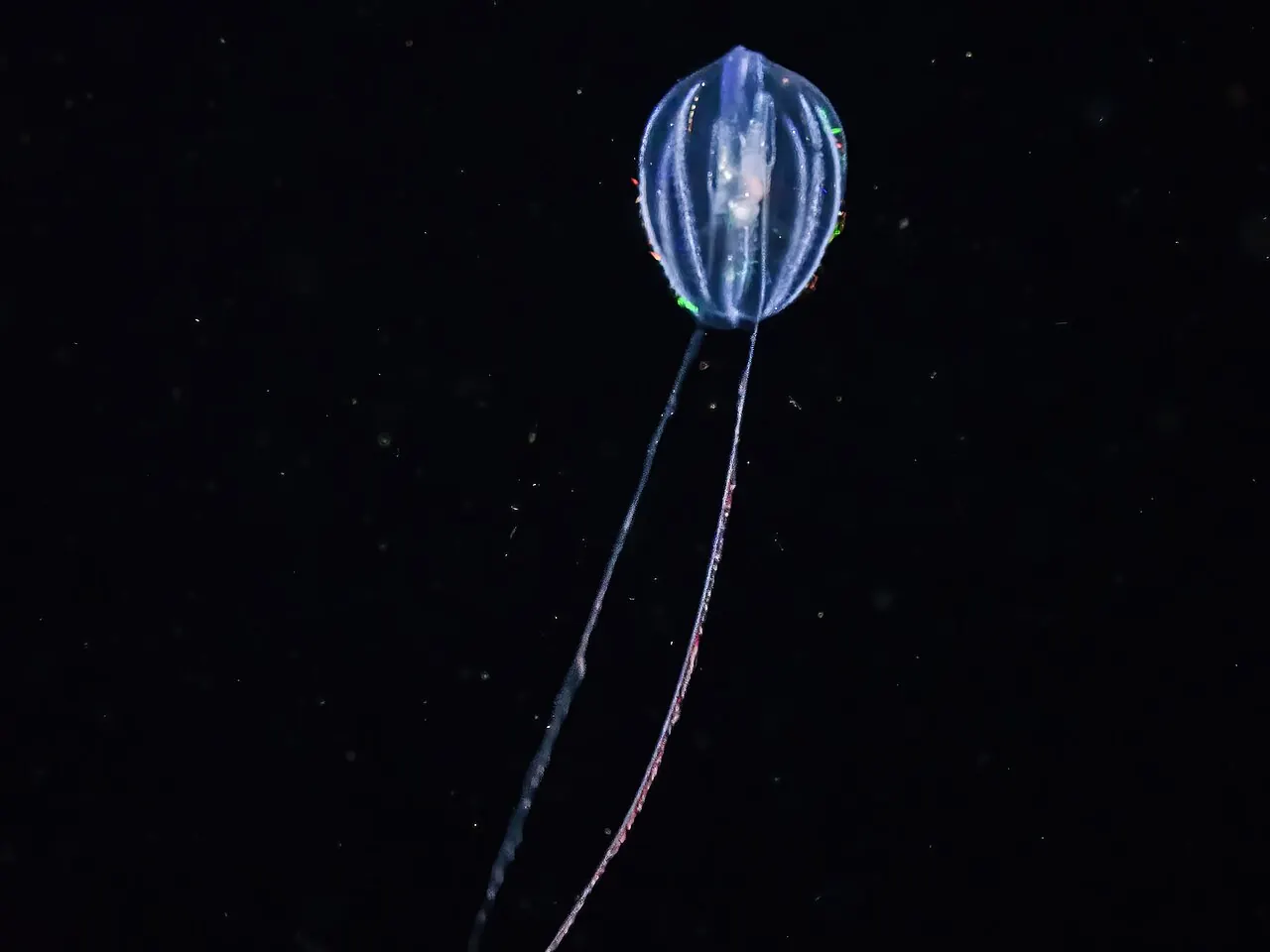
About the size of a grape, the sea gooseberry is a comb jelly with a clear, oval to round body 1 to 2.5 centimeters (0.4 to 1 inch) high, lined with eight rows of beating combs that give it a shimmering look. Comb jellies, or ctenophores, form their own phylum, separate from jellyfish, and do not sting. Instead, two long fishing tentacles, 15 to 20 times the length of the body and up to 50 centimeters (20 inches), trail behind it with side filaments, and they carry sticky cells called colloblasts that glue prey in place. Each tentacle can be pulled completely back into the body. It eats zooplankton, especially copepods.
Pleurobrachia pileus is common in open coastal water around Britain and Ireland, most abundant there in summer and late autumn, and sometimes gets trapped in tide pools. SeaLifeBase lists it from temperate to polar waters and gives a depth range of 0 to 170 meters (560 feet). It migrates daily, gathering near the surface at night. Each animal is a hermaphrodite, and its eggs hatch into small juveniles that gradually take on the adult form. Until the early 1980s it was the only comb jelly in the Black Sea, before the sea walnut arrived. On the US East Coast, a Pleurobrachia sea gooseberry is a rare spring visitor to Chesapeake Bay.
A Pacific relative put the genus at the center of an old argument. In 2014, Leonid Moroz of the University of Florida's Whitney Laboratory and colleagues published a draft genome of Pleurobrachia bachei, the Pacific sea gooseberry, from animals collected at the University of Washington's Friday Harbor Laboratories. Many genes that build nerve cells in other animals were missing, or were not used in its neurons, and the team proposed that comb jellies evolved nervous systems separately from the rest of the animal kingdom. They also placed comb jellies as the earliest branch of the animal family tree. Whether that place belongs to comb jellies or sponges stayed disputed. In 2023, Darrin Schultz, Steven Haddock and colleagues wrote that conventional methods had not settled it, then compared the order of genes along chromosomes and concluded that comb jellies are the sister group to all other animals.
The sea gooseberry has not been assessed for the IUCN Red List.
Sources
- marlin.ac.uk/species/detail/2050
- sealifebase.se/summary/Pleurobrachia-pileus.html
- vims.edu/bayinfo/jellyfish/guide/sea_gooseberry.php
- tos.org/oceanography/assets/docs/18-2_kideys.pdf
- Study: doi:10.1038/nature13400
- pmc.ncbi.nlm.nih.gov/articles/PMC4337882
- Study: doi:10.1038/s41586-023-05936-6
- api.gbif.org/v1/species/2501136/iucnRedListCategory



