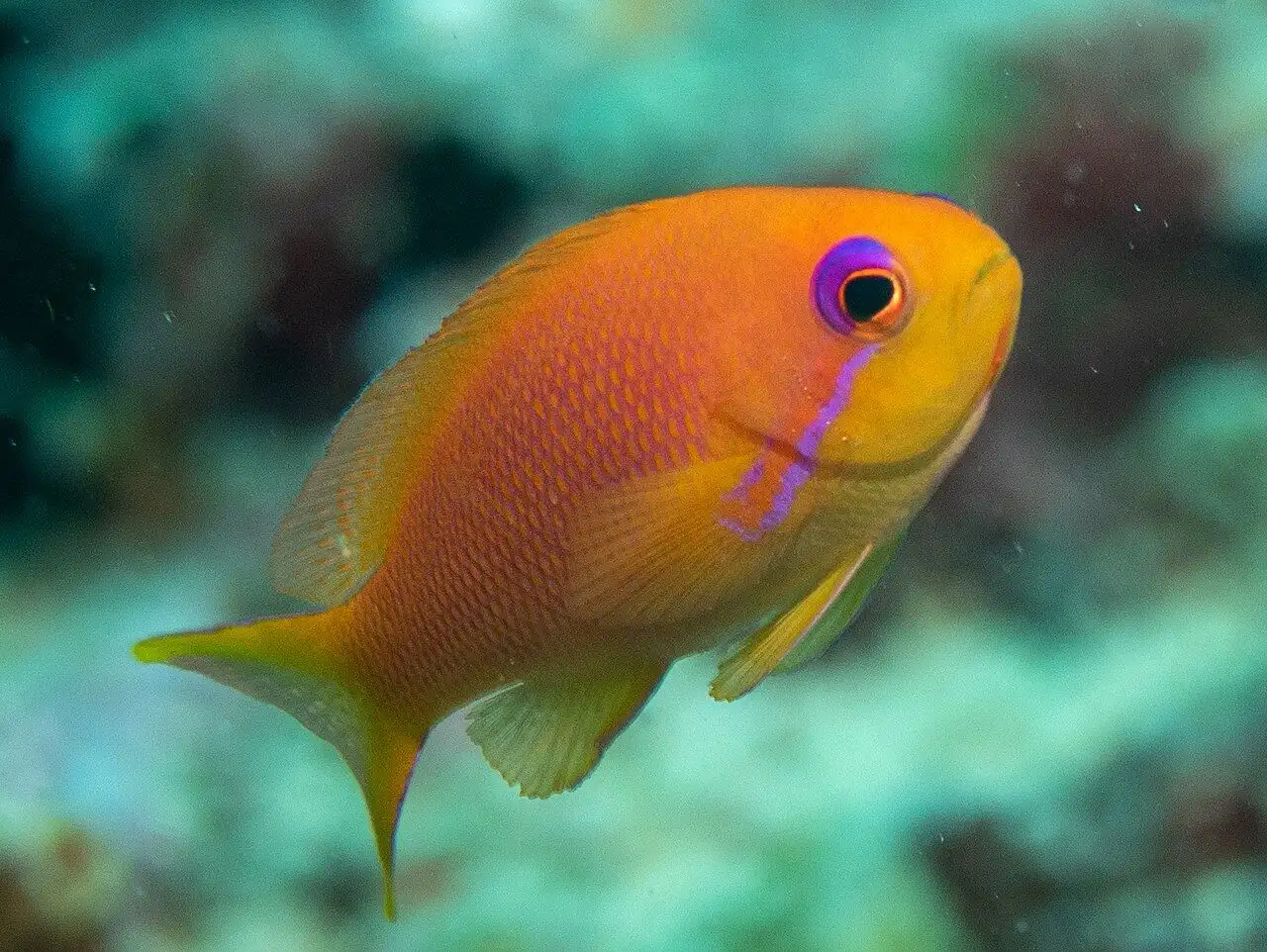
Sea Goldie
Pseudanthias squamipinnis
A small orange reef fish that lives in harems, where a female turns into a male when the group loses one.
Photo: Storm Martin / CC BY 4.0
3 things to know
- Females are golden-orange, while males are purplish-pink with an extra-long third ray in the dorsal fin.
- When males were removed from groups in a 1980 experiment, females changed into males one after another, about two days apart.
- Successful males spawn every night with one female after another.
- Scientific name
- Pseudanthias squamipinnis
- Depth
- 5 m – 35 m
16 – 115 ft - Size
- Males up to 15 cm (6 in); females up to about 7 cm (2.8 in)
- Weight
- Unknown
- Lifespan
- Not well known
- Diet
- Zooplankton picked from the water above the reef
- Where
- Indo-West Pacific, from the Red Sea and South Africa east to Niue, north to Japan and south to Australia
- IUCN status
- Least Concern
- Depth zones
- Sunlight
Sea goldies, also known as lyretail or scalefin anthias, hover in clouds of small orange fish above coral heads. Females are golden-orange with a violet streak from below the eye to the pectoral fin and no more than about 7 centimeters (2.8 inches) long. Males grow to 15 centimeters (6 inches). They are purplish-pink, with a red patch on the pectoral fin, an extra-long third ray in the dorsal fin and long streamers on both tips of the tail. FishBase notes that the colors vary slightly from one locality to another.
The species is listed across the Indo-West Pacific, from the Red Sea and South Africa to Niue in the South Pacific, and from Japan south to Australia. Fishes of Australia points out that some authors restrict the true sea goldie to the Western Indian Ocean and call the Australian fish Pseudanthias cheirospilos. Adults gather in large aggregations above coral outcrops and patch reefs in clear lagoons, channels and outer reef slopes, usually 5 to 35 meters (16 to 115 feet) down and sometimes to 55 meters (180 feet). They feed on zooplankton.
In this species every male was once a female. Males are territorial and keep harems, and FishBase reports that successful males spawn every night with one female after another, releasing eggs into open water. When a male disappears, one of the females changes sex and takes his place.
Douglas Shapiro showed how orderly that replacement can be. In a 1980 paper in Science, he removed three to nine males at a time from large social groups. Females replaced them almost one for one, and they did it in sequence, with an average of 1.9 days between the start of one change and the next. The timing of each fish's switch was tied to what the others in the group were doing. FishBase adds that a female completes the change in 2 to 4 weeks when a male is removed, but takes 170 to 280 days in a group made up only of females.
The IUCN lists the sea goldie as Least Concern, from a 2015 assessment, with a stable population.



