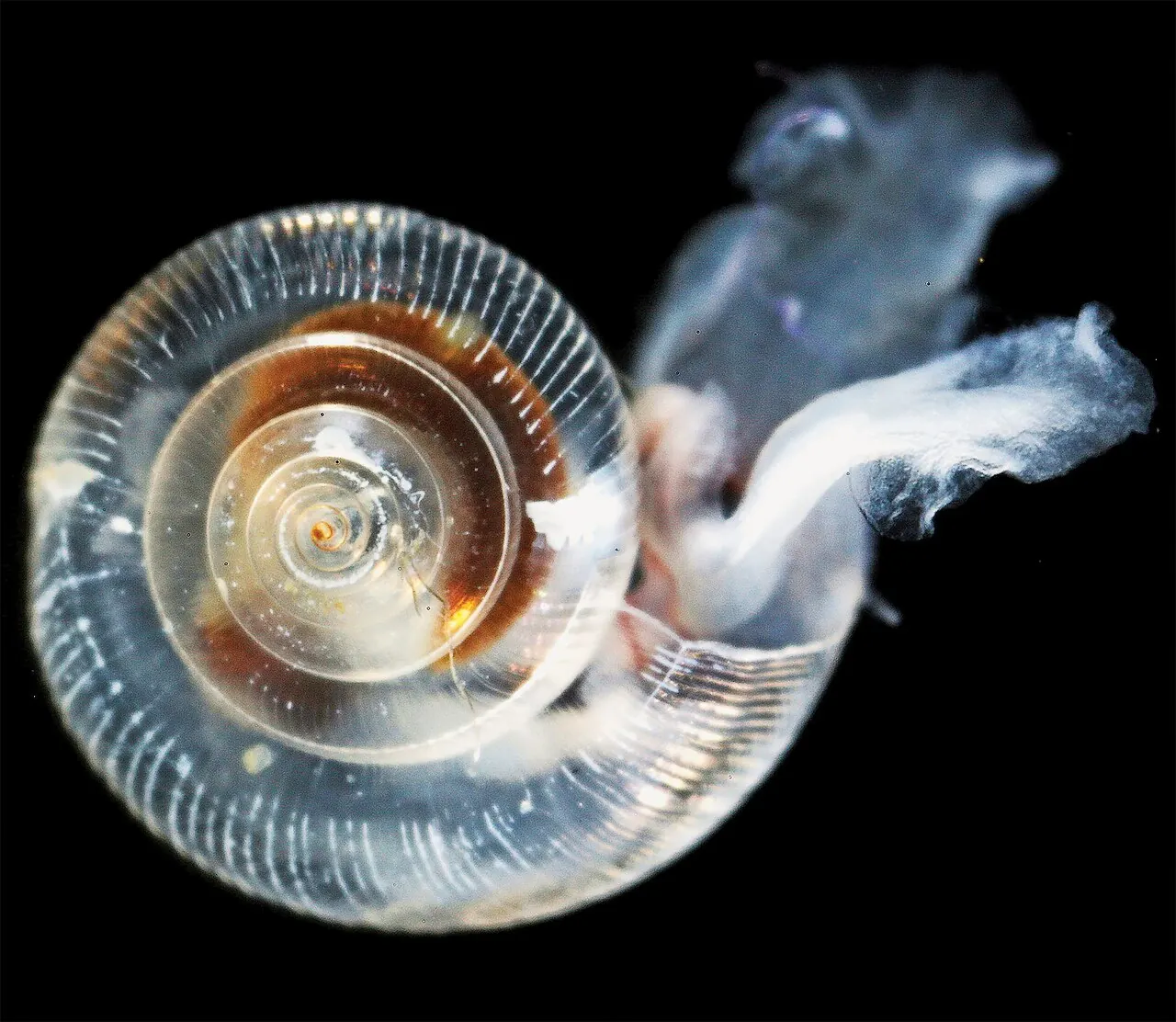
Sea Butterfly
Suborders Euthecosomata and Pseudothecosomata (order Pteropoda), many genera including Limacina
Tiny swimming sea snails that fly through the water on two wings, feed salmon and whales, and are watched closely as seawater grows more acidic.
Photo: NOAA Photo Library (NOAA Fisheries) / CC BY 2.0
3 things to know
- A sea butterfly beats its wings in a figure-eight, the way very small insects fly.
- It catches food in a sticky mucus net, then wraps up the net and eats it.
- Off the US West Coast in 2011, 53% of the sea butterflies caught near shore had severely dissolved shells.
- Scientific name
- Suborders Euthecosomata and Pseudothecosomata (order Pteropoda), many genera including Limacina
- Depth
- 0 m – 200 m
0 – 656 ft - Size
- Mostly under 1 cm (0.4 in); Limacina helicina shells are a few millimeters across
- Weight
- Not well known
- Lifespan
- Not well known
- Diet
- Small plankton such as diatoms, plus copepods and other tiny animals, caught in a mucus net
- Where
- All the world's oceans, from polar seas to the tropics
- IUCN status
- Not Evaluated (for the species we checked)
- Depth zones
- Sunlight
Sea butterflies are snails that spend their whole lives in open water, flapping two wing-like lobes, and most carry a thin, see-through shell made of aragonite, a form of calcium carbonate. Most are under a centimeter (0.4 inch) long. The Woods Hole Oceanographic Institution counts hundreds of pteropod species, sea butterflies and their relatives, in all the world's oceans; a few, such as Clio and Peracle, live in the twilight zone or deeper. A global database of pteropod net samples compiled in 2012, mostly sea butterflies, put 62% of the biomass in the top 200 meters (660 feet), though most nets sampled only that deep. Their shell-less relatives, the sea angels, include species that eat nothing but sea butterflies.
To feed, a sea butterfly spreads a sticky mucus net around its body that snags drifting particles and plankton, then wraps the net up and pushes it into a slit-like mouth. Many populations feed near the surface at night and retreat deeper by day to avoid predators. Cod and whales eat them, and in the North Pacific so do anchovy and pink, coho, chum and sockeye salmon.
In 2016, David Murphy and colleagues at Georgia Tech filmed Limacina helicina, a species about 3 millimeters long, with high-speed cameras. It swims the way very small insects fly. Its wings trace a figure-eight, and they clap together and peel apart at the start of each power stroke for extra lift. To make that stroke the snail rotates its whole body so far that the team called it hyper-pitching, and knew of no other animal that pitches that far in normal movement.
Their shells make them a test case for ocean acidification, because water that has absorbed more carbon dioxide is more corrosive to aragonite. On an August 2011 survey off Washington, Oregon and California, NOAA's Nina Bednaršek and colleagues found severe shell dissolution in 53% of sea butterflies caught near shore and 24% offshore. They estimated that this damage near shore had doubled since pre-industrial times and was on track to triple by 2050.
In week-long lab tests on unfed Puget Sound sea butterflies, Shallin Busch's NOAA team found that more corrosive water dissolved shells faster, but survival fell clearly only in the harshest treatment. In 2018, Victoria Peck and colleagues used micro-CT scans to show that Limacina helicina can patch thinning shell from the inside, likely at an energy cost.
Sources
- whoi.edu/ocean-learning-hub/ocean-facts/pteropod
- Study: doi:10.5194/essd-4-167-2012
- Study: doi:10.1371/journal.pone.0105884
- pmc.ncbi.nlm.nih.gov/articles/PMC4146564
- Study: doi:10.1242/jeb.129205
- news.gatech.edu/news/2016/02/18/animal-flies-through-ocean
- Study: doi:10.1098/rspb.2014.0123
- climate.gov/news-features/featured-images/ocean-acidity-dissolving-tiny-snails%E2%80%99…
- Study: doi:10.1038/s41467-017-02692-w
- api.gbif.org/v1/species/5190433/iucnRedListCategory



