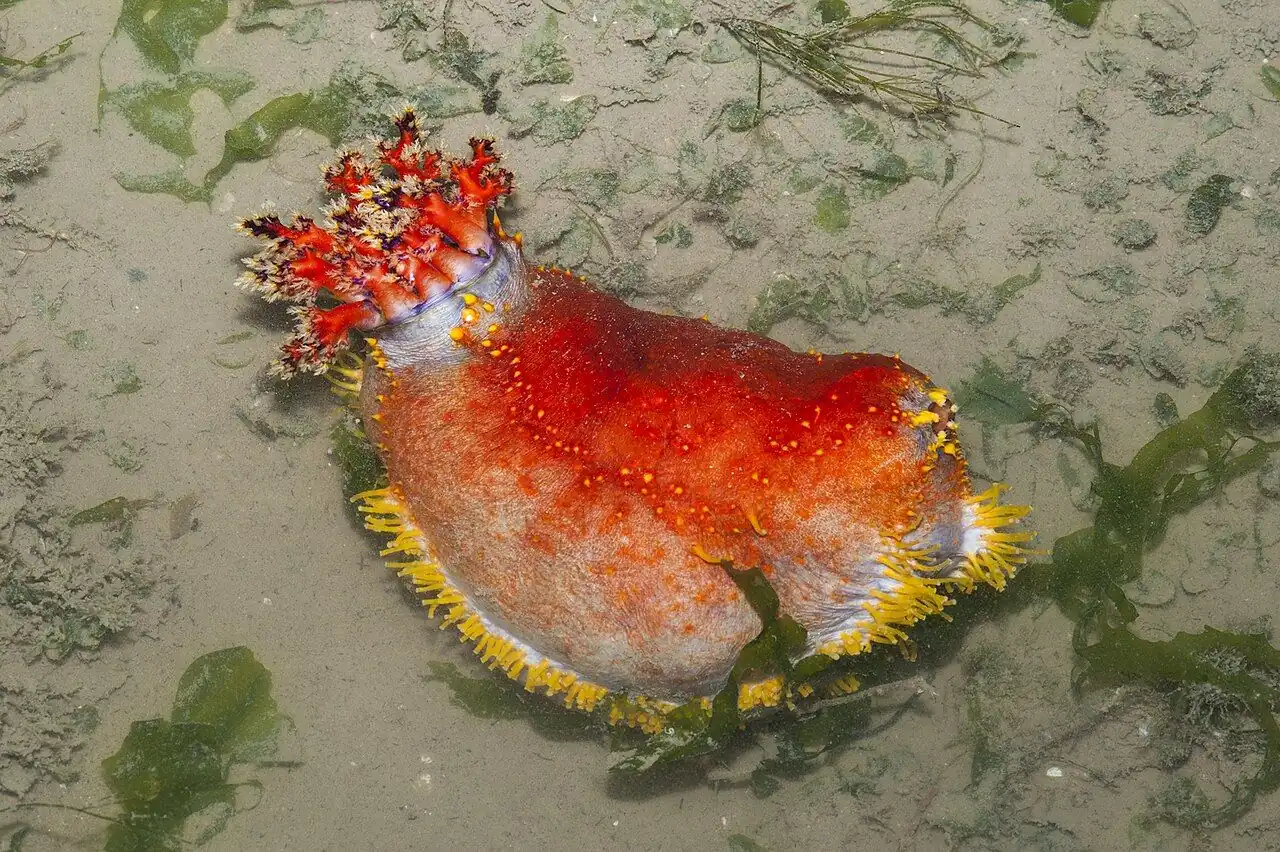
Sea Apple
Pseudocolochirus spp. (including P. violaceus and P. axiologus)
A plump, brightly colored sea cucumber that sifts food from the water with tree-like tentacles and, aquarists warn, can poison a tank when stressed.
Photo: Ria Tan / CC BY-SA 4.0
3 things to know
- It is a sea cucumber that catches food with a crown of tree-like tentacles around its mouth.
- Aquarium keepers are warned that a stressed sea apple can release toxins that kill other animals in the tank.
- In a 2020 genetic study, its closest match among the species compared was a sea cucumber from Alaska and Canada.
- Scientific name
- Pseudocolochirus spp. (including P. violaceus and P. axiologus)
- Depth
- 12 m – 97 m
39 – 318 ft - Size
- About 10 to 18 cm (4 to 7 in) long
- Weight
- Not well known
- Lifespan
- Unknown
- Diet
- Organic particles, bits of algae and zooplankton caught on branching tentacles
- Where
- Tropical Indo-West Pacific, from East Africa to Japan and Australia
- IUCN status
- Not Evaluated (for the species we checked)
- Depth zones
- Sunlight
Sea apples are sea cucumbers, though they look nothing like the sausage-shaped kind lying on the bottom. The body is plump and round to oval, about 10 to 18 centimeters (4 to 7 inches) long, boldly colored and lined with rows of tube feet. They belong to the genus Pseudocolochirus, which includes P. violaceus and P. axiologus, and live in the tropical Indo-West Pacific. Survey and museum records gathered in the OBIS database place P. violaceus from East Africa to Vietnam, the Philippines and Australia, with depth-tagged records from about 12 to 97 meters (40 to 320 feet), the depth range given above. In Singapore they also turn up on the beach at low tide.
A sea apple grips rock with its tube feet and spreads a crown of branching, tree-like tentacles around its mouth. The tentacles trap drifting organic particles, bits of algae and zooplankton. According to Reef Builders, an aquarium-hobby site, sea apples can deflate when stressed, or inflate and drift off to find a better spot.
Their bright colors may be a warning. Singapore's National Parks Board suggests the colors signal some kind of chemical defense, and chemists have isolated several triterpene glycosides from P. violaceus that proved toxic to cancer cells in the lab. Aquarium keepers know the danger. Reef Builders warns that a stressed sea apple, caught on a pump intake or nibbled by a fish, can release a toxin that can wipe out every animal in a tank, and that under extreme stress it can throw out its own sticky guts. Most sea apples kept in aquariums, the site adds, slowly starve, because they need large amounts of phytoplankton.
They are sold in the aquarium trade. In Singapore, the National Parks Board names collecting by beachcombers and land reclamation around Changi as threats to local populations, and notes that sea apples are never found there in large numbers.
Their family tree reaches the other side of the Pacific. In 2020, Yan Wang and colleagues sequenced the mitochondrial genome of P. violaceus and found it closest to Cucumaria miniata, a sea cucumber that lives in rocky crevices from the low tide line to about 24 meters (80 feet) deep along the coasts of Alaska and Canada. The species we checked have not been assessed by the IUCN.
Sources
- sealifebase.se/summary/Pseudocolochirus-violaceus.html
- sealifebase.se/summary/Pseudocolochirus-axiologus.html
- nausicaa.fr/en/my-visit/animals/sea-apple
- nparks.gov.sg/florafaunaweb/fauna/4/1/419
- api.obis.org/v3/occurrence
- reefbuilders.com/2015/05/06/sea-apples-hazardous-holothurians-best-left-to-advanced-hob…
- Study: doi:10.1002/cbdv.200690083
- Study: doi:10.1080/10286020500034972
- Study: doi:10.1080/23802359.2020.1788455
- sealifebase.se/summary/Cucumaria-miniata.html
- api.gbif.org/v1/species/5721357/iucnRedListCategory
- api.gbif.org/v1/species/10476196/iucnRedListCategory



