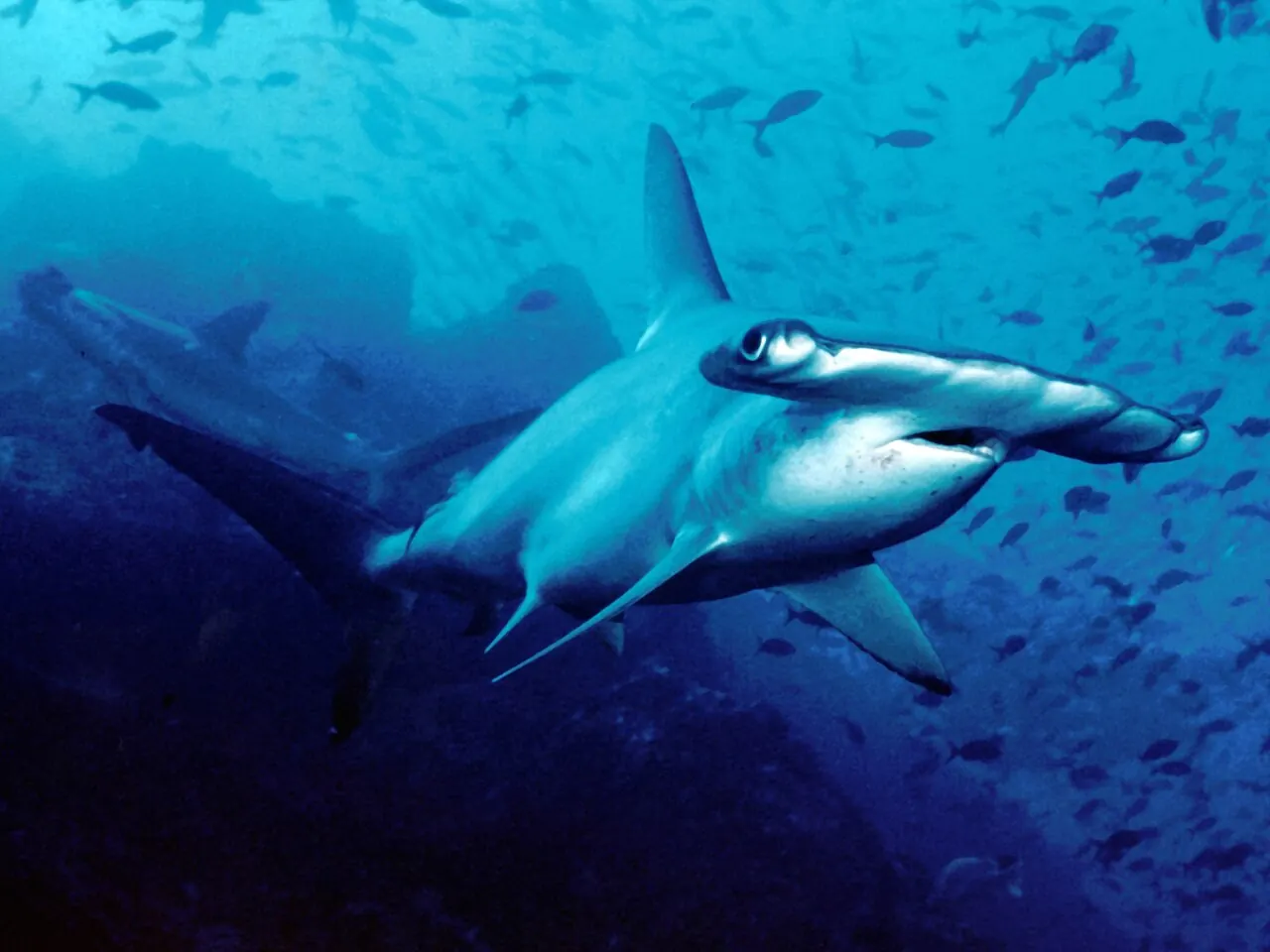
Scalloped Hammerhead
Sphyrna lewini
A schooling hammerhead with a notched, scalloped head that dives into deep, cold water and holds its breath to stay warm.
Photo: Barry Peters` / CC BY 2.0
3 things to know
- The front edge of its hammer has a notch in the middle and smaller notches along each side.
- Tagged sharks held their breath for an average of 17 minutes on deep dives.
- A female can give birth to 12 to 41 pups at a time.
- Scientific name
- Sphyrna lewini
- Depth
- 0 m – 275 m
0 – 902 ft - Size
- Up to about 3.5 m (11.5 ft); reports of 4.3 m (14 ft) exist
- Weight
- Up to about 152 kg (336 lb)
- Lifespan
- More than 30 years; FishBase gives a maximum reported age of 35
- Diet
- Mainly fishes and cephalopods such as deep-sea squid; also lobsters, shrimps, crabs and smaller sharks and rays
- Where
- Warm temperate and tropical coastal seas worldwide; in US waters from New Jersey to Florida, the Gulf of Mexico, Southern California and Hawaii
- IUCN status
- Critically Endangered
- Depth zones
- Sunlight · Twilight
Look at a scalloped hammerhead head-on and the front edge of its hammer is arched, with a notch in the middle and smaller notches along each side. The body is light gray to grayish brown or olive above and white below, and the pectoral fin tips are dusky. Reported maximum sizes run to about 3.5 meters (11.5 feet), with a few reports up to 4.3 meters (14 feet).
It lives in warm coastal seas worldwide, over continental shelves and the deep water beside them, and sometimes enters bays and estuaries. FishBase places it from the surface to about 275 meters (900 feet). In US waters, NOAA Fisheries lists it from New Jersey to Florida, in the Gulf of Mexico, off Southern California and around Hawaii. Adults often travel in schools sorted by sex, and young sharks gather in large schools. It eats mostly fishes and cephalopods, including deep-sea squid, plus lobsters, shrimps, crabs and smaller sharks and rays. Females give birth to 12 to 41 pups after a pregnancy of 9 to 10 months.
Adults also dive fast and often, from surface water near 26°C (79°F) to more than 800 meters (2,600 feet), where the water can be as cold as 5°C (41°F). Mark Royer and colleagues at the University of Hawaiʻi's Hawaiʻi Institute of Marine Biology fitted sharks with tags that recorded muscle temperature, depth, body position and activity. The muscles stayed warm through the deepest part of each dive and cooled quickly only late in the climb back up. Their heat-transfer model, published in Science in 2023, indicated that the sharks stop losing heat through their gills, probably by shutting the gills down. Video of a hammerhead swimming along the seabed at 1,044 meters (more than 3,400 feet) showed its gill slits tightly closed. Royer said the sharks hold their breath for an average of 17 minutes but spend only about four minutes at the bottom of each dive before returning to warm water to breathe.
The IUCN lists the scalloped hammerhead as Critically Endangered, and NOAA says the main threat is commercial fishing, mostly for the shark fin trade. Under the US Endangered Species Act, NOAA lists the Eastern Pacific and Eastern Atlantic populations as endangered and the Central and Southwest Atlantic and Indo-West Pacific populations as threatened. The University of Hawaiʻi notes that the species is not listed as threatened in Hawaii.
Sources
- fisheries.noaa.gov/species/scalloped-hammerhead-shark
- fishbase.se/summary/Sphyrna-lewini.html
- floridamuseum.ufl.edu/discover-fish/species-profiles/sphyrna-lewini
- Study: doi:10.1126/science.add4445
- hawaii.edu/news/2023/05/11/hammerhead-sharks-hold-breath-2
- api.gbif.org/v1/species/2418789/iucnRedListCategory
- iucnredlist.org/species/39385/2918526



