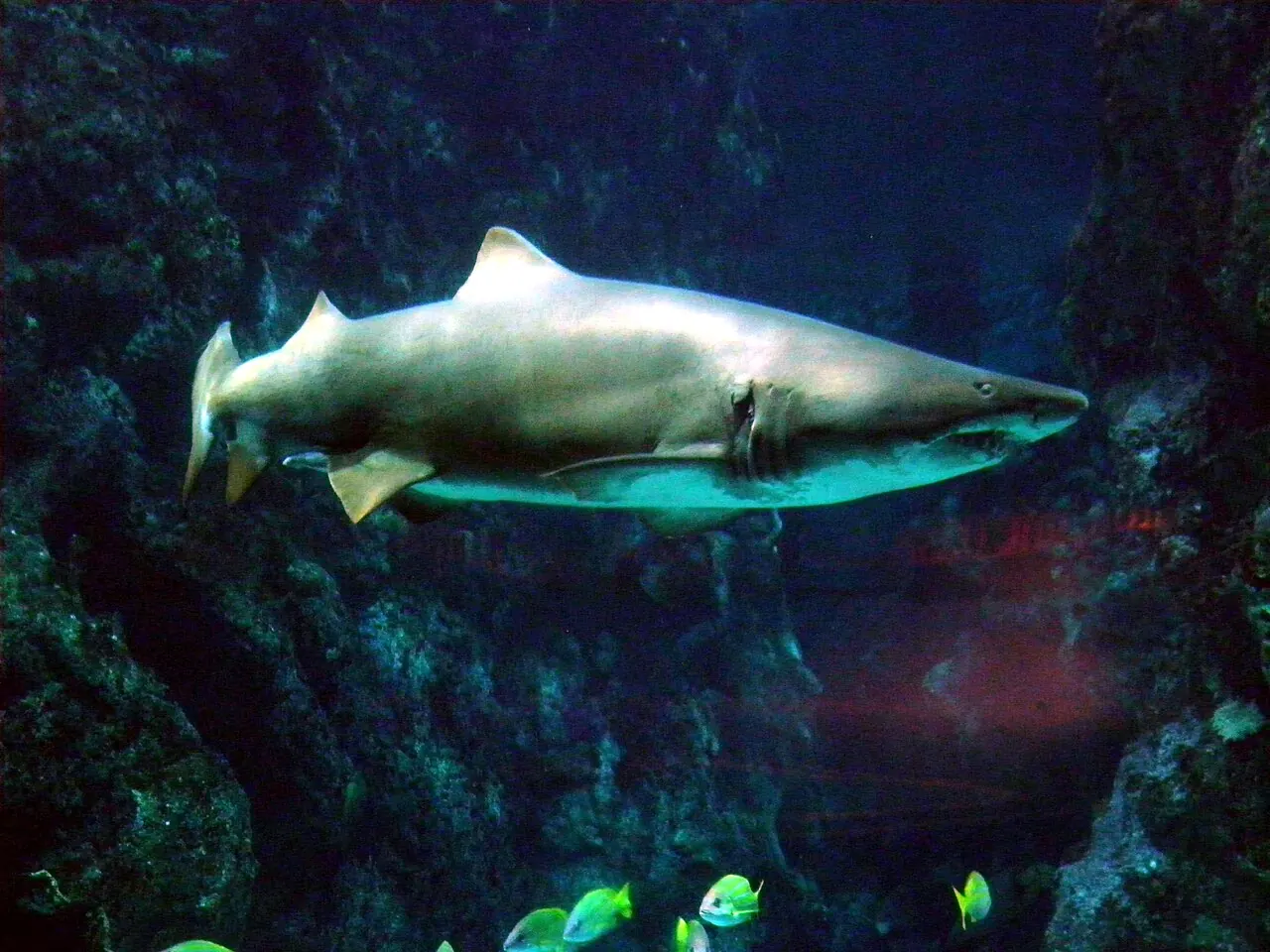
Sand Tiger Shark
Carcharias taurus
A ragged-toothed coastal shark whose unborn young eat their own siblings, so a mother usually gives birth to just two pups.
Photo: Gzen92 / CC BY-SA 4.0
3 things to know
- It is the only shark known to gulp air and store it in its stomach to stay neutrally buoyant.
- Embryos have working teeth by the time they are about 17 cm (6.7 in) long.
- US commercial shark fishers on the Atlantic and Gulf coasts must release any sand tiger they catch.
- Scientific name
- Carcharias taurus
- Depth
- 1 m – 191 m
3 – 627 ft - Size
- Commonly about 2.5 m (8 ft); up to about 3.2 m (10.5 ft)
- Weight
- Up to about 159 kg (350 lb)
- Lifespan
- Estimated at 30 to 35 years from growth bands in the vertebrae
- Diet
- Bony fishes, plus small sharks, rays, squid, crabs and lobsters
- Where
- Warm and temperate coastal seas worldwide except the eastern Pacific; in the western Atlantic from the Gulf of Maine to Argentina
- IUCN status
- Critically Endangered
- Depth zones
- Sunlight
Long, spike-like teeth jut from the sand tiger's mouth, which makes it look fiercer than it usually behaves. It is a bulky shark with a flattened, cone-shaped snout, light brown or gray-green above and paler below, often with scattered reddish or brown spots. Its two dorsal fins and its anal fin are almost the same size. Adults commonly reach about 2.5 meters (8 feet), and the largest are about 3.2 meters (10.5 feet).
Sand tigers live in warm and temperate coastal water around the world except the eastern Pacific, from the surf zone and shallow bays out to about 191 meters (627 feet), often near reefs and shipwrecks. On the US East Coast they range from the Gulf of Maine southward and are common in summer around Cape Cod and Delaware Bay. They hunt bony fishes, small sharks, rays, squid, crabs and lobsters, and schools have been seen surrounding and bunching up schools of prey before feeding. According to FishBase, it is the only shark known to gulp air and hold it in its stomach so that it stays neutrally buoyant, neither sinking nor rising.
Eggs are fertilized and packed into egg cases in groups of 16 to 23, yet a female usually gives birth to only two pups, one from each of her two uteri. In each uterus, the first embryo to reach a certain size eats its smaller siblings, and the embryos also feed on eggs produced by the mother. Embryos already have working teeth at about 17 centimeters (6.7 inches). Pups are born about 1 meter (39 inches) long.
Demian Chapman, then at Stony Brook University in New York, and colleagues used DNA to examine 15 mothers and their litters. They conservatively estimated that 60 percent of the females had mated with more than one male, yet only 40 percent of litters had surviving embryos with different fathers. In three females, eggs had been fertilized by several males, but the embryos that won the cannibal contest all came from one of them. The study appeared in Biology Letters in 2013.
Recovery is slow: the Florida Museum notes that even under protection, sand tigers off Australia have come back very slowly. The IUCN's 2020 assessment lists it as Critically Endangered, and in the United States it has been fully protected under the federal Atlantic fishery management plan since 1997.



