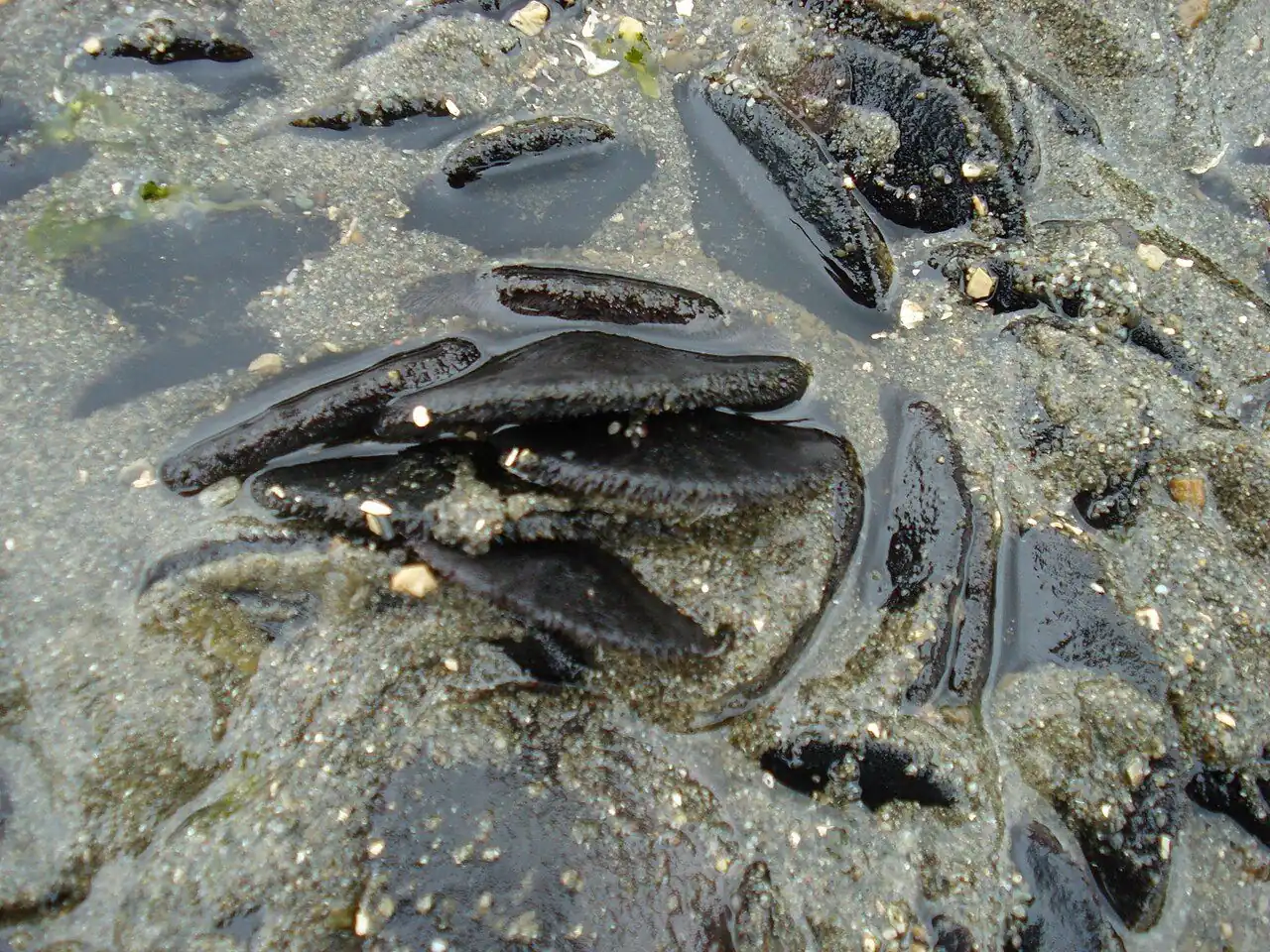
Sand Dollar
Order Clypeasteroida (many species, including the Pacific sand dollar, Dendraster excentricus)
Flat, burrowing cousins of sea urchins whose young swallow heavy sand as a weight belt and whose larvae clone themselves when fish are near.
Photo: Brikat20 / Public domain
3 things to know
- In calm water, Pacific sand dollars stand on edge, partly buried, to catch passing plankton.
- Young sand dollars swallow heavy sand grains and keep them in the gut as a weight belt.
- Sand dollar larvae can bud off clones within 24 hours of sensing fish mucus.
- Scientific name
- Order Clypeasteroida (many species, including the Pacific sand dollar, Dendraster excentricus)
- Depth
- 0 m – 40 m
0 – 131 ft - Size
- Pacific sand dollar up to about 9 cm (3.5 in) across
- Weight
- Not well known
- Lifespan
- Pacific sand dollar usually 6 to 10 years
- Diet
- Crustacean larvae, small copepods, diatoms, algae and detritus
- Where
- Sandy seafloors in many seas: the Pacific sand dollar from Alaska to Baja California; Echinarachnius parma in the Arctic, North Atlantic and North Pacific; Mellita quinquiesperforata in the Caribbean
- IUCN status
- Not Evaluated (for the species we checked)
- Depth zones
- Sunlight
The white disc found on beaches is only the skeleton, or test, of a sand dollar. Alive, the animal is a flattened member of the sea urchin class, covered in short, densely packed spines, gray to purple in the Pacific sand dollar, Dendraster excentricus, that hide the five-part flower pattern, the petaloids, on its back. This species grows to about 9 centimeters (3.5 inches) across and lives from Alaska to Baja California, from the low intertidal zone to about 40 meters (130 feet) deep; SeaLifeBase records it to 90 meters (300 feet). Other sand dollars range from the Arctic to the Caribbean.
In calm water, Pacific sand dollars stand on end, partly buried in sand. They catch plankton with their spines and tiny pincers, and cilia help move food to a mouth in the center of the underside. The menu includes crustacean larvae, small copepods, diatoms, algae and detritus. They live packed together. In 1982, Raymond Highsmith described beds that often hold several hundred adults per square meter, and he found that larvae ready to settle prefer sand from those beds. Adults working through the sand keep out tiny tube-building crustaceans that would otherwise eat newly settled young.
Juveniles face another hazard, shifting sand. In 1973, Fu-Shiang Chia of the University of Alberta reported in Science that young Pacific sand dollars pick out and swallow heavy sand grains and store them in a pouch off the intestine that seems to work as a weight belt, helping them stay put. The sand disappears once the animal reaches about 30 millimeters (1.2 inches) long.
The larvae have a defense of their own. Dawn Vaughn, a doctoral student at the University of Washington's Friday Harbor Laboratories, exposed 4-day-old larvae to fish mucus. Within 24 hours they had grown clone buds that broke off as new larvae. The original larva shrank from about 300 microns to roughly half that size, and the clones were smaller still. Larvae not exposed to mucus did not clone. In their 2008 Science paper, Vaughn and her adviser Richard Strathmann suggested that being smaller helps larvae avoid predators that hunt by sight.
Pacific sand dollars usually live 6 to 10 years, and California sheephead, starry flounders and large pink sea stars prey on them. The species we checked have not been assessed by the IUCN.
Sources
- montereybayaquarium.org/animals/animals-a-to-z/sand-dollar
- sealifebase.se/summary/Dendraster-excentricus.html
- sealifebase.se/summary/Echinarachnius-parma.html
- sealifebase.se/summary/Mellita-quinquiesperforata.html
- Study: doi:10.2307/1938950
- Study: doi:10.1126/science.181.4094.73
- Study: doi:10.1126/science.1151995
- washington.edu/news/2008/03/13/sand-dollar-larvae-use-cloning-to-make-change-confound-p…
- api.gbif.org/v1/species/2279084/iucnRedListCategory
- api.gbif.org/v1/species/2279041/iucnRedListCategory



