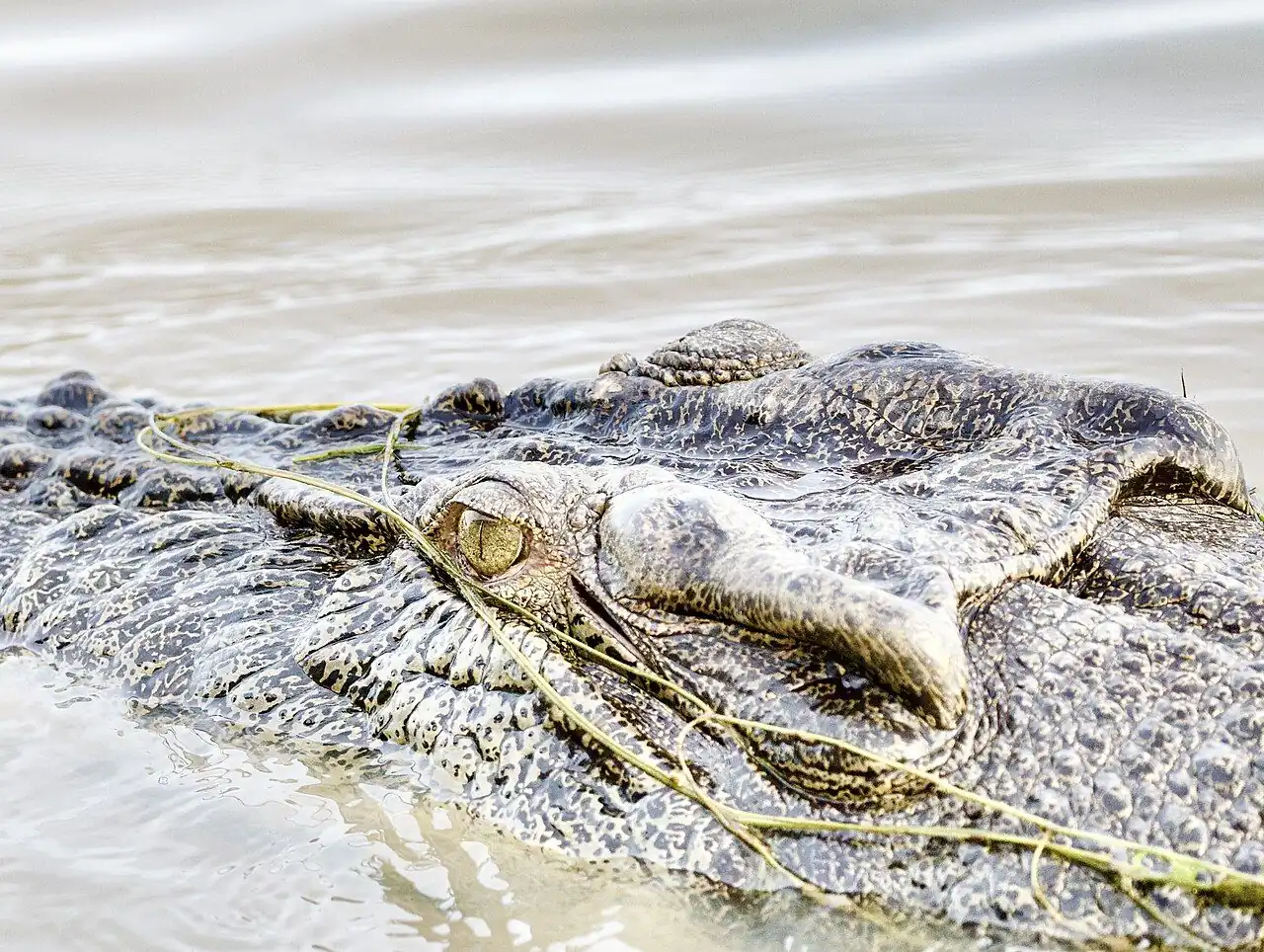
Saltwater Crocodile
Crocodylus porosus
The largest living reptile, a poor long-distance swimmer that crosses open sea by riding surface currents and sheds salt through glands in its tongue.
Photo: Jurie.vw / CC BY-SA 4.0
3 things to know
- It has salt glands in its tongue that get rid of excess sodium chloride.
- One tagged male traveled 590 km (367 miles) in 25 days down the coast of Cape York Peninsula.
- On long trips it travels only when the current is in its favor.
- Scientific name
- Crocodylus porosus
- Depth
- 0 m – 4 m
0 – 13 ft - Size
- Adults usually 3–5 m (10–16 ft); the largest reliably measured was at least 6.15 m (20 ft)
- Weight
- Up to about 1,000–1,200 kg (2,200–2,650 lb)
- Lifespan
- Not well known
- Diet
- Almost any animal it can overpower, from crustaceans and fish to birds, sea turtles and mammals as big as water buffalo
- Where
- Coasts, estuaries and rivers from India and Sri Lanka through Southeast Asia to northern Australia and the Solomon Islands; strays reach remote islands such as Fiji
- IUCN status
- Least Concern
- Depth zones
- Sunlight
Saltwater crocodiles are the largest living reptiles. Adults usually measure 3 to 5 meters (10 to 16 feet), and the biggest one reliably measured, caught in the Northern Territory's Mary River in 1974, was at least 6.15 meters (20 feet) long. They live in rivers, estuaries and swamps but also turn up on islands far from any mainland. The Australian Museum lists records from remote islands such as Fiji, and Australian crocodiles live on islands as far as 96 kilometers (60 miles) off the coast.
They can live in anything from fresh water to full-strength sea water and have been recorded in water twice as salty. The apparent lack of salt glands in marine and estuarine crocodiles long puzzled biologists, until Laurence Taplin and Gordon Grigg reported in Science in 1981 that this species has them in its tongue, exuding concentrated sodium chloride.
Getting between islands is harder, because these crocodiles are poor swimmers. In 2007 Mark Read, Grigg, the late Steve Irwin and colleagues published the first satellite tracking of any crocodilian. Three large males were moved by helicopter 56, 99 and 411 kilometers of coastline from where they were caught, and all three went home. The one that had to go around Cape York Peninsula covered more than 400 kilometers (250 miles) in 20 days. In 2010 Hamish Campbell of the University of Queensland and colleagues showed how they manage it. Of 27 crocodiles tagged in the Kennedy River in north Queensland, those making long trips traveled only when the current flowed their way, staying at the surface. When it turned against them, they dived to the riverbed or climbed out on the bank. Measured dive depths are scarce: a logger trace published by Craig Franklin's team in 2009 shows a female about 3 meters long diving to roughly 3.5 meters (11 feet) along a river bed. At sea, one 3.84-meter male timed a 590-kilometer (367-mile), 25-day trip down the west coast of Cape York to a seasonal current, and another waited four days in a sheltered bay until the current in the Torres Strait switched in its favor.
They eat almost anything they can overpower, from crustaceans to sea turtles and water buffalo. Skin hunting cut their numbers sharply before the 1970s; since being protected they have reclaimed much of their former range in Australia. The IUCN lists the species as Least Concern.
Sources
- australian.museum/learn/animals/reptiles/estuarine-crocodile
- animaldiversity.org/accounts/Crocodylus_porosus
- Study: doi:10.1126/science.212.4498.1045
- Study: doi:10.1371/journal.pone.0000949
- Study: doi:10.1111/j.1365-2656.2010.01709.x
- eurekalert.org/news-releases/697165
- Study: doi:10.2305/IUCN.UK.2021-2.RLTS.T5668A3047556.en
- Study: doi:10.1071/MF08153



