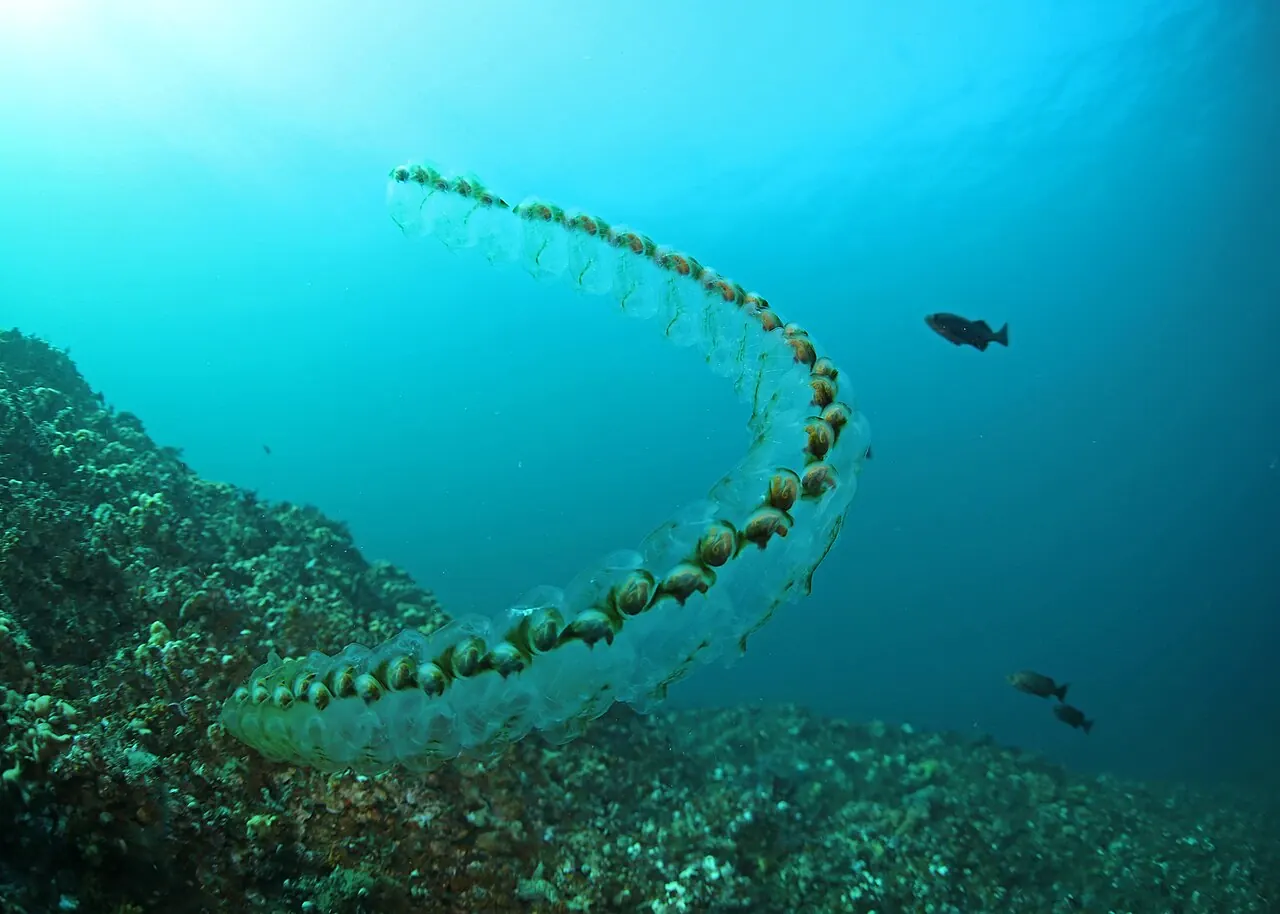
Salp
Family Salpidae (several genera, including Salpa, Thalia and Pegea)
Clear, barrel-shaped drifters that look like jellyfish but are tunicates, closer kin to people, and whose blooms can carpet the deep seafloor.
Photo: Oregon Department of Fish & Wildlife / CC BY-SA 2.0
3 things to know
- Salps are tunicates, more closely related to humans than to jellyfish.
- A solitary salp buds off long chains of identical clones.
- One species, Salpa aspera, is reported to migrate at least 800 meters (2,600 feet) up and down each day.
- Scientific name
- Family Salpidae (several genera, including Salpa, Thalia and Pegea)
- Depth
- 0 m – 800 m
0 – 2,625 ft - Size
- Single salps about 1–20 cm (0.4–8 in) long; chains can be several meters long
- Weight
- Unknown
- Lifespan
- Not well known
- Diet
- Phytoplankton, strained from the water through a mucus net
- Where
- Oceans worldwide; most species live in warm waters, and two are confined to the Southern Ocean
- IUCN status
- Not Evaluated (none of the salp species checked has been assessed)
- Depth zones
- Sunlight · Twilight
Salps drift alongside jellyfish and look a lot like them, but they are tunicates, members of the chordate phylum that also includes people. The Woods Hole Oceanographic Institution notes that salps are more closely related to humans than to jellyfish, with a brain, a heart and intestines. Each salp is a clear barrel about 1 to 20 centimeters (0.4 to 8 inches) long. It swims by jet propulsion, squeezing its body muscles to pump water through, and the same stream passes a mucus net that strains out phytoplankton.
The life cycle alternates between two forms. A solitary salp reproduces asexually, budding off long chains of identical salps that can stretch several meters. The chains break free and reproduce sexually as hermaphrodites, each parent in the chain growing a baby salp inside it. When food is plentiful they make more chains quickly and grow fast, which WHOI says makes them one of the fastest-growing multicellular animals on Earth. Swarms can cover large areas of ocean at densities of hundreds per cubic meter.
Salps are found throughout the world ocean. Most species are warm-water animals, while two, Ihlea racovitzai and Salpa gerlachei, are confined to Antarctic waters. They are most common near the surface, but some travel far each day. A South Atlantic zooplankton guide hosted by the Naturalis museum, citing a 1979 study by Peter Wiebe and colleagues, says Salpa aspera migrates at least 800 meters (2,600 feet) up and down each day, the figure behind the header depth. In the Southern Ocean, swarms of Salpa thompsoni may replace krill in some years, which also eat the diatoms there but are a much richer food for whales and penguins.
What salps eat can end up on the deep seafloor. Their carbon-rich fecal pellets and dead bodies sink. After a large bloom of Salpa in the northeast Pacific in the spring of 2012, a team led by K. L. Smith Jr. watched the results arrive at a study site called Station M, about 4,000 meters (13,100 feet) down. A time-lapse camera showed salp remains covering as much as 98% of the seafloor in late June and early July, and the team estimated that the detritus supplied 97 to 327% of the seafloor community's food demand, measured by its oxygen use, over six months.
None of the salp species we checked has been assessed for the IUCN Red List.
Sources
- whoi.edu/ocean-learning-hub/ocean-facts/salp
- whoi.edu/oceanus/feature/transparent-salps-may-play-conspicuous-ecological-role
- sat-zooplankton.linnaeus.naturalis.nl/linnaeus_ng/app/views/introduction/topic.php
- Study: doi:10.1007/BF00952433
- Study: doi:10.4319/lo.2014.59.3.0745
- Study: doi:10.1038/s41598-020-73446-w
- sealifebase.se/summary/Salpa-maxima.html
- api.gbif.org/v1/species/5232503/iucnRedListCategory
- api.gbif.org/v1/species/5232502/iucnRedListCategory



