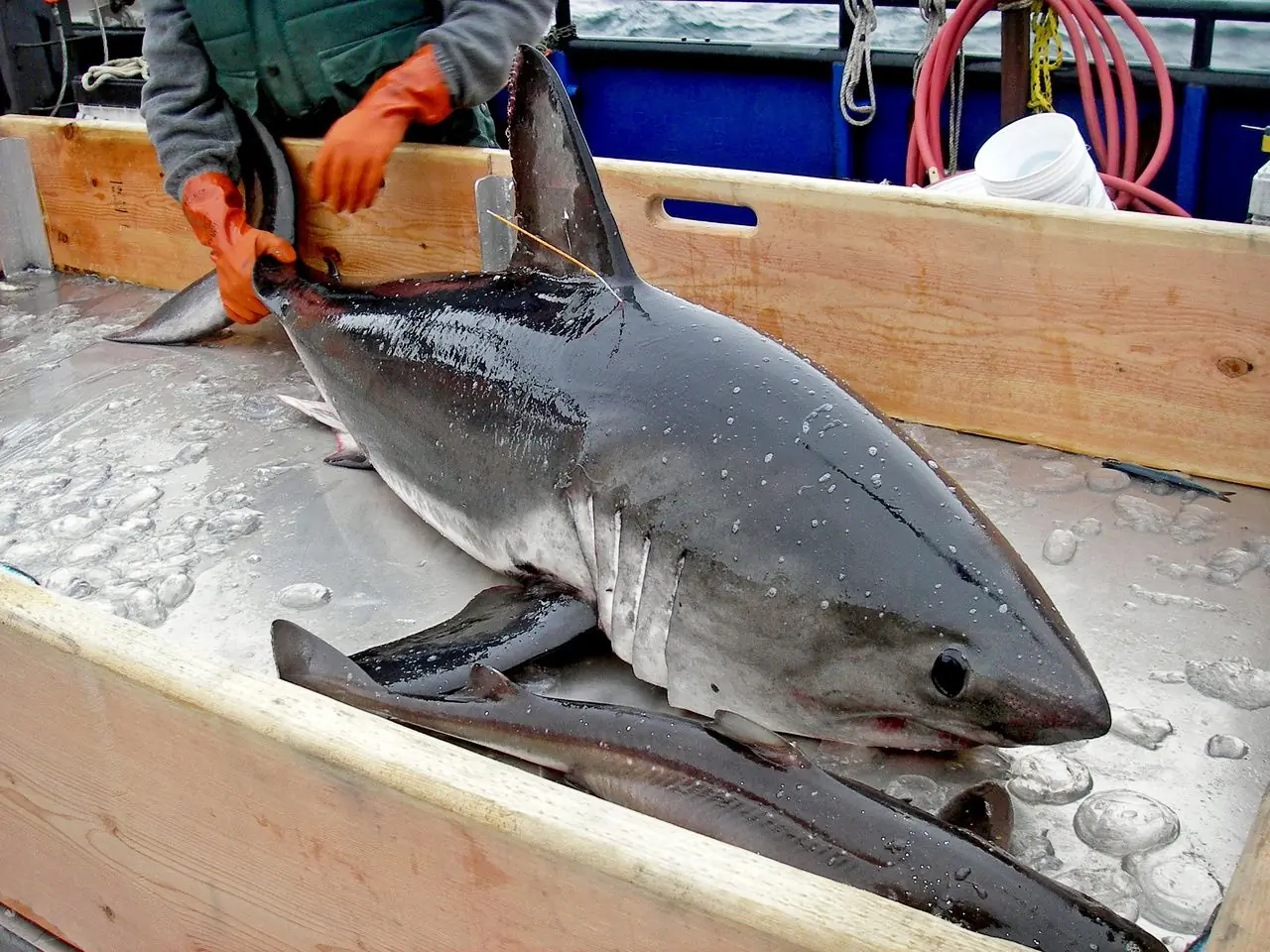
Salmon Shark
Lamna ditropis
A North Pacific cousin of the great white that keeps its body warm enough to hunt salmon in Alaskan water as cold as 2 °C (36 °F).
Photo: NOAA Fisheries / Public domain
3 things to know
- Four salmon sharks tracked in Prince William Sound, Alaska, kept stomach temperatures of about 25 °C (77 °F) in water as cold as 5 °C (41 °F).
- Stanford scientists tagged 51 female salmon sharks in Alaska from 2002 to 2004, and some later swam as far as waters off Hawaii.
- Alaska's Department of Fish and Game says salmon sharks ate 12 to 25 percent of the 1998 salmon run in Prince William Sound.
- Scientific name
- Lamna ditropis
- Depth
- 0 m – 150 m
0 – 492 ft - Size
- Usually about 2–2.4 m (6.5–8 ft); up to about 3 m (10 ft)
- Weight
- Sources differ: FishBase gives a maximum published weight of 175 kg (386 lb), while Alaska's Department of Fish and Game reports maximums of about 300 kg (more than 660 lb)
- Lifespan
- Up to about 25–27 years
- Diet
- Salmon, squid, herring, sablefish, walleye pollock and other fish; occasionally sea otters and seabirds
- Where
- Subarctic and temperate North Pacific, from the Bering Sea and Sea of Okhotsk to Japan, and from the Gulf of Alaska to Baja California
- IUCN status
- Least Concern
- Depth zones
- Sunlight
Stocky, dark gray above and white below with dusky blotches, the salmon shark looks like a small great white, and the two are close relatives. It has large teeth, long gill slits and a strong, wide tail with a second short keel on it, a feature it shares only with its Atlantic cousin, the porbeagle. Adults usually measure 2 to 2.4 meters (6.5 to 8 feet) and can exceed 3 meters (10 feet).
It lives across the cold North Pacific, from the Bering Sea and the Sea of Okhotsk south to Japan, and on the American side from the Gulf of Alaska to Baja California. It usually stays in the top 150 meters (500 feet), but it has been recorded deeper than 790 meters (2,600 feet). Besides salmon they eat squid, herring, pollock and sablefish. Alaska's Department of Fish and Game says they ate 12 to 25 percent of the 1998 salmon run in Prince William Sound.
Networks of blood vessels act as heat exchangers and keep the warmth made by its muscles inside its body. In Prince William Sound, Kenneth Goldman and colleagues used acoustic tags to follow four free-swimming salmon sharks. Their stomachs stayed between 25.0 and 25.7 °C (77 and 78 °F) while the surrounding water ranged from about 5 to 16 °C (41 to 61 °F), up to 21.2 °C (38 °F) warmer than the sea. The team reported in 2004 that adults essentially function as homeotherms, animals that hold a steady body temperature.
That warmth does not reach the heart, which is cooled by blood coming from the gills. From 2002 to 2004 a Stanford University team led by Barbara Block tagged 51 female salmon sharks in Prince William Sound. In 2005, Kevin Weng, Block and colleagues reported that some spent winter in Alaskan waters as cold as 2 to 8 °C (36 to 46 °F), while others swam thousands of miles south to subtropical waters around Hawaii. In heart tissue, proteins that move calcium worked about 10 times faster than in blue sharks, which may keep the heart beating in the cold.
Females give birth to two to five pups after about nine months, and the unborn young feed on unfertilized eggs. Salmon shark numbers appear stable, and the IUCN lists the species as Least Concern, in an assessment from 2018.



