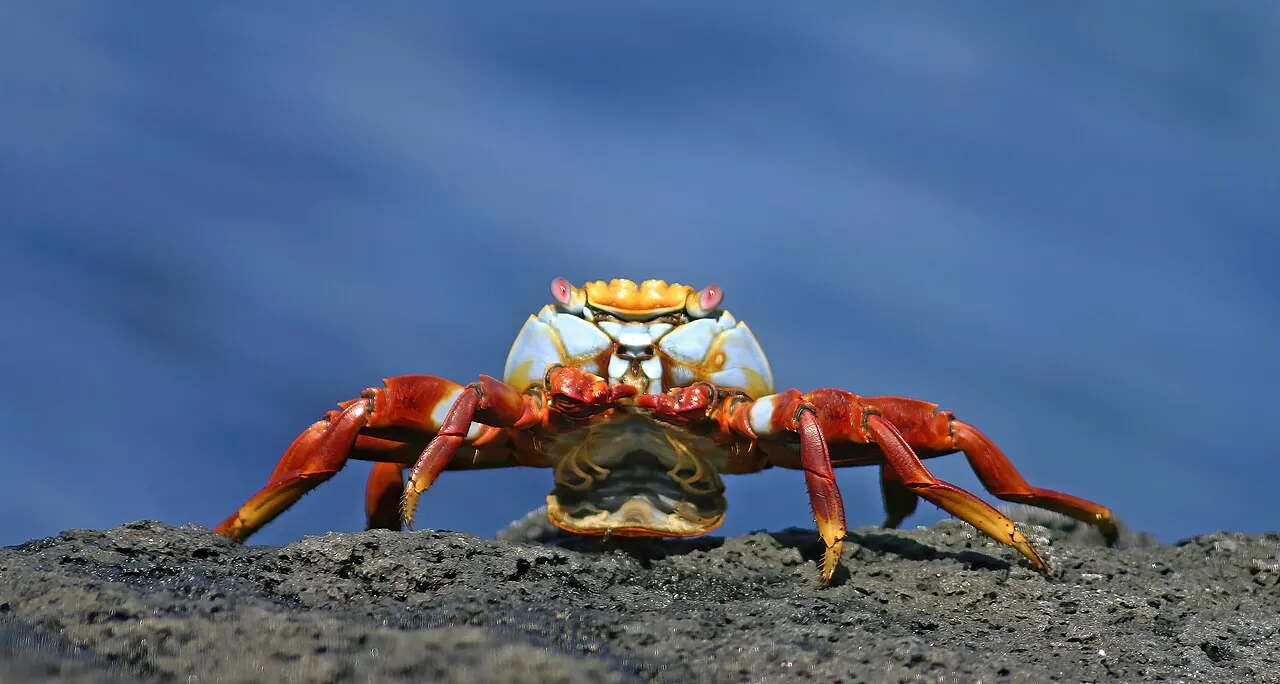
Sally Lightfoot Crab
Grapsus grapsus
A fast, brightly colored crab of wave-splashed rocks in the Galápagos and along the Pacific coast of the Americas, known for leaping from rock to rock.
Photo: Charles J. Sharp / CC BY-SA 3.0
3 things to know
- Young Sally Lightfoot crabs are dark with red spots, which hides them on black lava; the spots grow with each molt.
- In the Galápagos it picks ticks off marine iguanas.
- Its larvae grow up out at sea, then the young crabs swim back to shore.
- Scientific name
- Grapsus grapsus
- Depth
- 0 m – 5 m
0 – 16 ft - Size
- Shell up to about 8.7 cm (3.4 in) wide
- Weight
- Unknown
- Lifespan
- Unknown
- Diet
- Mostly algae; also barnacles, mussels, porcelain crabs, carrion and ticks picked off marine iguanas
- Where
- Pacific coast of the Americas from Baja California, Mexico, south to Peru or Chile (sources differ), including the Galápagos; also reported from Atlantic coasts
- IUCN status
- Not Evaluated
- Depth zones
- Sunlight
Bright red legs, a pale belly and a talent for sprinting across wave-splashed lava make Grapsus grapsus one of the most visible animals on Galápagos shores. According to the Galápagos Conservation Trust, adults are intensely red and blue on top, while young crabs are dark with red spots, which hides them on black volcanic rock. The spots grow larger with every molt until the adult colors take over. SeaLifeBase gives a maximum shell width of 8.7 centimeters (3.4 inches).
This crab lives at the very edge of the sea, on rocks near the waterline and in the splash zone, and SeaLifeBase records it down to only 5 meters (16 feet). It is very active out of the water and retreats into the sea when threatened. Its range runs along the Pacific coast of the Americas from Baja California, Mexico, south to Peru or Chile, depending on the source, and out to the Galápagos and other offshore islands. The common name is rumored to honor a Caribbean dancer, a nod to the way the crab leaps from rock to rock, runs in four directions and climbs vertical surfaces. John Steinbeck, who collected them with the biologist Ed Ricketts on their 1940 Gulf of California expedition, wrote that they were exceedingly hard to catch.
Adults graze mostly on algae but take much more when they can. SeaLifeBase lists barnacles, mussels and porcelain crabs and notes that the crab also scavenges, and the trust says its diet runs from sea lion placenta to other crabs. In the Galápagos it also eats ticks off marine iguanas.
Females carry their eggs on the underside of the body until the eggs hatch into the water. The larvae head out to deeper water, feed on phytoplankton and molt quickly, then change into juvenile crabs and swim back to shore. Young crabs travel in large groups, while adults are mostly solitary outside mating. Lava herons, octopuses and tuna eat them, and so do rats, cats and dogs that people brought to the islands.
How long the crabs live is not known, and the species has not been evaluated by the IUCN. The trust lists marine plastic pollution as a possible risk.
Sources
- galapagosconservation.org.uk/species/sally-lightfoot-crab
- sealifebase.se/summary/Grapsus-grapsus.html
- thecephalopodpage.org/MarineInvertebrateZoology/Grapsusgrapsus.html
- api.gbif.org/v1/species/2225819/iucnRedListCategory
- en.wikipedia.org/wiki/Grapsus_grapsus
- naturalhistory.si.edu/sites/default/files/media/file/brusca2020seaofcortezexpeditionwit…
- depts.washington.edu/scipos/wordpress/2021/10/20/species-species-of-the-week-week-3-or-…



