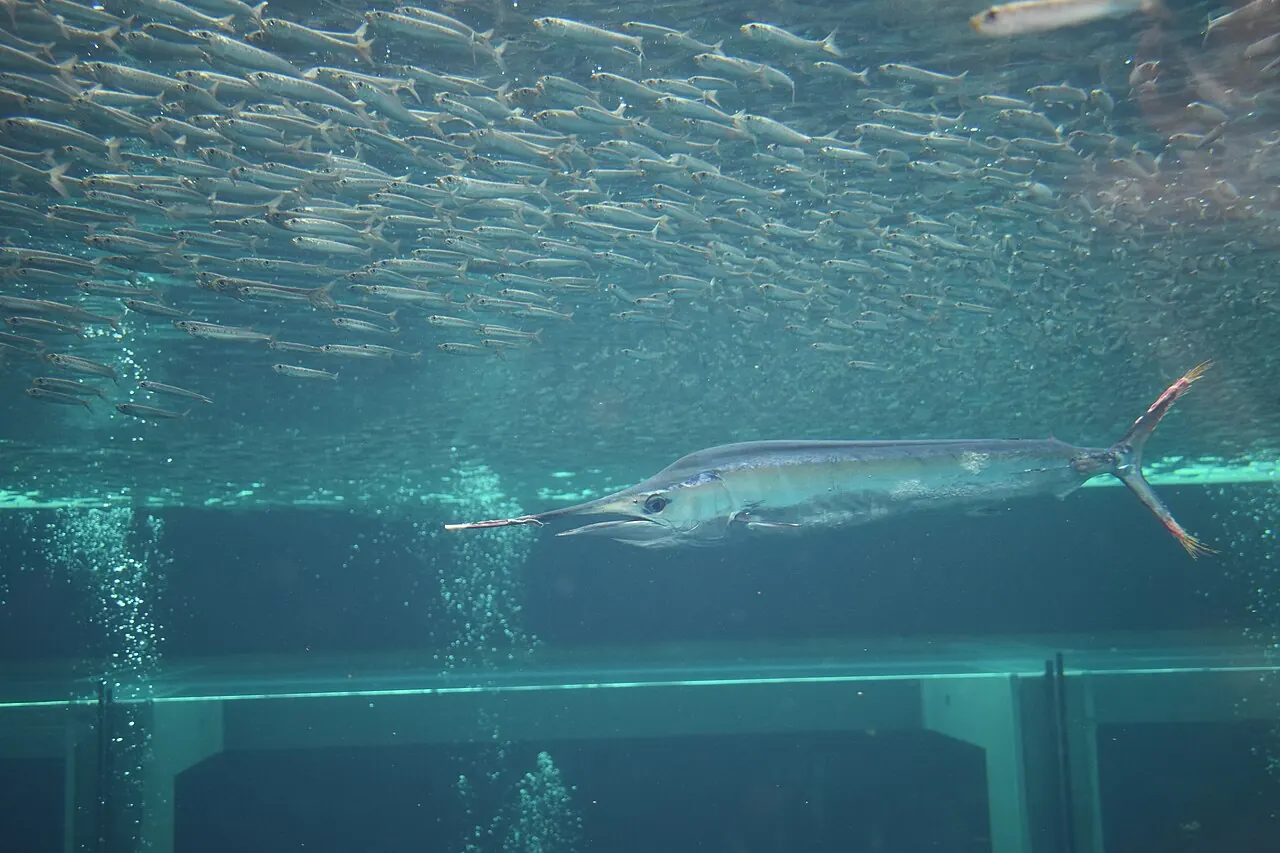
Sailfish
Istiophorus platypterus
A billfish with a towering blue sail on its back, famous for a speed record that muscle measurements now put in doubt.
Photo: 出羽雀台 / CC BY-SA 4.0
3 things to know
- Its body color can change with its level of excitement.
- A large female may release 4.5 million eggs while spawning.
- Muscle measurements suggest its top speed is far below the famous 68 mph claim.
- Scientific name
- Istiophorus platypterus
- Depth
- 0 m – 200 m
0 – 656 ft - Size
- Up to about 3.4 m (11 ft) long, including the bill
- Weight
- Up to about 100 kg (220 lb)
- Lifespan
- Maximum reported age about 13 years
- Diet
- Schooling fish such as sardines, anchovies, mackerels and jacks; squid and octopus
- Where
- Tropical and subtropical waters of the Atlantic, Pacific and Indian oceans
- IUCN status
- Vulnerable
- Depth zones
- Sunlight
A huge first dorsal fin, the sail, runs most of the length of the sailfish's back and stands much taller than the body is deep. Below it, the fish is dark blue on top and white underneath, with about 20 bars of light blue spots down each side, and its colors can shift when it gets excited. The upper jaw stretches into a long bill that is round in cross section, about twice the length of the lower jaw.
Most authorities treat the sailfish as one species found in warm waters around the world, though FishBase still separates an Atlantic sailfish, Istiophorus albicans. Sailfish live in the open ocean's surface layer, generally above the thermocline in water of 21 to 28°C (70 to 83°F), and they come closer to coasts and islands than other billfish. In the western Atlantic they are most abundant in the Gulf of Mexico, along Florida's Atlantic coast and in the Caribbean. They grow to about 3.4 meters (11 feet) and roughly 100 kilograms (220 pounds).
They eat schooling fish such as sardines, anchovies, mackerels, jacks and halfbeaks, plus squid and octopus. High-speed video published in 2014 showed Atlantic sailfish slipping their bills into sardine schools without startling them, then tapping single fish or slashing sideways through the crowd with one of the highest accelerations recorded in an aquatic vertebrate.
In the western North Atlantic, spawning peaks in summer. A female swims slowly in shallow water with her sail above the surface while one or more males follow, and a large female may release 4.5 million eggs. Young fish grow fast, to about 1.4 meters in six months. The IUCN lists the sailfish as Vulnerable, and US commercial boats may not sell Atlantic sailfish.
The species is often called the fastest fish, credited with about 68 mph from a hooked fish in the Florida Keys a century ago. Guinness World Records says no definitive evidence for that figure survives. A 2016 study that timed sailfish muscle twitches estimated a top speed of about 8.3 meters per second (19 mph) and concluded sailfish probably cannot top 10 to 15 meters per second (22 to 34 mph).
Sources
- floridamuseum.ufl.edu/discover-fish/species-profiles/istiophorus-platypterus
- australian.museum/learn/animals/fishes/sailfish-istiophorus-platypterus
- fishbase.se/summary/Istiophorus-platypterus.html
- Study: doi:10.1242/bio.019919
- Study: doi:10.1098/rspb.2014.0444
- guinnessworldrecords.com/world-records/70737-fastest-fish



