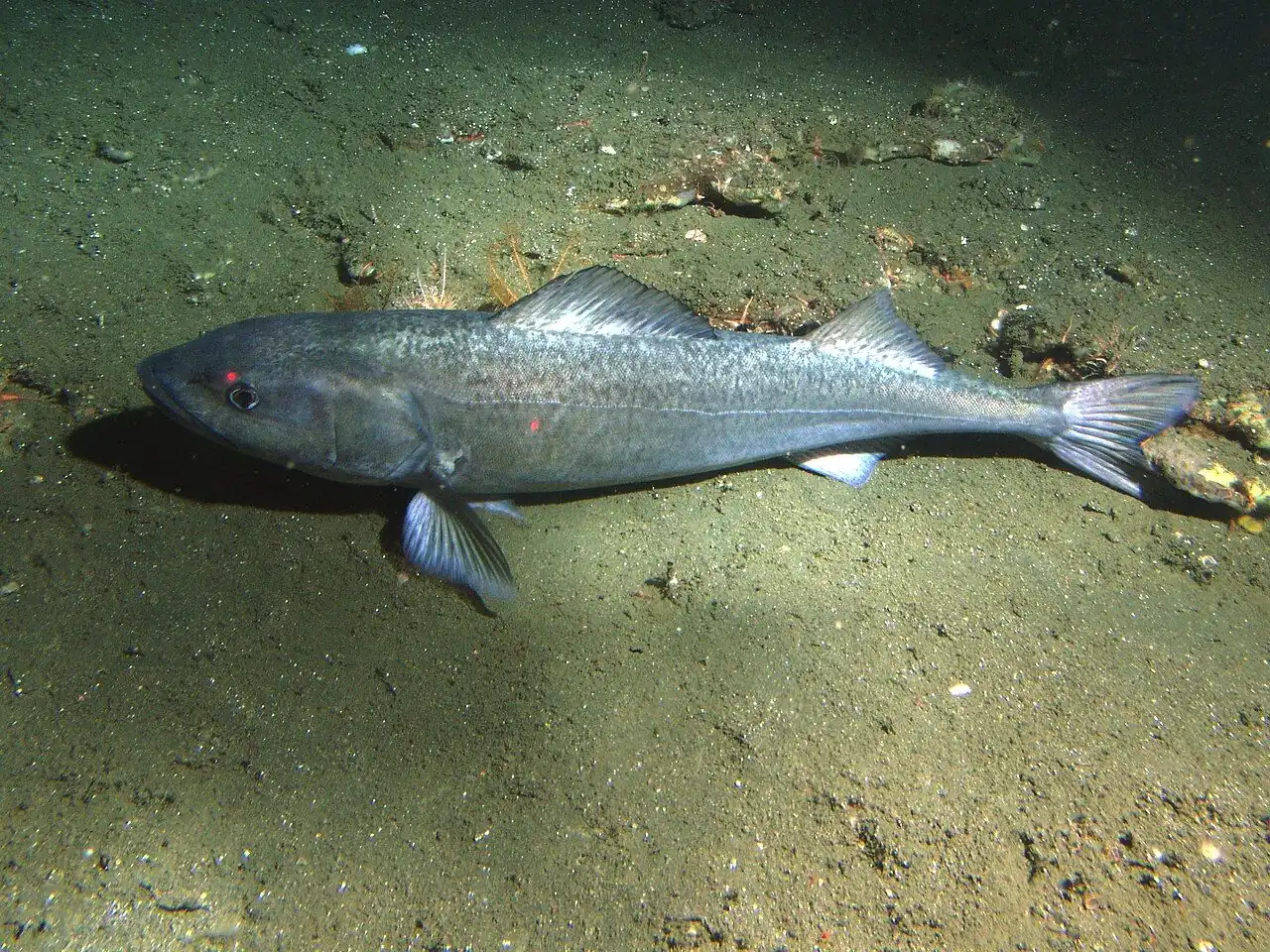
Sablefish
Anoplopoma fimbria
A deep-water fish of the North Pacific sold as black cod, which can live 94 years and whose catch is raided on longlines by killer whales and sperm whales.
Photo: Rick Starr, NOAA/CBNMS / Public domain
3 things to know
- Sablefish can live up to 94 years.
- A tagged sablefish once traveled 2,364 nautical miles from the Aleutian Islands to southern California.
- Killer whales taking fish off longlines have cut sablefish catch rates by 45 to 70 percent, NOAA estimated.
- Scientific name
- Anoplopoma fimbria
- Depth
- 175 m – 1,450 m
574 – 4,757 ft - Size
- Commonly about 80 cm (31 in); FishBase lists up to 120 cm (47 in)
- Weight
- Not well documented; FishBase cites a report of 57 kg (126 lb)
- Lifespan
- Up to 94 years
- Diet
- Crustaceans, worms and small fish
- Where
- North Pacific, from central Baja California north to the Gulf of Alaska, the Aleutian Islands and the Bering Sea, and across to Kamchatka and southern Japan
- IUCN status
- Not Evaluated
- Depth zones
- Sunlight · Twilight · Midnight
Sablefish are often sold as black cod, but NOAA Fisheries points out they are not in the cod family. They are long, dark gray fish with two well-separated dorsal fins, and an oily, buttery flesh that has earned them another market name, butterfish. Females can grow longer than 90 centimeters (3 feet).
Adults live on muddy bottoms deeper than about 200 meters (650 feet), and NOAA counts them among the deepest-dwelling commercial fish in the northeastern Pacific. FishBase gives a usual depth of 175 to 1,450 meters (575 to 4,760 feet) and a maximum of 2,740 meters (8,990 feet). They eat crustaceans, worms and small fish. Their range runs from Baja California to the Gulf of Alaska, the Aleutians and the Bering Sea, and across to Japan.
Spawning happens in deep water along the continental slope in winter and early spring. The eggs develop in deep water for about two weeks, then the larvae rise toward the surface and drift with currents. Young sablefish live near shore before moving into deep water. Females mature at about 6 and a half years, and the species can live to 94.
Since 1979, according to NOAA, more than 300,000 sablefish have been tagged and about 30,000 tags recovered. One tagged fish was caught again after 37 years, and another traveled 2,364 nautical miles, from the Aleutian Islands to southern California.
Whales raid the catch. Killer whales strip sablefish off longlines as they are hauled up and usually leave the heads behind; sperm whales take whole fish, which makes their thefts harder to spot. NOAA estimated that killer whales cut catch rates by 45 to 70 percent and, more recently, sperm whales by 24 to 29 percent. In 2017 NOAA scientists counted whale losses in their population estimates for the first time, and fishers in the Gulf of Alaska were allowed to use pots, which sperm whales cannot rob. NOAA reports that neither US stock, in Alaska or off the Pacific coast, is overfished. The IUCN has not assessed the species.



