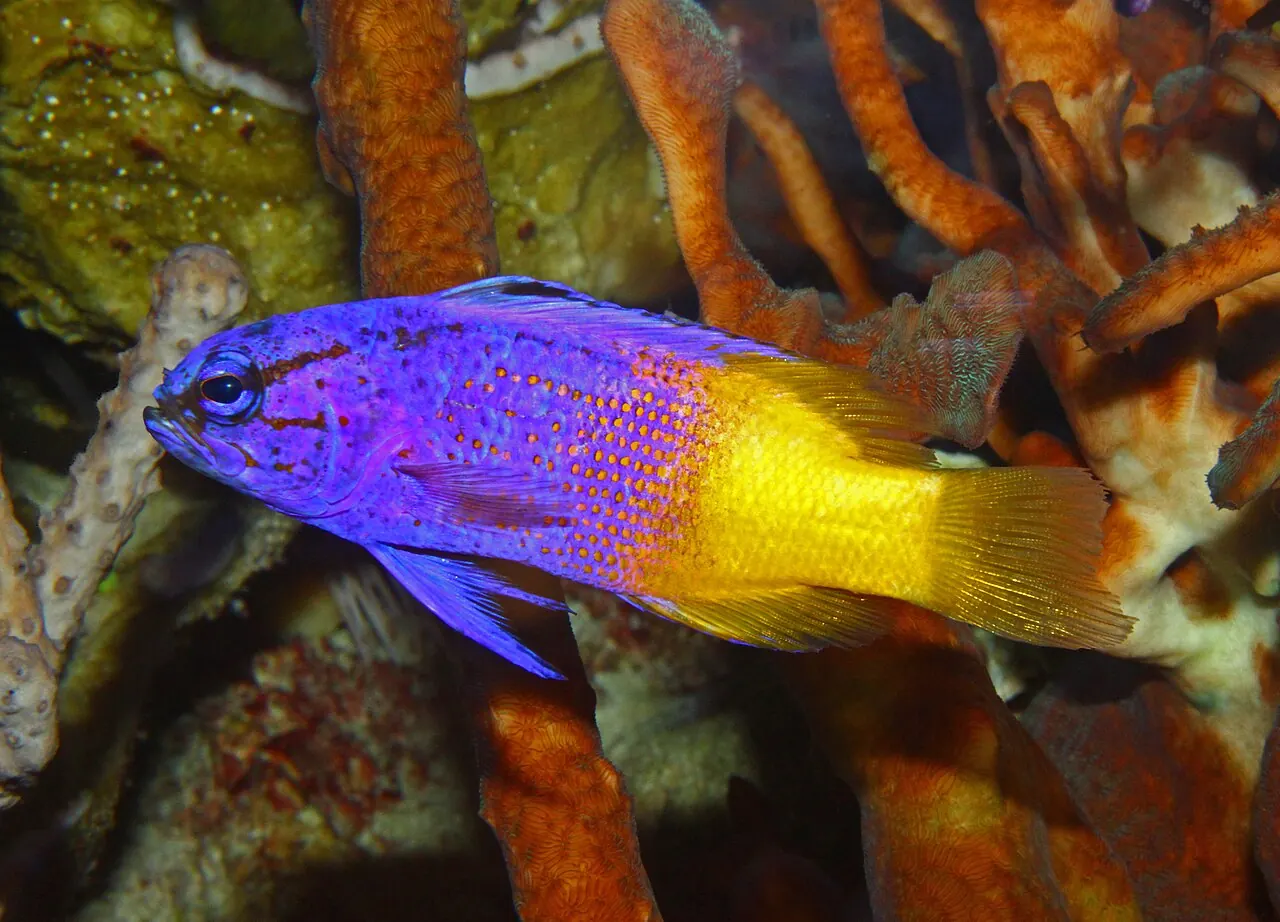
Royal Gramma
Gramma loreto
A tiny purple-and-yellow Caribbean reef fish that swims upside down under ledges and whose males tend nests of eggs.
Photo: H. Zell / CC BY-SA 3.0
3 things to know
- It keeps its belly toward the nearest surface, so under ledges it swims upside down.
- Females lay their eggs in nests that males set up in small holes.
- In 2005 it was Haiti's most common marine aquarium export to the United States.
- Scientific name
- Gramma loreto
- Depth
- 1 m – 40 m
3 – 131 ft - Size
- Up to about 8 cm (3 in) long
- Weight
- Not well known
- Lifespan
- Unknown
- Diet
- Parasites picked from other fish, and small plankton
- Where
- Western central Atlantic: Bermuda and the Bahamas through the Caribbean to Central America and northern South America
- IUCN status
- Least Concern
- Depth zones
- Sunlight
Half purple and half yellow, the royal gramma looks hand-painted. The front of the body is purple, which can look blue underwater, and the rear is bright orange-yellow, the two colors blending around the middle. A dark line runs through the eye, and a black spot marks the front of the dorsal fin. It grows to about 8 centimeters (3 inches). The IUCN uses another common name, fairy basslet.
It lives in the western central Atlantic, from Bermuda and the Bahamas through the Caribbean to Central America and northern South America, usually between 1 and 40 meters (3 and 130 feet) deep, with records to 60 meters. Royal grammas stay close to caves and ledges and dart back into a hole when alarmed. A royal gramma keeps its belly turned toward the nearest surface, so one hovering under a ledge swims upside down.
FishBase lists it as a fish that feeds on parasites picked from other fishes. It also takes small plankton from the water.
Its nesting was described in 1996 in the journal Copeia by Asoh and Yoshikawa. Before spawning, some males set up nests in small holes and crevices. Females traveled to the males' nests around dawn to lay eggs, and the male that built the nest then tended them in four ways: guarding, maintaining the nest, clearing out debris and simply entering it. FishBase adds that there is no evidence the species broods eggs in its mouth. In a 1997 paper, Asoh and Shapiro examined royal gramma gonads, found no support for sex change and classed the species as having separate males and females.
The royal gramma is a staple of the aquarium trade and has been reared in captivity. When Rhyne and colleagues tallied the 11 million marine fish imported into the United States in 2005, it was the most common export from Haiti, one of the leading suppliers. The IUCN lists the species as Least Concern, from a 2011 assessment.



