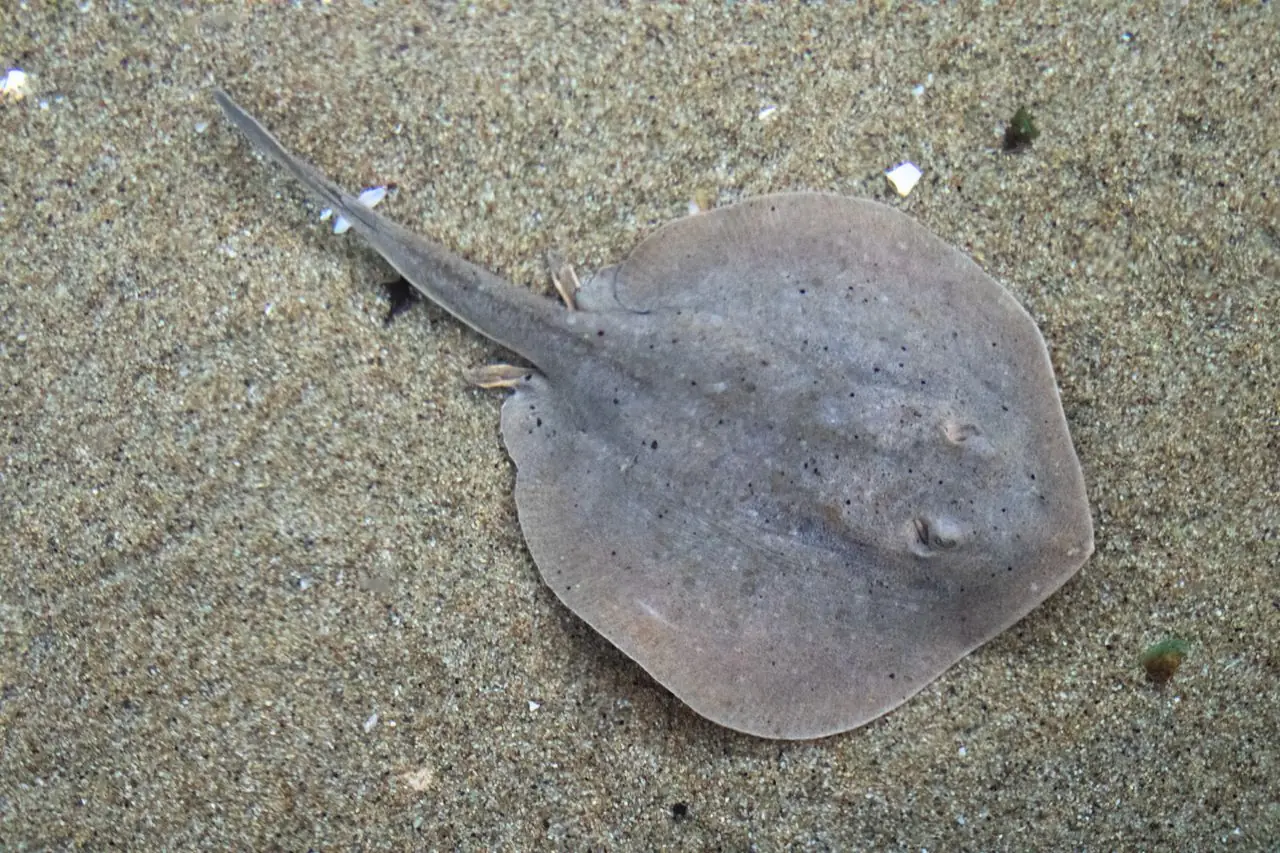
Round Stingray
Urobatis halleri
A small, round-bodied stingray of Southern California beaches, the likely culprit in most of the hundreds of stings at Seal Beach each summer.
Photo: Coughdrop12 / CC BY-SA 4.0
3 things to know
- Its pregnancy lasts only 3 to 4 months, one of the shortest of any shark or ray.
- Its tail barb is a modified scale, and new barbs replace old ones mostly between August and October.
- Adult females can produce two litters a year.
- Scientific name
- Urobatis halleri
- Depth
- 1 m – 21 m
3 – 69 ft - Size
- Up to about 58 cm (23 in) long, including the tail
- Weight
- Up to about 1.4 kg (3 lb)
- Lifespan
- 14 years or more
- Diet
- Worms when young; mainly clams and crustaceans as adults; also small fish
- Where
- Eastern Pacific, from California to Panama and Ecuador
- IUCN status
- Least Concern
- Depth zones
- Sunlight
The round stingray packs its defense into a small body, at most about 58 centimeters (23 inches) from snout to tail tip and 1.4 kilograms (3 pounds), with a nearly round disc and a sturdy tail. About halfway along the tail sits a barb. Researchers at the California State University, Long Beach Shark Lab explain that the barb is a modified scale and that venom from the mucus coating the spine runs along grooves on its underside.
It lives from California to Panama and Ecuador in bays, estuaries and off sandy beaches, on sand, mud or rubble and often near seagrass, usually in water less than 15 meters (50 feet) deep. Young rays eat mostly worms. Adults switch to clams and crustaceans. They mature at about four years. Courtship and mating happen in April and May, and after a pregnancy of only three to four months, one of the shortest of any shark or ray, a female gives birth to one to six pups in August or September. FishBase reports that adult females can produce two litters a year. The Shark Lab says round stingrays live 14 years or more.
At Seal Beach, hundreds of stingray injuries are reported each summer, mostly from June to August and often in the afternoon, when the tide is lower and the water warmer. Two electrical generating stations nearby release heated seawater used for cooling. In a 2005 study comparing Seal Beach with Surfside, a beach without the warm outflow, Hoisington and Lowe of the Shark Lab found more round stingrays at Seal Beach, and the most within 30 meters (100 feet) of shore.
The lab also tested a direct fix. Lowe and colleagues caught 2,183 rays at Seal Beach, clipped their barbs and released them. Only 13 were caught again over three years, a sign of a large population that moves around, and injuries to beachgoers did not drop significantly. The rays shed and regrow barbs on their own, mostly from August to October. The Shark Lab's advice is to shuffle your feet through the sand so a buried ray feels you coming and swims off. The IUCN lists the species as Least Concern.



