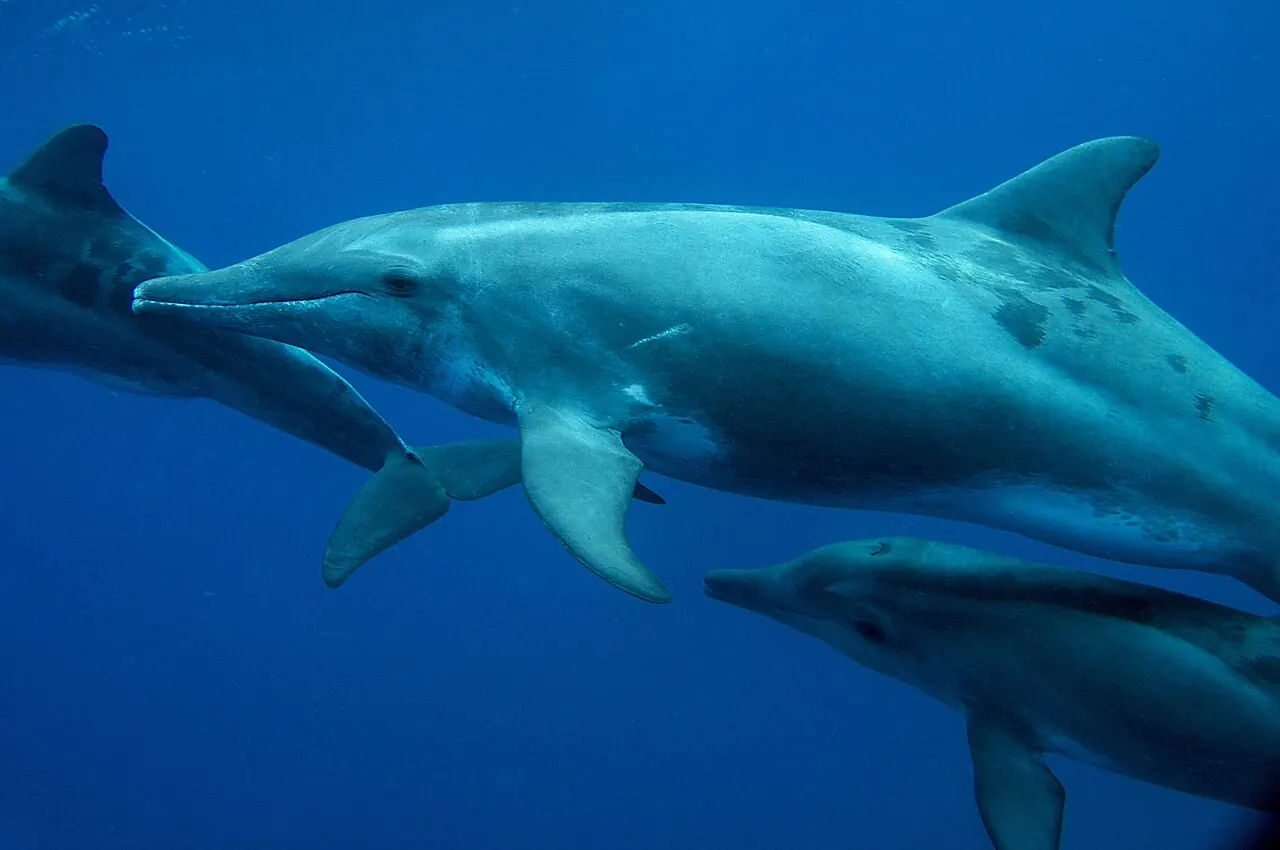
Rough-toothed Dolphin
Steno bredanensis
A 'reptilian'-looking dolphin with ridged teeth and a long, sloping head that hunts mostly near the surface of deep tropical seas.
Photo: Laurent Bouveret / CC BY-SA 4.0
3 things to know
- Fine ridges on its teeth, unique among dolphins, give it its name.
- Tagged dolphins off Kauai spent 84 to 94 percent of their time in the top 30 m (100 ft) of the sea.
- Atlantic and Indo-Pacific rough-toothed dolphins split about 890,000 years ago, a 2022 study estimated.
- Scientific name
- Steno bredanensis
- Depth
- 0 m – 134 m
0 – 440 ft - Size
- Up to about 2.6 m (8.5 ft) long
- Weight
- About 160 kg (350 lb)
- Lifespan
- Up to 36 years or more
- Diet
- Squid and a variety of fish
- Where
- Deep tropical and warm temperate waters of the Atlantic, Indian and Pacific oceans, from about 40° N to 35° S
- IUCN status
- Least Concern
- Depth zones
- Sunlight
NOAA Fisheries calls the rough-toothed dolphin "reptilian" in appearance, and the head explains why. It is small, and the forehead slopes straight into a long beak with no crease between them. The body is dark gray with a narrow dark cape along the back, a white throat and lips, and often white or pale blotches underneath, and the dorsal fin and flippers are unusually large. The name comes from fine ridges on the teeth, found in no other dolphin. Adults reach about 2.6 meters (8.5 feet) and 160 kilograms (350 pounds) and can live 36 years or more.
It lives in deep tropical and warm temperate waters of the Atlantic, Indian and Pacific oceans, roughly between 40° north and 35° south, often in the company of pilot whales, bottlenose dolphins and spotted and spinner dolphins. It eats squid and a variety of fish and can stay under for up to 15 minutes.
In 2008 Robin Baird of Cascadia Research Collective and colleagues reported that rough-toothed dolphins around the main Hawaiian Islands were sighted most often over water deeper than 1,500 meters (4,900 feet), and that individuals off the island of Hawaii were seen again and again, a sign of a small population that stays put. Two dolphins traveled 480 kilometers (300 miles) from Kauai to Hawaii Island. Later, Jacquelyn Shaff and Baird put depth-transmitting satellite tags on nine dolphins off Kauai. In a 2021 paper they reported that the dolphins spent 84 to 94 percent of their time in the top 30 meters (100 feet). Their median dive went to 67.5 meters (221 feet) and the deepest to 399.5 meters (1,311 feet). Dives were deepest at dusk, averaging 134 meters (440 feet), probably to catch prey rising toward the surface.
NOAA estimates about 6,000 rough-toothed dolphins in the Hawaiian stock, 600 in the northern Gulf of Mexico and 300 in the western North Atlantic, with another stock around American Samoa. Longline fisheries in Hawaii and American Samoa entangle some, and the species has been hunted in Japan, Sri Lanka, Indonesia, West Africa and the Caribbean.
Genetics point to two lineages. In 2022 Renee Albertson and colleagues found that Atlantic rough-toothed dolphins split from the rest about 890,000 years ago and can be told apart genetically with 98 percent accuracy, enough, they argued, to make them separate subspecies. The IUCN's assessment, published in 2019, lists the species as Least Concern.
Sources
- fisheries.noaa.gov/species/rough-toothed-dolphin
- Study: doi:10.1111/mms.12811
- cascadiaresearch.org/wp-content/uploads/2022/03/ShaffandBaird_12811.pdf
- Study: doi:10.1111/j.1748-7692.2008.00201.x
- Study: doi:10.1111/mms.12933
- iucnredlist.org/species/20738/178929751
- marinemammalscience.org/science-and-publications/list-marine-mammal-species-subspecies



