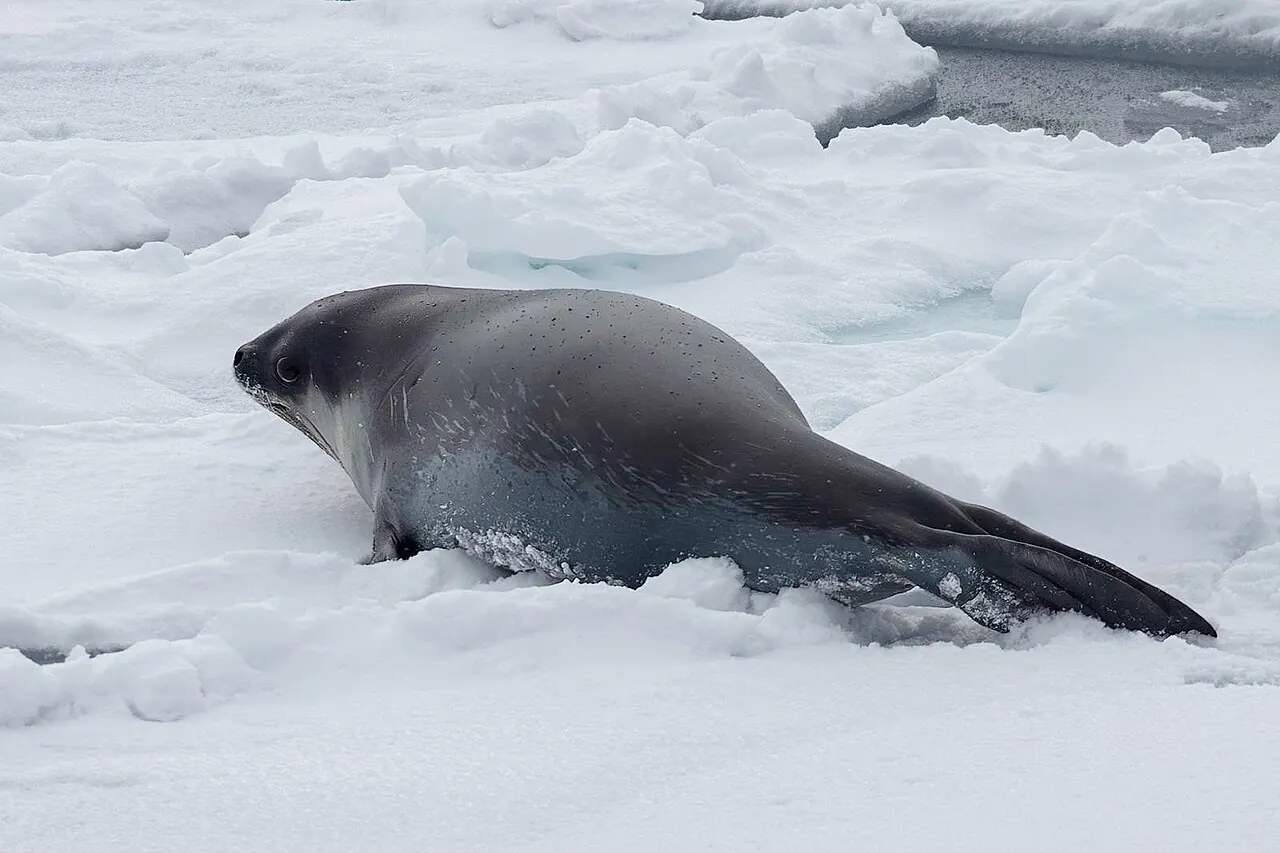
Ross Seal
Ommatophoca rossii
The least known Antarctic seal: a big-eyed loner of the thick pack ice that feeds in open water and calls like a siren.
Photo: Benjamin Viola / CC BY-SA 4.0
3 things to know
- Its eyes can be up to 7 cm (2.8 in) across.
- Its underwater siren calls are usually two tones sounding at once.
- Tagged Ross seals in the eastern Weddell Sea mostly dived to 100–200 m (330–660 ft).
- Scientific name
- Ommatophoca rossii
- Depth
- 0 m – 300 m
0 – 984 ft - Size
- About 1.7–2.5 m (5.5–8.2 ft) long; females slightly larger than males
- Weight
- Males about 130–215 kg (285–475 lb)
- Lifespan
- Thought to be around 20 years in the wild
- Diet
- Mostly squid and other cephalopods, plus fish and other invertebrates
- Where
- Pack ice all around Antarctica; rare strays reach subantarctic islands and southern Australia
- IUCN status
- Least Concern
- Depth zones
- Sunlight · Twilight
Of the four seals that live in the Antarctic pack ice, the Ross seal is the smallest, the least common and the least studied. It has a thick neck and very large eyes, up to 7 centimeters (2.8 inches) across. Adults are dark brown above and silvery white below and measure roughly 1.7 to 2.5 meters (5.5 to 8.2 feet), with females slightly larger than males.
Ross seals are usually seen alone, hauled out on the thickest, densest ice, and they are spread thinly all the way around the continent. Counting them is hard: a 1999–2000 survey off East Antarctica put the seals in that region at 41,300 to 55,900, though plausible estimates ran from 20,500 to 226,600. The IUCN reassessed the species in January 2026, kept it at Least Concern, and gives about 50,000 mature animals, with the trend unknown.
For most of the year they are not on the ice at all. Mia Wege, Horst Bornemann and Marthán Bester put tags on Ross seals in the eastern Weddell Sea between 2016 and 2019 and found that the seals leave the pack ice and forage in open water for most of the year. Their dives were mostly 100 to 200 meters (330 to 660 feet) deep, often deeper than 300 meters (980 feet), and usually lasted 5 to 12 minutes, sometimes more than 20. From March to July the seals dived deepest at twilight and shallowest at night. The IUCN gives 792 meters (2,600 feet) as the species' lower depth limit. Stomach studies put the diet at about 64 percent squid and other cephalopods, 22 percent fish and 14 percent other invertebrates.
Pups are born on the ice in November, weighing about 16 kilograms (35 pounds), and nurse for about four to six weeks. Little is known about how they mate. Three females that Wege's team tracked in the breeding season stayed hauled out for 5 to 7 days at a stretch, slipping into the water for 1 to 3 hours at a time. Ross seals mature at two to four years old and are thought to live around 20 years.
They are also unusually vocal. William Watkins and G. Carleton Ray, recording Ross seals in the Ross Sea in 1966, heard siren-like calls both on the ice and underwater, where the calls were usually two independently varying tones at once. What the calls are for is not known.
Sources
- antarctica.gov.au/about-antarctica/animals/seals/ross-seals
- animaldiversity.org/accounts/Ommatophoca_rossii
- Study: doi:10.2305/IUCN.UK.2026-1.RLTS.T15269A95971509.en
- Study: doi:10.1017/S0954102022000438
- Study: doi:10.1017/S0954102007000879
- Study: doi:10.1121/1.392003
- dosits.org/galleries/audio-gallery/marine-mammals/pinnipeds/ross-seal
- pinnipeds.org/seal-information/species-information-pages/the-phocid-seals/ross-seal



