Risso's Dolphin
Grampus griseus
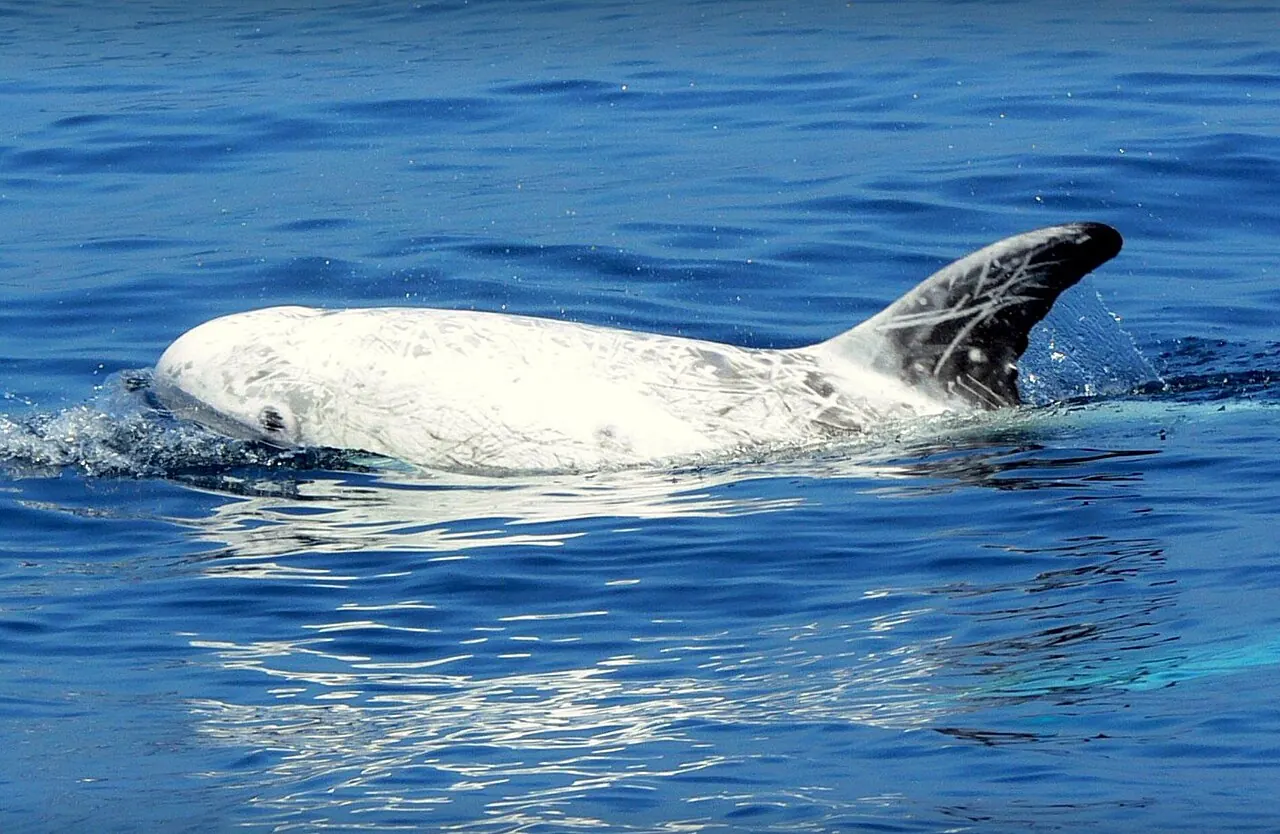
A blunt-headed, squid-eating dolphin that turns paler and more scarred with age, until adults can look almost white.
Photo: William Terry Hunefeld (via iNaturalist) / CC BY 4.0
3 things to know
- Adults are covered in scars from other Risso's dolphins' teeth and from squid and cookiecutter sharks.
- It has only two to seven pairs of teeth, at the front of the lower jaw, and usually none in the upper jaw.
- It can dive to at least 300 m (1,000 ft) and hold its breath for 30 minutes.
- Scientific name
- Grampus griseus
- Depth
- 0 m – 300 m
0 – 984 ft - Size
- About 2.6–4 m (8.5–13 ft) long
- Weight
- About 300–500 kg (660–1,100 lb)
- Lifespan
- At least 35 years
- Diet
- Mostly squid; also octopus, cuttlefish, fish and krill
- Where
- Temperate and tropical oceans worldwide, from about 64° N to 46° S
- IUCN status
- Least Concern
- Depth zones
- Sunlight · Twilight
Risso's dolphins get paler as they age. Calves start out black, dark gray or brown, and the color fades over the years to pale gray or almost white. Adults are also heavily scarred, with long scratches from the teeth of other Risso's dolphins and round marks left by squid, cookiecutter sharks and lampreys. A mature adult swimming just under the surface can look white.
The body is robust, with a narrow tail stock, a bulbous head creased down the front, no obvious beak, and a tall, curved dorsal fin. Adults reach about 2.6 to 4 meters (8.5 to 13 feet) and 300 to 500 kilograms (660 to 1,100 pounds), and males and females are about the same size. The teeth are odd for a dolphin: two to seven pairs of pegs at the front of the lower jaw, and usually none in the upper jaw.
The species lives in temperate and tropical water in every ocean, from about 64° North to 46° South. Its range includes the Gulf of Alaska, the Gulf of Mexico and the western Atlantic from Florida to Newfoundland. It prefers deep water over steep slopes near the edge of the continental shelf, usually in groups of 10 to 30.
Most of the diet is squid, caught mainly at night when prey rises toward the surface. Risso's dolphins can dive to at least 300 meters (1,000 feet) and hold their breath for 30 minutes, though most dives last a few minutes. In 2018 Patricia Arranz and colleagues published results from dolphins fitted with sound-and-motion tags, matched against prey maps from echosounders on an underwater vehicle. How the dolphins aimed their echolocation at the start of a dive suggested they were planning to feed at a particular depth, and what they learned about prey on one dive shaped the next.
Pregnancy lasts about 13 to 14 months, and the species lives at least 35 years. It is not endangered or threatened in the United States, where the Marine Mammal Protection Act covers it, and the IUCN lists it as Least Concern. Gillnets, longlines and trawls are a main threat, and the dolphins are hunted for meat and oil in Indonesia, Japan, the Lesser Antilles, Sri Lanka and the Solomon Islands.



