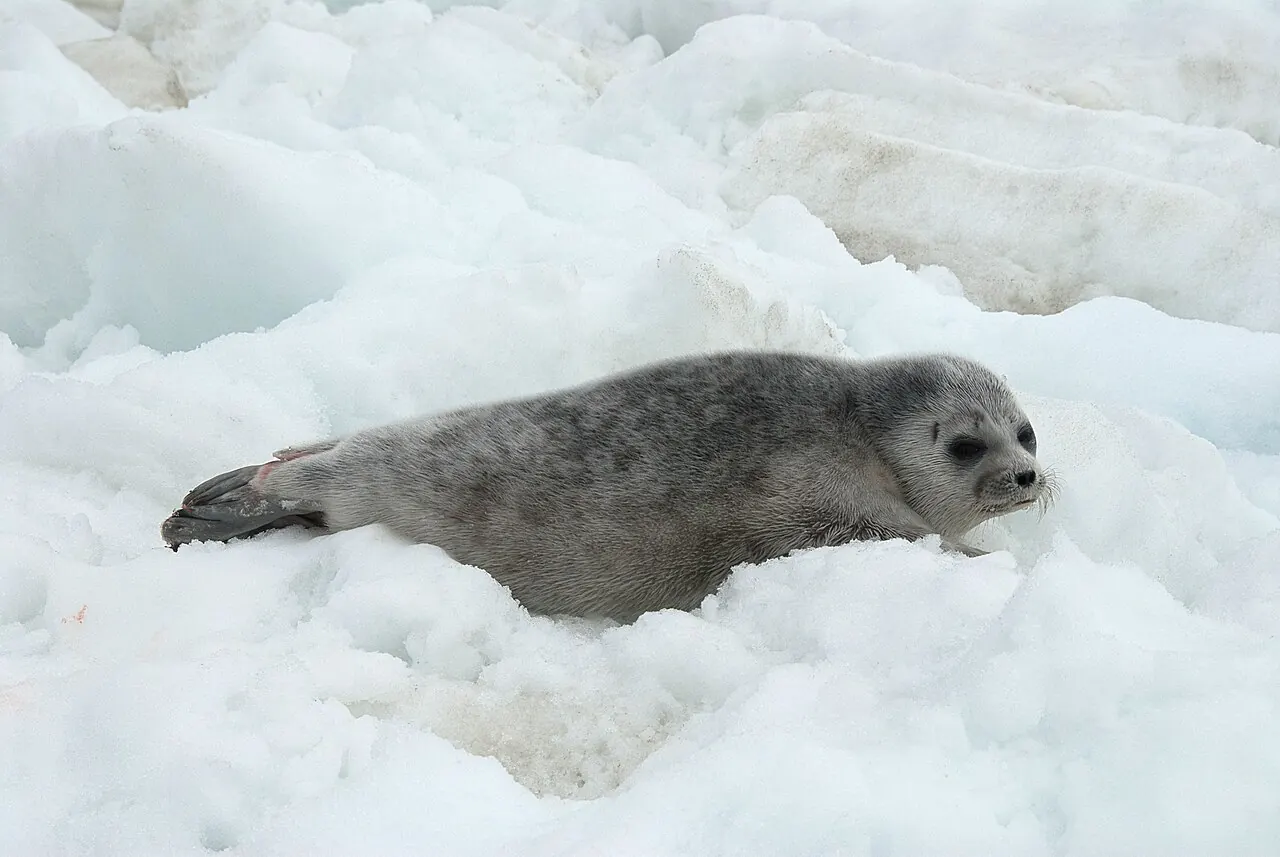
Ringed Seal
Pusa hispida
The smallest and most common Arctic seal, which raises its pup in a snow cave over a breathing hole and is the polar bear's main prey.
Photo: Michael Cameron, NOAA / Public domain
3 things to know
- Ringed seals keep breathing holes open with their claws through ice 1.8 m (6 ft) or more thick.
- Pups are born inside snow-covered lairs dug over breathing holes.
- Alaska's Department of Fish and Game says a polar bear may kill a ringed seal every two to six days.
- Scientific name
- Pusa hispida
- Depth
- 0 m – 46 m
0 – 151 ft - Size
- About 1.2–1.4 m (4–4.5 ft) long
- Weight
- About 50–68 kg (110–150 lb)
- Lifespan
- About 25–30 years
- Diet
- Arctic cod, saffron cod and other small fish, shrimp and other crustaceans
- Where
- Ice-covered seas around the Arctic, south to the Bering and Labrador seas, plus the Baltic Sea, Sea of Okhotsk and lakes Ladoga and Saimaa
- IUCN status
- Least Concern
- Depth zones
- Sunlight
Ringed seals can live where the sea freezes over completely. Each seal uses the thick, strong claws on its small front flippers to keep breathing holes open through ice 1.8 meters (6 feet) thick or more, and in late winter it digs a lair in the snowdrift over a hole. Females give birth inside these snow caves, which shelter the pups from cold and from predators, and NOAA Fisheries calls ringed seals unique in their use of birth lairs. A pup is born in a white coat, weighs about 4.5 kilograms (10 pounds), and nurses for up to two months on stable shore-fast ice, or three to six weeks on drifting ice.
This is the smallest and most common Arctic seal. Adults average 1.2 to 1.4 meters (4 to 4.5 feet) and 50 to 68 kilograms (110 to 150 pounds), with a small head, a short catlike snout and a plump body. The name comes from the pale rings scattered over the dark back and sides.
Ringed seals live all around the Arctic and south into the Bering and Labrador seas. Of the five subspecies, one lives in the Baltic Sea, one in the Sea of Okhotsk, and two in freshwater lakes, Ladoga in Russia and Saimaa in Finland. They eat small prey: fish of the cod family in late autumn through spring and more crustaceans in the open-water season, diving to 46 meters (150 feet) or more. In the breeding season, males' faces turn black and give off a strong smell, and Alaska hunters, who call them "gasoline seals," avoid them.
Polar bears depend on them. The Alaska Department of Fish and Game says a bear may kill a ringed seal every two to six days, and bears and Arctic foxes find the lairs by smell. Ringed seals are also an important food for Alaska Native communities, whose harvest appears to be sustainable.
There are probably more than 2 million Arctic ringed seals, over 300,000 of them in US waters, and the IUCN Red List rates the species Least Concern (2016). Under the US Endangered Species Act, however, all five subspecies are listed as threatened or endangered, and NOAA names the loss of sea ice and snow cover as the main threat.



