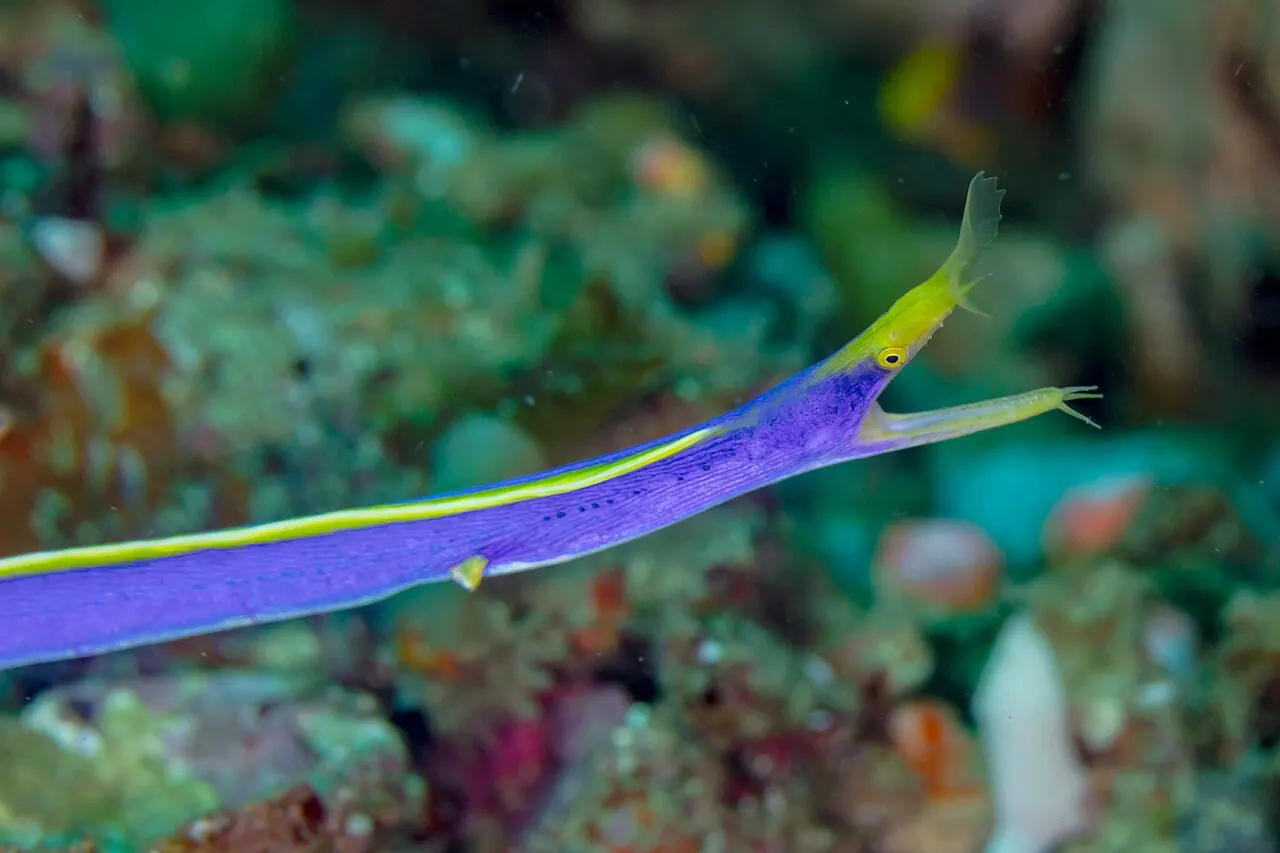
Ribbon Eel
Rhinomuraena quaesita
A slender moray with flared, fan-like nostrils whose black, blue and yellow color phases have long been read as a switch from male to female.
Photo: Diego Delso / CC BY-SA 4.0
3 things to know
- It is the only moray known to change color abruptly as it grows, from black to blue and yellow to mostly yellow.
- Its tube-shaped front nostrils end in fan-like flaps.
- In 2014 the Vienna Zoo reported the first fertilized ribbon eel eggs to hatch into feeding larvae.
- Scientific name
- Rhinomuraena quaesita
- Depth
- 1 m – 67 m
3 – 220 ft - Size
- Up to about 1.3 m (4.3 ft) long
- Weight
- Unknown
- Lifespan
- Unknown
- Diet
- Small fishes
- Where
- Indo-Pacific, from East Africa to the Tuamotu Islands, north to southern Japan and south to New Caledonia and French Polynesia
- IUCN status
- Least Concern
- Depth zones
- Sunlight
Long, thin and brightly colored, the ribbon eel is a moray that grows to about 1.3 meters (4.3 feet). Its face is decorated: three fleshy tentacles on the tip of the lower jaw, a single pointed projection on the snout, and tube-shaped front nostrils that end in flared, fan-like flaps.
It lives on lagoon and seaward reefs from East Africa to the Tuamotu Islands, north to southern Japan and south to New Caledonia, at depths of 1 to 67 meters (3 to 220 feet). Ribbon eels are secretive. They usually hide in burrows in sand or rubble next to coral, often with only the head sticking out, and they eat small fishes.
Color is what makes them famous. Small juveniles are jet black and develop a yellow dorsal fin. Adult males are bright blue with a yellow snout, lower jaw and dorsal fin. Females are yellow, sometimes with blue toward the tail. Fishes of Australia calls the ribbon eel the only moray to undergo abrupt color changes as it grows, and both it and FishBase describe the species as a sequential hermaphrodite that starts life as a male and later becomes female, with the colors marking each stage.
Whether they really change sex is not settled. FishBase itself notes that the sex change has been diagnosed from coloration but not confirmed. At the Vienna Zoo, Preininger and colleagues reported in 2014 that body color in their captive ribbon eels did not reflect sex or sexual maturity. The same team managed a first: fertilized eggs that hatched into feeding larvae, which they kept alive for seven days.
Ribbon eels are collected for the aquarium trade, and FishBase rates their vulnerability to fishing as high to very high. The IUCN lists it as Least Concern, in an assessment last carried out in 2009.



